
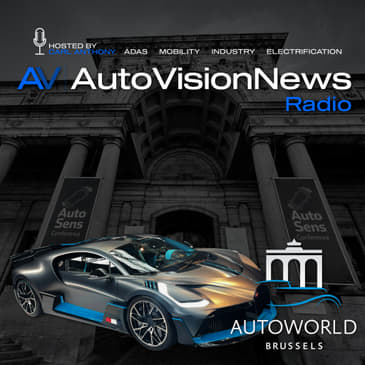
Mechanic Ghislain Mahy (1907-1999) would see his dream of a living history museum realized when the Autoworld opened its doors on July 1st, 1986, in Brussels, Belgium. Alongside sons Hans and Ivan, Ghislain would restore about 1,000 vehicles throughout his life, 200 of which were incorporated into the Autoworld on its opening day.
In this special episode of AutoVision News Radio, Carl Anthony takes us on an audio tour of this extraordinary museum. Carl recounts Mahy's journey and Autoworld's devotion to those who aim their creative pursuits and technical passions toward all things motorized.
Cars featured on this tour of the Autoworld:
1904 Oldsmobile Model 6
1911 Opel
1948 Bentley MK VI Saloon Vanden Plas
1963 Alpine M63
1966 Porsche 912
1969 Volvo 121 "Amazon"
1988 Mazda MX-5 Miata
1990 Honda NSX
2020 Bugatti Centodieci
2021 Bugatti La Voiture Noire
2020 Bugatti Divo
More Resources:
Autoworld Brussels: https://tinyurl.com/4u3kyvcn
Beautiful 75th Anniversary Book Chronicles Porsche's Original Sports Car: https://tinyurl.com/yckfveru
Rare Bugatti Supercars, The Wild Italdesign Aztec & Other Amazing Historical Cars: A Grand Tour of the Autoworld Museum via the Automoblog YouTube channel: https://tinyurl.com/5n82v7yd
Follow AutoVision News Radio on LinkedIn: https://tinyurl.com/49jyrd3b
[00:00:00] Now in the middle of one of the most significant eras in automotive, Carl Anthony amplifies the minds and voices behind this historic transformation as the host of AutoVision News Radio, all while coming to terms with middle age, father loss, and what it means to be successful in Detroit.
[00:00:16] The Autoworld Museum in Brussels, Belgium opened its doors on July 1, 1986.
[00:00:23] Autoworld founder Guylain Mahi, a lifelong mechanic, had worked for years before the summer of 1986 to build up a collection of vehicles.
[00:00:33] Guylain always had an eye for finding cars to restore, and by the late 1960s he had amassed one of the world's largest collections of vintage vehicles.
[00:00:43] It soon became apparent he needed something larger than his current garage and workshop in the Circus of Ghent.
[00:00:49] While initial attempts to locate a new museum elsewhere yielded only modest success, Guylain remained steadfast in his vision and ultimately saw Brussels, the heart of Europe, as the best place to establish a living museum of automotive history and culture.
[00:01:06] News of Guylain's quest would eventually capture the attention of Prince Albert of Belgium, along with Hermann Ducroix, Belgium's Minister of Communications and External Trade, and Louis Olivier, Minister of Public Works.
[00:01:20] The Belgian government ultimately saw the potential of Guylain's vision, and the location was determined to be the South Hall of the park of the 50th anniversary in Brussels, the home of the Autoworld today, as well as the Royal Museum of the Armed Forces and Military History, and the Art and History Museum.
[00:01:39] In 2012, the Sport and Competition Zone, a tribute to motorsport, was added to the Autoworld.
[00:01:45] The area includes over 20 racing cars, banked corners, a starting grid, and old paddocks.
[00:01:52] Depending on when you visit the Autoworld, you may see a special themed display.
[00:01:57] These limited-time showings pay tribute to historically significant and beloved vehicles.
[00:02:03] Past exhibitions include 70 years of Vespa, the 60th anniversary of the Volvo Amazon, the 75th anniversary of Ferrari, and Fiat 125 years.
[00:02:15] In the words of the Autoworld Museum,
[00:02:17] This is a space that pays tribute to all those who have devoted their creativity and research to the happiness of those who have traveled the highways.
[00:02:26] I believe those words to be true, having been to the Autoworld four times over the years for our Autosense conference.
[00:02:33] It's one of the best car museums I've ever seen.
[00:02:37] I've made so many fond memories there with friends and family.
[00:02:41] The last time I was at Autoworld was in September 2023.
[00:02:44] At that time, a limited-run exhibit was dedicated to a trio of Bugatti supercars, beautiful cars,
[00:02:51] one of which is the only one of its kind on the planet, a one-of-one Bugatti supercar.
[00:02:57] Join me now for an audio tour of the Autoworld Museum,
[00:03:01] as I take us around and highlight some of the cars on display, including the aforementioned Bugattis.
[00:03:08] We begin with a car from the early 1900s that protected your feet from the elements.
[00:03:14] Moving at the speed of mobility, this is AutoVision News Radio with Carl Anthony in Detroit, Michigan.
[00:03:20] The first car on our stop is the 1904 Oldsmobile Model 6, also known as the Curved Dash.
[00:03:27] And the Curved Dash was so successful that the Olds Motorworks became the most prominent car manufacturer in the world from 1903 to 1905.
[00:03:36] And in 1905 alone, Oldsmobile sold over 5,000 curved dash models, just like the one we see here.
[00:03:44] And that effectively earned it the title as the first mass-produced car.
[00:03:49] The name, as you can imagine, comes from the front end, that curved dash, this arched floor plate.
[00:03:55] And that would protect your feet from mud and dirt and road grime and all of that stuff.
[00:04:00] So if you had a pair of nice shoes back in 1904, this is the car you wanted to drive.
[00:04:05] The Oldsmobile Model 6, seen here, has a one-cylinder engine with five horsepower.
[00:04:10] And that's fitted under the seat with a chain drive system that includes a reverse gear.
[00:04:16] Next stop is this gorgeous 1911 Opel, characterized by its white tires on what are known as removable continental rims.
[00:04:25] And the odometer is actually fitted in the hub of the right wheel.
[00:04:29] There are two spare tires held on the driver's side with belt buckles,
[00:04:34] and the same for the small spare fuel tank that actually sits just behind the spare tires on the running board.
[00:04:41] So drivers could pull up the retractable top when the weather didn't cooperate,
[00:04:46] and if they needed more cargo room, they could use this picnic-style basket at the rear.
[00:04:52] For the time, this 1911 Opel has really everything you could want.
[00:04:57] It's a convertible, there's running boards for easy entry and for extra storage,
[00:05:02] there's four headlamps, and really unique styling, especially with those white tires.
[00:05:08] The four-cylinder engine produced a maximum of 20 horsepower,
[00:05:12] and it was coupled to a four-speed transmission.
[00:05:15] Opel produced this model from 1911 until the outbreak of World War I.
[00:05:22] This 1948 Bentley Mark VI embodies the words of company founder W.O. Bentley, Walter Owen Bentley,
[00:05:30] when he spoke of his desire to build a fast car, a good car, one that was best in its class.
[00:05:37] The Bentley Mark VI was the first of 14 models the British coachbuilder designed following World War II
[00:05:44] and was produced from 1946 until 1952.
[00:05:49] Inspired by the Rolls-Royce Silver Wraith,
[00:05:51] the Bentley Mark VI was considered a true coachbuild model,
[00:05:56] as the chassis components were still in a reduced supply following World War II.
[00:06:01] As such, the Bentley Mark VI features custom aluminum bodywork from Vandenplass,
[00:06:06] a Belgian company that was also quite successful in Great Britain.
[00:06:11] The inline six engine produced 150 horsepower,
[00:06:14] and was connected to a four-speed manual transmission,
[00:06:18] which is located on the floor, interestingly enough.
[00:06:22] This 1948 Bentley Mark VI is a right-hand drive,
[00:06:26] so the shifter would not be on the left in the center console area like we might think today,
[00:06:33] but rather down on the floor where you would shift with your right-hand,
[00:06:37] and if it was a left-hand drive, just reverse that.
[00:06:40] Shifter was on the floor,
[00:06:41] and rather than shifting with your right hand in the center console,
[00:06:45] you would lean down and shift with your left hand.
[00:06:47] The AutoWorld Museum here in Brussels is split into dedicated zones,
[00:06:53] including historical workshops,
[00:06:55] a section dedicated to the cars and the culture of the United States,
[00:06:59] and a section that highlights the history of the automobile in Belgium.
[00:07:02] We are in Brussels, after all.
[00:07:04] And there's even an area that houses some magnificent carriages,
[00:07:08] stunning carriages, that predate the automobile.
[00:07:11] When you walk through the motorsports section,
[00:07:14] you will find this 1963 Alpine M63,
[00:07:18] Alpine's first racing car that underwent development in 1962.
[00:07:23] Based on the structure and the body style of the A110,
[00:07:26] the M63 here at AutoWorld took part in the 1963 24 Hours of Le Mans,
[00:07:33] but did not finish the race.
[00:07:35] As part of our Book Garage series on Automoblog,
[00:07:38] we featured a work by author Gordon Maltby,
[00:07:42] commemorating the 75th anniversary of the Porsche 356.
[00:07:45] And it's a book that every Porsche fan should have.
[00:07:49] In 1965, though,
[00:07:51] Porsche debuted the 912 to bridge the gap,
[00:07:54] essentially, between the 911 and the 356.
[00:07:57] The 912 was quite similar to the 911,
[00:08:01] but a key difference was the 1.6 liter flat 4 engine
[00:08:06] from the 356 SC at the rear.
[00:08:08] As described by the Porsche archive,
[00:08:11] its power output was reduced from 95 to 90 horsepower
[00:08:15] at 5,800 RPM for the 912.
[00:08:19] At the AutoWorld Museum here in Brussels,
[00:08:21] we are standing in front of a 1966 Porsche 912.
[00:08:26] And over the years,
[00:08:27] the 912 seems to be a somewhat misunderstood car,
[00:08:31] but also, at the same time,
[00:08:33] a beloved car.
[00:08:34] Here we come to the 1969 Volvo 121 Amazon,
[00:08:39] first introduced in 1957
[00:08:41] and later assembled in Belgium,
[00:08:44] where the AutoWorld Museum is.
[00:08:46] The Amazon name, at first,
[00:08:49] was really only heard in Sweden,
[00:08:50] but it caught on elsewhere around the world,
[00:08:53] most likely because it was easier to remember Amazon
[00:08:57] versus the numeric model designations like 121.
[00:09:00] This unassuming car from 1969
[00:09:04] is historically significant
[00:09:06] because it was among the first
[00:09:08] to feature three-point safety belts.
[00:09:11] Volvo engineer Nils Bolin
[00:09:13] created the world's first three-point safety belt in 1959.
[00:09:18] The three-point seat belt,
[00:09:20] also called a V-tide belt,
[00:09:22] was inspired by Bolin's time at Saab
[00:09:25] as an aviation engineer working on ejection seats.
[00:09:28] Before, the three-point safety belt
[00:09:31] was the two-point belt,
[00:09:32] and Volvo had originally implemented
[00:09:34] this design in 1957.
[00:09:37] But the primary flaw of the two-point belt
[00:09:40] was how it required the buckle
[00:09:41] to fasten around your ribcage,
[00:09:44] and in the event of an accident,
[00:09:45] this design would actually increase
[00:09:47] the chances of soft tissue and organ damage.
[00:09:51] Bolin's design differed
[00:09:52] in that it utilized one belt across the hips
[00:09:55] and another diagonal belt across the chest,
[00:09:58] with a low anchorage point attachment
[00:10:00] next to the seat.
[00:10:01] This improved V-style pointed down
[00:10:04] toward the vehicle floor,
[00:10:06] and was described in Volvo's patent
[00:10:08] as one that, quote,
[00:10:10] effectively and in a physiologically favorable manner
[00:10:13] prevents the body of the strapped person
[00:10:16] from being thrown forward.
[00:10:18] Recognizing the life-saving potential
[00:10:20] of the three-point safety belt,
[00:10:22] Volvo would later give away the patent
[00:10:24] to all other manufacturers,
[00:10:26] which is why every vehicle today has seat belts.
[00:10:30] We have to include this one
[00:10:33] on our tour of the Auto World Museum
[00:10:35] because it's my favorite car here.
[00:10:39] 1988 Mazda MX-5 Miata.
[00:10:42] The Mazda Miata made its official debut
[00:10:46] at the Chicago Auto Show in February of 1989,
[00:10:49] but in the run-up to that,
[00:10:53] Mazda built about 34 pre-production vehicles.
[00:10:57] This one here is VIN number 26,
[00:11:00] 1988 Mazda MX-5 Miata, VIN number 26.
[00:11:05] So these pre-production vehicles
[00:11:07] in the run-up to the Chicago Auto Show
[00:11:09] were used for testing and training and display purposes.
[00:11:13] But after the Chicago Auto Show ended
[00:11:16] and the Miata made its official debut,
[00:11:19] these cars would have gone back to Mazda.
[00:11:22] They would have been disassembled.
[00:11:24] They would have been crushed.
[00:11:25] They essentially would have been thrown in the garbage can.
[00:11:28] They are not certified for road use,
[00:11:32] hence the pre-production designation.
[00:11:34] And it's believed that only five of them survived.
[00:11:38] And this is one of the surviving cars.
[00:11:42] 1988 Mazda MX-5 Miata,
[00:11:46] VIN number 26 of 34 pre-production vehicles
[00:11:50] before it made its official debut in 1989.
[00:11:54] Like the Mazda Miata we saw a moment ago,
[00:11:57] the NSX made its North American debut
[00:11:59] at the Chicago Auto Show in February of 1989
[00:12:03] and then made a second debut
[00:12:05] at the Tokyo Motor Show in October of that year.
[00:12:08] The model we see here at the Auto World Museum
[00:12:11] is a 1990 Honda NSX,
[00:12:14] denoting the version for the Japanese market.
[00:12:16] But in the United States,
[00:12:18] we would come to know it as the Acura NSX.
[00:12:21] Naming aside,
[00:12:22] Honda research and development engineers at the time
[00:12:25] had been wanting to produce a world-class sports car.
[00:12:29] And with the launch of Acura in 1986,
[00:12:31] there seemed to be an avenue available to do just that,
[00:12:36] that the Acura brand was the right space for this type of car.
[00:12:40] In the press kit for the 1991 Acura NSX dated June 2nd, 1990,
[00:12:47] the NSX is described as an automobile
[00:12:49] that would become both a rolling showcase
[00:12:51] for Acura's technical capability
[00:12:53] while establishing a performance and luxury image for the brand.
[00:12:57] It was envisioned that the NSX would become a competitor
[00:13:01] for the exotic cars already on the market
[00:13:04] while also serving as a groundbreaking vehicle
[00:13:07] that would provide emotional and visceral excitement for the driver.
[00:13:11] Today, Acura talks a lot about precision crafted performance,
[00:13:16] and you see this terminology
[00:13:18] when reading about the PMC edition vehicles especially,
[00:13:22] PMC being short for Acura's Performance Manufacturing Center in Ohio.
[00:13:28] When Acura's PMC began production in 2016,
[00:13:32] it was strictly for the assembly of hand-built, low-volume vehicles.
[00:13:36] So when we look at this 1990 NSX here at the AutoWorld Museum
[00:13:40] and we understand more about the vision
[00:13:42] that Honda and Acura had for the car at the time,
[00:13:45] you can see how the foundation is being laid for what Acura is today.
[00:13:50] Some quick key specs for this 1990 NSX.
[00:13:53] Two-seater, mid-engine layout,
[00:13:55] an all-aluminum 3-liter VTEC V6 with 270 horsepower and 210 pound-feet of torque,
[00:14:02] the sequential port fuel injection was controlled by an 8-bit microprocessor
[00:14:07] that monitored different sensors,
[00:14:10] including the throttle and crankshaft angle,
[00:14:12] coolant temperature, intake air temperature,
[00:14:15] manifold air pressure, and the ambient air pressure.
[00:14:19] This NSX has an all-aluminum body to reduce weight,
[00:14:23] an independent suspension with aluminum alloy control arms,
[00:14:26] and for the time, a state-of-the-art traction control system and climate control system.
[00:14:32] It even had an alarm system with sensors placed in the doors,
[00:14:36] the engine, trunk, hood, battery cable, radio, and ignition switch.
[00:14:42] At the time we took this tour,
[00:14:44] one of the specialty vehicle showcases at the AutoWorld
[00:14:47] was this trio of Bugatti cars valued at over $30 million.
[00:14:52] For the pronunciation, since I'm from the United States,
[00:14:55] I'll be saying them in English,
[00:14:57] although there are French and Italian pronunciations as well.
[00:15:01] In this collection, we have the 2020 Bugatti Centodieci,
[00:15:05] the 2021 Bugatti Lavature Noire,
[00:15:08] and the 2020 Bugatti Devo.
[00:15:11] The first car in the collection is the 2020 Bugatti Centodieci,
[00:15:15] which is Italian for $110,
[00:15:17] meaning the Centodieci is a tribute to the EB110.
[00:15:22] The Italian link here is how Romano Artioli,
[00:15:26] an entrepreneur, importer, and distributor of Ferrari, GM, and Suzuki vehicles,
[00:15:32] eventually acquired the Bugatti brand in 1987
[00:15:36] and went on to build the EB110 supercar of the 90s.
[00:15:41] Bugatti designers and engineers had some technical challenges ahead of them
[00:15:45] for the Centodieci, since the EB110 is considered by Bugatti's standards today
[00:15:51] as a flat and wedged-shaped design.
[00:15:55] Akam Anscheit, head designer at Bugatti,
[00:15:58] said that transporting this classic look into the new millennium was technically complex.
[00:16:03] To make the design work for a new era,
[00:16:07] there are a few things that stand out when you look at the Centodieci.
[00:16:11] Although it doesn't seem like it from the front,
[00:16:13] the horseshoe-style radiator does have some depth to it when viewed from the side,
[00:16:18] and it's accompanied by a new front splitter and then the three-section air intakes.
[00:16:24] The front of the Centodieci is low,
[00:16:27] so the Bugatti horseshoe was adjusted accordingly in size,
[00:16:30] meaning that the Bugatti logo is on the hood.
[00:16:34] Anscheit would later explain that when the team looked at all of these design modifications
[00:16:39] for the Centodieci, that it brought back some fond memories of the EB110.
[00:16:44] The Centodieci has an 8-liter W16 engine with four turbochargers
[00:16:50] connected to a 7-speed dual-clutch gearbox and a permanent all-wheel drive system.
[00:16:55] The W16 creates 1,600 horsepower at 7,000 rpm.
[00:17:00] It's the same powertrain as the Chiron Supersport.
[00:17:03] The Centodieci sprints from 0 to 62 mph in 2.4 seconds,
[00:17:09] to 124 in 6.1 seconds,
[00:17:13] and to 186 mph in 13 seconds.
[00:17:17] The top speed is electronically limited at 236 mph.
[00:17:23] Only 10 Centodieci examples were built,
[00:17:26] going for about 8 million euros,
[00:17:28] and each one was sold before the car's unveiling in 2019.
[00:17:33] The next one in the collection is the 2021 Bugatti Lava Tour Noir,
[00:17:38] and this one really touches on Bugatti's history.
[00:17:42] Between 1936 and 1938,
[00:17:45] there were only four Type 57SC Atlantic coupes produced.
[00:17:50] They were all handcrafted,
[00:17:52] and Bugatti only sold three of them.
[00:17:55] One of the cars was sold to British banker Victor Rothschild,
[00:17:59] initially without a supercharger,
[00:18:01] and it's known as the Rothschild Atlantic.
[00:18:04] Businessman Jacques Holshue owned one of the original three,
[00:18:07] having it delivered in October of 1936.
[00:18:11] The Holshue Atlantic would later be owned by a collector
[00:18:14] who tragically died in an accident with the car.
[00:18:17] There was a restoration process,
[00:18:20] but the engine was beyond repair.
[00:18:22] Today, fashion designer Ralph Lauren owns the Pope Atlantic,
[00:18:27] which was originally sold to British citizen Richard B. Pope.
[00:18:30] That accounts for three of the four,
[00:18:34] but the mystery is what happened to the fourth car.
[00:18:39] Ettore Bugatti's son,
[00:18:40] Jean,
[00:18:41] had one of the original four Type 57SC Atlantic models,
[00:18:45] and he actually owned the second in the group of four,
[00:18:49] so the car between the Rothschild Atlantic
[00:18:51] and the Holshue Atlantic.
[00:18:53] Jean deemed his Atlantic as
[00:18:56] Lavature Noir,
[00:18:58] or the black car.
[00:18:59] After 1938,
[00:19:01] there is no record of Jean Bugatti's black car.
[00:19:05] Its whereabouts and what happened to it
[00:19:07] remain a mystery to this day.
[00:19:09] It's possible that Jean Bugatti sold it to a friend
[00:19:12] or moved it somewhere for safekeeping
[00:19:15] during the Nazi invasion of France.
[00:19:18] We don't really know.
[00:19:20] Adding to the mystery of the Lavature Noir
[00:19:23] is how just a short time later,
[00:19:25] in August of 1939,
[00:19:27] young Jean Bugatti
[00:19:28] would die in a crash while testing a Type 57.
[00:19:31] So what happened to his Lavature Noir?
[00:19:34] The secret may have gone to the grave with him.
[00:19:38] If it were somehow found,
[00:19:40] it might be worth upwards of $100 million
[00:19:43] by some estimates.
[00:19:44] This modern-day Lavature Noir
[00:19:47] with its W16 engine
[00:19:49] is on loan to the Auto World Museum,
[00:19:52] and it is the only one in the world.
[00:19:55] A Bugatti enthusiast
[00:19:56] who loves the Type 57 SC Atlantic
[00:19:59] owns it
[00:20:00] and paid about €18 million for it.
[00:20:03] This special Bugatti
[00:20:05] is named in honor of Albert Devo,
[00:20:07] a French pilot
[00:20:08] who was also a Bugatti works driver.
[00:20:11] The Devo made its premiere
[00:20:12] in August of 2018,
[00:20:14] and two years later,
[00:20:16] in August of 2020,
[00:20:17] Bugatti began delivering
[00:20:18] the first Devo models to customers.
[00:20:21] Only 40 examples of the Devo were made,
[00:20:24] selling for about €5 million each.
[00:20:27] Here we have the W16 engine again
[00:20:29] with its four turbochargers,
[00:20:32] seven-speed dual-clutch gearbox,
[00:20:34] and permanent all-wheel drive system.
[00:20:36] The Devo represents a modern era
[00:20:39] of coach building for Bugatti,
[00:20:40] and that fits the theme
[00:20:42] when you look at the historic vehicles
[00:20:44] here at the Auto World Museum.
[00:20:46] Today, for modern cars,
[00:20:48] we might call it personalization
[00:20:49] or customization.
[00:20:50] That could be things like
[00:20:52] bespoke wheel designs,
[00:20:54] interior materials,
[00:20:55] and even infotainment features.
[00:20:57] But a century ago,
[00:20:59] it was known more as coach building,
[00:21:01] or the idea of taking a chassis
[00:21:03] and then customizing the look
[00:21:05] of the body from there.
[00:21:07] The Devo is the first Bugatti
[00:21:09] created digitally,
[00:21:10] with designers using VR goggles.
[00:21:13] They use those to look at
[00:21:15] full-scale foam models of the car
[00:21:17] from as far as 130 feet away
[00:21:20] in order to really dial in
[00:21:22] the Devo's shape
[00:21:23] and overall proportions.
[00:21:25] So this is quite the trifecta
[00:21:27] on display here for us
[00:21:29] at the Auto World Museum.
[00:21:30] The 2020 Bugatti Cento Di Echi,
[00:21:33] the 2021 Lava Tour Noir,
[00:21:36] and the 2020 Devo.
[00:21:38] The three cars combined
[00:21:40] have a value at or above $30 million.
[00:21:43] It's interesting to consider
[00:21:45] how the EVs we see today
[00:21:47] will be in a museum
[00:21:48] like the Auto World
[00:21:49] at some point in the future.
[00:21:51] The same is true
[00:21:52] for software-defined cars
[00:21:54] or autonomous vehicles.
[00:21:56] Collectors will one day embrace
[00:21:58] these four-wheeled wonders.
[00:22:00] For us in the industry now,
[00:22:02] they are the vehicles of tomorrow,
[00:22:04] but someday,
[00:22:05] for that eager collector
[00:22:07] and avid restorer,
[00:22:08] they will be the vehicles
[00:22:09] of yesterday.
[00:22:11] If you would like to see
[00:22:12] this tour with visuals,
[00:22:13] I will leave a link
[00:22:14] in the show notes
[00:22:15] to a video on the
[00:22:16] Automoblog YouTube channel.
[00:22:18] That video also includes
[00:22:19] more cars,
[00:22:20] as this audio tour
[00:22:22] for AutoVision News Radio
[00:22:23] was a bit abbreviated.
[00:22:25] In Detroit,
[00:22:26] with a little bit of my heart
[00:22:28] back in Belgium,
[00:22:29] at the Auto World Museum,
[00:22:31] I'm Carl Anthony,
[00:22:33] AutoVision News Radio.