
If software will define every vehicle in the world, how do we create software that provides a world-class experience? How do we harness the promise of new software innovations to drive engagement, excitement, and brand loyalty among a new generation of car buyers?
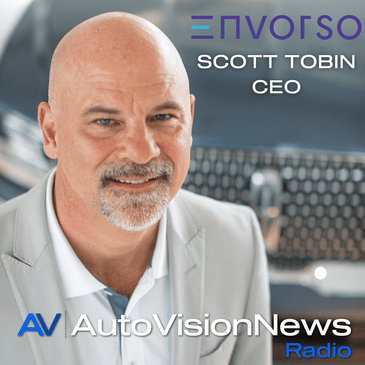
Scott Tobin, CEO of Envorso, joins Carl Anthony on AutoVision News Radio to discuss effective strategies and key benchmarks for companies as they plan and evaluate their software roadmaps. Recorded during the Mobility Global Forum at the 2025 Detroit Auto Show, Scott also expands on the organizational challenges hindering SDV innovation, the need for standardization, and the importance of focusing on talent.
More Resources:
Avoiding Pitfalls and Seizing Opportunities for Software-Designed Vehicles: Scott Tobin, CEO of Envorso, speaks to attendees during the Mobility Global Forum as part of the 2025 Detroit Auto Show.
- Part One: https://tinyurl.com/bd79xb9c
- Part Two: https://tinyurl.com/3kzap8ru
Definitions, Challenges & Considerations of SDVs ft. Intrepid Control Systems, Dataspeed, Keysight Technologies, and AutoVision News Radio: https://tinyurl.com/4se7xxxz
The Software-Defined Future of Automotive ft. Volvo Group, Ford of Europe, and AutoVision News Radio via Reuters Events: https://tinyurl.com/2snc7vdu
Envorso Case Studies Portfolio: https://envorso.com/portfolio/
Follow AutoVision News Radio on LinkedIn: https://tinyurl.com/49jyrd3b
AV Radio is a Detroit Deep Media Production: https://detroitdeepmedia.com/
[00:00:00] Now in the middle of one of the most significant eras in automotive, Carl Anthony amplifies the minds and voices behind this historic transformation as the host of AutoVision News Radio. Mic check one two. All while coming to terms with middle age, father loss, and what it means to be successful in Detroit. We've all heard someone rave about what they drive.
[00:00:20] Maybe it's the leather seats, the towing capacity, cargo space, the 20-inch wheels, or exterior styling, or simply because a certain OEM builds it. Likewise, we hear people list why they prefer an Apple or an Android phone. Now, what if they comment on their vehicle's navigation system or infotainment options? Can we in the automotive industry capitalize on that with a software-defined vehicle?
[00:00:48] We still keep the plush leather seats, the panoramic roof, that awesome exterior look. We keep all that. But we zero in on the software, so future consumers will love that, too. If we believe software-defined cars are a north star, how do we optimize our launch pads so we can hit that target? That's where Envorso comes in.
[00:01:11] They help clients build out these launch pads by focusing on key success pillars like strategy and product leadership, software delivery and talent management, enterprise agility, and training solutions. By way of introduction, Scott Tobin is the CEO of Envorso, where he leads a team of Silicon Valley connected product and automotive development experts to meld the best of both worlds.
[00:01:39] Efficient coding techniques with the mindfulness and necessary rigor to enable higher levels of safety, quality, and output. While there is a natural association between SDVs and EVs, Scott encourages us to consider that traditional gasoline powertrains and hybrids are equally valid options under the umbrella of software-defined vehicles.
[00:02:03] Before Envorso, he spent nearly 30 years at Ford Motor Company, including six as the director of product development for the Lincoln brand from 2012 until 2018. Scott's time at Lincoln culminated with the 2018 Navigator, which was named North American Truck of the Year, during the 2018 North American International Auto Show.
[00:02:26] It was the first time in Lincoln's history that one of its vehicles secured North American car, truck, or utility of the year honors. Automotive is a rewarding career because along the way you get to meet interesting people like Scott. I have a great deal of respect for him and his laser focus on making our industry better through software innovation. Moving at the speed of mobility, this is AutoVision News Radio with Carl Anthony in Detroit, Michigan.
[00:02:54] I'm happy to say I had just a fantastic 30-year career. And of course, being the director of Lincoln was the last assignment I held. In fact, I was walking in here to Huntington Place and saw the plaque of the Navigator's Truck of the Year Award, which has brought back some memories. I've had the privilege to work all over the world, Asia, Europe, North America, working with many of the brands, Volvo, Mazda, Jaguar, Land Rover.
[00:03:22] I worked at Mazda for a while in Japan. And I also worked on many of the partnerships that those set of brands were involved in. Peugeot Diesel sharing, obviously, across the brands and the C1 platform with Volvo and Mazda, transmission with General Motors. And so a lot of exposure to the industry in all three major regions. And it was a ton of fun. But I'd say, Carl, I think the most important work I've ever done is what I'm doing now, which may sound strange, actually.
[00:03:49] But if we don't get this software thing right, I think there's an existential threat to the domestic industry with how fast some of the, particularly the Chinese, are moving in that space. Let's talk about that, Scott. So quoting from the Envorso website, Envorso, a trusted advisor to Fortune 500 companies, delivers software and systems consulting, engineering excellence, and training services to drive innovation, modernization, and critical changes.
[00:04:19] There's a journey going on. We all know it, right? It's all products that have been, quote, traditionally hardware products are moving to become software-defined, right? The software is defining the experience. In fact, when I drove up here, I realized I'd forgotten to turn off my ice maker. And I did that from the car as I was driving down the road. Isn't that incredible? Yeah, it is. And so the point there is everything's becoming more software-defined. There's companies out there stalwarts the American landscape, Harley-Davidson and Oshkosh Defense and Ford and GM.
[00:04:48] They made hardware successfully for over 100 years, and they are now making software and have to make it. And it's really becoming what defines the customer's experience with their product. So we help them make that transition, okay? We help them put in the right talent, assess that talent. We help them put in the right tools and processes that they need. We help them define the right architectural platforms they need to build upon. And also, of course, you have to have the right customer knowledge as well.
[00:05:16] And so that's kind of the four pillars that we work across in many spaces with many of our clients. With regard to your clients, your customers, those spaces that you're working in, on the Envorso website, you have case studies. What are some key learnings, Scott, that you have taken away from those case studies? When you go back, when you review them, when you look at them, what are some findings that really stand out? Well, the observation I would make kind of holistically across many of those case studies is, let's say you've set up your software tool chain. Okay.
[00:05:46] And you have the tools, but do you have it set up correctly? Do you have it set up the most efficiently? And we can bring a very large set of benchmarking data, not only from the product and industrial space, but from the West Coast tech leaders as well. So we can bring that combination of industrial know-how with software technology companies, and we bring that to them. So there's those little gaps they have in their talent, again, in their processing tools, in their software factory that we come in.
[00:06:17] It's not like they don't understand where they need to get to, but they might not know what good looks like. Okay. Right? How do I know I'm doing it world-class? And that's where we help. Right. And how do you know you're doing it world-class, Scott? What defines a world-class in that space? Yeah. I mean, it's all about having code. You're never done with software. If you ask any developer, they're never done.
[00:06:40] But obviously, you have to launch it and benchmark yourself against the likes of some of the best in the industry to know you're doing it well. And you know that by there's metrics that define that, right? How long until when a developer comes into the company is it until he's releasing code? How long is your test cycle? Are you debugging at the right rates? Are you able to over-the-air update? Can you fix issues quickly over-the-air? Those are all kinds of KPIs, we call them key process indicators. Sure.
[00:07:10] Within your software factory that we would come and measure you against and say, ah, now you're world-class. Right. Right. I do believe that people in this industry see you as an expert in SDVs and software-defined vehicles. And I truly mean that. What are the challenges right now? Is this a technical thing? Is this an organizational thing? Is it a little bit of both? What does the landscape look like? Obviously, the answer is it's some of both.
[00:07:38] And obviously, there's a lot of technology that goes into it. But Tesla's basically doing an SDV. So the technology is known. I think it's around the organization. I mean, let's take the example of why actually some of the startups have been successful. Tesla, I think, is the benchmark. But even the likes of Rivian, of Lucid, and some others have done a pretty good job. And one of the reasons they can do that is they're very focused.
[00:08:06] They actually have teams of 3, 4, 500, not 3, 4, 5,000. Okay. Like some of the traditional OEMs. Sure. They have no legacy products to worry about. There's no units in operation. They have no technical debt. And what I mean by technical debt is they don't have huge software systems that are already in place. They've got a clean sheet of paper. They've got a very simplified mission, very clear mission. And if they have a good leader, and some of them have, they're able to pull this off with pretty significant success.
[00:08:35] The VW Rivian kind of tie-up shows you that some of these very powerful OEMs can't manage to do what some of these startups can do. Now, can it be done? Absolutely. It can be done with the traditional OEMs, but it's an enormous task, and there's many elements they have to put in place to make it happen. And historically, we know that automakers have created proprietary technology, but there's another side to this coin.
[00:09:03] I actually have a pretty strong perspective on it, but we're a long way from it. Yeah. Yeah. Yeah. I talked earlier about the existential threat that we have. Yes. There's also a talent shortage, and there's also a lot of software recalls going on. So there's quality issues, there's talent shortfalls, and there's threats from competition. So what does that say to me? It says, really, we should look at, as an industry, standardizing some of the non-customer differentiating software and hardware. Okay. Okay.
[00:09:33] And I think it's really important because the first pushback is, well, you don't know our brand, and we have to do this for our customer. And those are good concerns, and they should do those things. But there's elements below the abstracted layer in a software-defined vehicle that deliver services and capabilities to the product that are pretty standard. But they take a lot of resources to build, and of course, they're expensive. So think about it. If you could get a collaboration and standardize things like the operating system, the communication
[00:10:01] protocols, the diagnostics, things that go on that customers are more or less unaware of. If those could be done on a zonal-type architecture that multiple OEMs could use, all those resources, one, the cost would be lower, the quality would be better, and the resource demands would be less. We were laughing the other day, my colleague and I, when we were in the industry, there was two large OEMs that were trying to collaborate on a high-mount stop lamp and could not agree
[00:10:30] the specifications of a high-mount stop lamp. So if you can't agree the specifications on a high-mount stop lamp, a software-defined vehicle is going to be really, really tough. But there are examples in the industry. I know of one where in the cloud, cloud data, they've collaborated and been able to transfer data from the cloud to each company's server. So I think that is a huge opportunity. And I think we need to talk more about that, Carl. So I'm glad you're asking that. I think the industry needs to talk about that.
[00:10:56] When it comes to talent, I know you mentioned it just a couple minutes ago, but we have also talked before in the past about the need to have talented people within the automotive ecosystem. What do we need to do in this industry to ensure we have the right people in place to develop the SDV of the future? Another great question, Carl. I think the key is, firstly, there is a lot of great talent already in the industry. I don't want to walk past that.
[00:11:26] In fact, the automotive industry is the best in the world at things like reliability, requirements, compliance, safety first solutions. And of course, they know the automotive customer. So let's be clear, the talent that's here is rock solid and we need to develop more of it. And we actually have a system to do that. You know, there's a lot of young developers who are very talented, but need some additional training. We can put a system together for that.
[00:11:53] But if you can take that core automotive skill and then bring in some of the tech industry skills, now what do they bring? They bring the ability to rapidly digitally innovate on high, large-scale platforms that are powerful and properly abstracted. And also, they have products that are living and updatable, right? You know, the phone, I'm sure you're carrying, whether it be an Android or an Apple or something else is updatable. And I'm sure a pure example of that.
[00:12:20] In fact, I would even bridge to say kind of what I was talking about on the base architecture and some of that combination is kind of what the Android has done in infotainment. It's a similar concept. So there is some precedent for it. But no, the talent's key. And, you know, you also got to get into things like providing the right work environment, flexibility, work flexibility. All those things are what young, talented people are now looking for. Scott, what is the legacy that you hope to leave when you retire? Wow.
[00:12:51] Wow. That's not one I've gotten before, Carl. Well, thank you. But I appreciate the question. You know, obviously, I've kind of had two careers. So I break it into two. I mean, I'm very proud of the work I did in vehicle development. And in this role, as I said at the beginning, if we can move the industry toward being more capable in software, I mean, we can't put tariffs on the Chinese forever, right? We have to become fully competitive. And if I can help move the needle just a little bit on that, that would make it for me.
[00:13:21] See the links in the show notes to learn more about Envorso and software-defined vehicles. AutoVision News Radio is available on Spotify, Apple Podcasts, Podbean, and more. In Detroit, alongside Scott Tobin. I'm Carl Anthony, AutoVision News Radio.