
The automotive industry is experiencing a historic transformation at every level, from the manufacturing plant to the showroom. While new technologies will always push the boundaries of what is possible, do we believe the same about leadership? As a collective automotive industry that is accustomed to putting our faith in technology, do we believe cultural innovations deserve equal merit and footing?
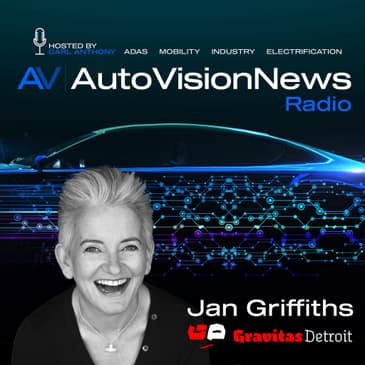
Gravitas Detroit founder Jan Griffiths is the architect of cultural change. Whether on stage, walking the shop floor, or behind the microphone as the host of the Automotive Leaders Podcast, Jan has become the industry's most significant force for authentic leadership, a style of leadership that demolishes old silos and antiquated principals, building up trust and inspiration in their place.
Jan joins AutoVision News Radio host Carl Anthony to discuss why she left her high-powered executive role, why a culture overhaul in automotive is necessary, and why having her daughter's support means everything to her.
More Resources
Gravitas Detroit: https://gravitasdetroit.com/
Automotive Leaders Podcast: https://tinyurl.com/3kry7azt
AutoCulture 2.0: https://amzn.to/4awtbmt
89.7 The River: https://897theriver.com/
Follow AutoVision News on LinkedIn: https://tinyurl.com/49jyrd3b
Because Carl didn't know anything about Telex: https://tinyurl.com/4arx5x7w
[00:00:00] Now in the middle of one of the most significant eras in automotive, Carl Anthony amplifies
[00:00:05] the minds and voices behind this historic transformation as the host of AutoVision News Radio.
[00:00:10] My check, my check.
[00:00:11] All while coming to terms with middle age, father loss and what it means to be successful
[00:00:16] in Detroit.
[00:00:17] In the winter of 2004, I was into my second semester of broadcasting school at Iowa Western
[00:00:24] Community College in Council Bluffs, Iowa.
[00:00:27] Around that time, a new program director, Sophia John was hired to oversee our college radio station,
[00:00:33] K-I-W-R or 897 the River, the cutting edge of rock.
[00:00:39] A short time after Sophia arrived, she held a meeting with all the students involved
[00:00:44] with 897 the River as part of the electronic media studies program.
[00:00:49] By the time that meeting ended on that winter afternoon in Stewart Hall, only a few students
[00:00:55] remained in her corner.
[00:00:57] You see the broadcasting students or radio kids, as was the slang term around campus, had
[00:01:03] a reputation for being poor students.
[00:01:06] They had a reputation for thinking they were a bit too cool for school because they were
[00:01:11] on the college radio station.
[00:01:13] Sophia came in and busted all of us down a notch, having cut her teeth in corporate commercial
[00:01:18] radio and discovering and managing one of the biggest metal bands in the world, a group
[00:01:25] of nine from Des Moines, Iowa who still wear their signature mask when performing.
[00:01:31] In that meeting, Sophia said being on the radio was a unique privilege, not a guaranteed
[00:01:36] right, and that to crack the microphone on 897 the River meant that everyone needed to
[00:01:43] up their game both academically and in terms of media performance.
[00:01:48] 897 the River's massive 100,000 watt tower meant that us as college students could compete
[00:01:54] with the likes of the corporate radio giants in the Omaha Metro.
[00:01:58] Few college stations are afforded that large of a tower with that far of a reach and if
[00:02:04] we wanted our voice on those airwaves, we had to earn it.
[00:02:08] That meant stronger critiques of our on-air work, more focus on broadcasting formatics and
[00:02:14] zero emphasis on us being cool.
[00:02:18] Most of my classmates hated Sophia from that day forward, many called her the B word,
[00:02:24] some the C word.
[00:02:26] In my life there has never been a greater mentor.
[00:02:29] The day after that meeting I went into our office and begged her to work with me outside
[00:02:34] of class so that I could get better on the air.
[00:02:38] I told Sophia that if I didn't succeed at Iowa Western and at 897 the River, I didn't
[00:02:43] have anywhere else to go.
[00:02:45] That the circumstances in my life at the time were such that college was a make it or break
[00:02:50] it thing for me.
[00:02:52] I told Sophia that when she spoke, she had lit a fire under my ass and that I would be
[00:02:58] okay with her holding me to the flame for the next couple of years so that I could complete
[00:03:03] the broadcasting program and graduate.
[00:03:06] She did and I will be forever grateful.
[00:03:09] This forward two decades to the evening of March 7th, 2024.
[00:03:14] The automotive culture 2.0 book launch by the founder of Gravitas Detroit and the architect
[00:03:20] of cultural change, Jan Griffis.
[00:03:23] As Jan was speaking at the event I saw my longtime mentor Sophia John.
[00:03:28] As Jan talked about challenging the status quo in automotive and changing the conventional
[00:03:34] notion of leadership, I felt that same fire being lit.
[00:03:38] That same fire that knocked me out of complacency 20 years ago.
[00:03:43] Armed with the skills she learned in the Welsh farmlands and a degree from the University
[00:03:47] of Wales, Jan moved to the United States at 23.
[00:03:51] She rose through the corporate ranks of the auto industry ultimately serving as chief
[00:03:55] procurement officer for a $3 billion tier 1 global automotive supplier and later earned
[00:04:01] a spot on automotive news as list of the 100 leading women in the North American automotive
[00:04:07] industry.
[00:04:08] Being at the speed of mobility, this is all to vision news radio with Karl Anthony
[00:04:13] in Detroit Michigan.
[00:04:14] Jan, let me begin by saying that and I'm not blowing smoke at you when I say this, that
[00:04:21] when it comes to being an automotive podcaster and broadcaster or just whatever it means
[00:04:29] to be in the automotive industry to be successful in Detroit to be successful in automotive,
[00:04:35] you have to know that I have a tremendous amount of respect and admiration for you.
[00:04:42] Wow, thank you.
[00:04:44] That's quite an opening.
[00:04:46] I'm not really sure what I want to be when I grow up but when I look at gravitas to
[00:04:51] Troy, I listen to the automotive leaders podcast, I come to things like your book launch,
[00:04:57] I think Jan is somebody that's who I want to be.
[00:05:03] Why, Karl?
[00:05:04] Why?
[00:05:05] What is it that you see in me that what draws you to that?
[00:05:11] I think because you had the dream job if you will and I'm going to use your word trappings.
[00:05:19] You had all the trappings that go with that and then you followed your heart and you walked
[00:05:26] away to do something that was close to you, something that meant a lot to you and you
[00:05:34] did it.
[00:05:35] And if I'm understanding right from the night that you got up and spoke at your book
[00:05:39] launch, you did it because it was the right thing to do.
[00:05:42] You felt called that the conviction was very strong and you do it with such grace, Jan.
[00:05:48] Thank you.
[00:05:49] Thank you.
[00:05:51] So at the beginning of the automotive leaders podcast, you introduce yourself as that
[00:05:56] passionate and rebellious farmer's daughter from Wales.
[00:06:00] I want to go back to Wales, I want to go back to the farm.
[00:06:04] Where does the passion come from?
[00:06:06] Where does the rebellion come from?
[00:06:08] The Welsh people are a rebellious sort of people.
[00:06:12] In fact, if you watch Braveheart, Mel Gibson will say, let's bring in the Welsh because
[00:06:20] that's who we are.
[00:06:21] We're rebellious, we're rebellious nature.
[00:06:23] We have a dragon on our flag.
[00:06:25] What's that tell you?
[00:06:26] Right?
[00:06:27] We have a lot of fire, a lot of passion.
[00:06:30] It's just who we are.
[00:06:32] But I use that tagline if you will at the beginning of the podcast because that's it.
[00:06:38] That's who I am really.
[00:06:39] I am that passionate rebellious farmer's daughter from Wales and there's a lot in that
[00:06:44] statement.
[00:06:45] I'm passionate about everything that I do.
[00:06:47] I love to challenge the status quo and I love if there's a rule, I want to break it
[00:06:52] or challenge it or find out why it's there or something.
[00:06:55] So that rebellious nature is in me.
[00:06:59] The farmer's daughter from Wales, I am a farmer's daughter from Wales and I think a lot of that
[00:07:04] brought in my work ethic and my ability to function in a male dominated environment
[00:07:09] because I grew up with farmers and farmers' sons around me.
[00:07:14] That taught me a lot.
[00:07:16] You taught me my negotiation skills.
[00:07:19] You've probably heard me say before, I learned my negotiation skills and the pub with
[00:07:22] my dad and I did.
[00:07:23] Yeah.
[00:07:24] I didn't go to some fancy negotiation school.
[00:07:27] That's where I learned it.
[00:07:28] Bryce attract the parts and hey, you see that these guys haggle in the pub?
[00:07:33] You learn a lot and I sat there and I was M's daughter.
[00:07:36] I didn't even have a name because women, well respected in the farming community back
[00:07:43] then.
[00:07:44] Just M's daughter.
[00:07:45] Oh yeah, M's daughter, whatever.
[00:07:49] And I remember you had said, I believe you've said it in your podcast also in your book,
[00:07:54] the pub was really divided into two sections.
[00:07:56] There was the male section and then that's where all the guys were drinking and then where
[00:08:02] the women were was basically the family section.
[00:08:04] I do remember you saying that at one time it was very clearly divided in half.
[00:08:08] Yes, and it was the norm.
[00:08:10] I mean, it wasn't a bad thing.
[00:08:11] It wasn't considered a bad thing.
[00:08:12] It was just the way it was.
[00:08:13] I mean, the culture had grown up over decades and it had a stone floor in the bar and the
[00:08:20] lounge area had carpet and the men, the working men went into the bar.
[00:08:25] Women didn't go in there.
[00:08:26] I went in there and I was daddy's little girl and I would sit there and I would listen
[00:08:31] to what he had to say and what the other guys had to say.
[00:08:34] I wasn't really encouraged to contribute too much but that's okay.
[00:08:39] You can sit back and you can learn a lot from these people.
[00:08:42] How old are you, Jan, when all of this is happening?
[00:08:46] About what age are you?
[00:08:47] I would say from the age of about 13, 14 onwards.
[00:08:53] Okay.
[00:08:54] Do you ever think that would be useful someday in the automotive industry?
[00:08:58] Did you ever have any idea of where that would go that that would be a skill set that you
[00:09:04] would fall back on someday?
[00:09:06] Did you ever envision that?
[00:09:07] Every one million years.
[00:09:08] I'd never heard the term automotive.
[00:09:11] I didn't know what automotive meant.
[00:09:13] I grew up in a farming community.
[00:09:15] I didn't know what a manufacturing plant was, what an office environment was.
[00:09:20] I had none of that sort of discussion around me.
[00:09:24] It was completely alien to me.
[00:09:27] How in the world, Jan, do you go from the farm to the automotive industry?
[00:09:34] How does that happen?
[00:09:36] How do you make that jump?
[00:09:38] That's the catalyst that sort of spurs that in motion.
[00:09:42] Just like many young people leaving college, you have a degree, you have a qualification,
[00:09:47] you have no experience.
[00:09:49] I signed up with a temp agency in Wales and they said we got this job at a company called
[00:09:56] Borg Warner and I thought Borg Warner, huh?
[00:09:59] I've seen them.
[00:10:00] I see the plant when I drive to college because they had a plant in a place called Kenfig.
[00:10:08] I would see it as I was driving to college and I thought, they make batteries.
[00:10:12] I don't know.
[00:10:13] They made transmissions at the time.
[00:10:15] They made manual transmissions for a sob and for jaguar.
[00:10:19] And I thought transmission was that.
[00:10:21] So anyway, my mother calls me in from the field.
[00:10:24] I was riding my horse on the field and before cell phones obviously.
[00:10:29] And she calls me in and I took the call and they said we have a job for you.
[00:10:33] You're going to be a temp in a manufacturing plant for this company called Borg Warner
[00:10:38] and I walked onto that shop floor and I inhaled that air in the coolant
[00:10:43] and I fell in love with manufacturing at that very moment.
[00:10:47] And the rest they say is history.
[00:10:48] And it was really that quick, Jan, just the smell and the environment.
[00:10:52] It was that quick.
[00:10:53] It was that and the ability to earn money.
[00:10:55] Yeah.
[00:10:56] I saw the ability to earn money at that point.
[00:10:59] It wasn't a lot of money.
[00:11:00] I don't remember how much it was, but it was probably just a few dollars an hour back then.
[00:11:04] And I was doing a lot of the grunt jobs and making coffee and copy and blueprints
[00:11:08] and sending tell access.
[00:11:10] I always left to tell people that because the young people are like, what?
[00:11:13] What's that?
[00:11:14] Google it.
[00:11:16] I'm going to have to Google that.
[00:11:21] I'll know what a facts machine is.
[00:11:22] I know that I tell like so.
[00:11:23] I have no idea Jan.
[00:11:25] Prefax.
[00:11:26] Prefax.
[00:11:27] Prefax.
[00:11:29] But this temp stuff builds though.
[00:11:33] I mean, it builds and I've heard you talk about this.
[00:11:36] You talk about this in your book, Automotive Culture 2.0 that at a certain point, you couldn't
[00:11:41] get enough of it.
[00:11:42] So you started asking questions.
[00:11:44] You started, you wanted to know more.
[00:11:46] Yeah.
[00:11:47] I don't have an engineering background.
[00:11:49] I have a business degree.
[00:11:51] And I'm not particularly good at math.
[00:11:53] For me, this whole idea of engineering was fascinating.
[00:11:57] There was this blueprint.
[00:11:59] But then there were two blueprints.
[00:12:00] There was a casting print and then there was a machining print.
[00:12:03] Well, why was that?
[00:12:04] And why were the numbers the same but not really but different?
[00:12:06] And why did one of more dimensions than the other?
[00:12:09] And then how do these parts come together?
[00:12:11] Oh, in a thing called a bill of materials.
[00:12:13] Oh, okay, what's that?
[00:12:15] And then the parts come in the plant and there's logistics and there's purchasing and there's
[00:12:19] supply chain.
[00:12:20] And I was all over it.
[00:12:21] I could not stop asking questions.
[00:12:24] And then I got into purchasing.
[00:12:27] They made me a buyer at a very, very young age.
[00:12:29] And they made me materials manager at 23, I think.
[00:12:34] Okay.
[00:12:35] And to be a materials manager and a manufacturing plant at 23 and not really know what the hell
[00:12:39] you were doing was pretty terrifying.
[00:12:42] But I throughout my entire career call, I have not been qualified for any job I've ever
[00:12:48] taken ever.
[00:12:49] I just have a belief in myself that I will figure it out.
[00:12:53] And I have.
[00:12:55] When you made the switch to gravitas Detroit and I do want to talk about that in a second
[00:13:00] but when you made that switch, were you asking sort of those similar questions?
[00:13:05] Why this?
[00:13:06] Why that?
[00:13:08] Did that come back into play when you were starting gravitas Detroit?
[00:13:12] Yeah.
[00:13:13] It's never left.
[00:13:14] I'm curious.
[00:13:15] And then I found out over the years that I became more curious about human behavior
[00:13:21] in how that behavior impacts bottom line results.
[00:13:25] And I saw that the way we were treating suppliers, when you're taught and trained to beat
[00:13:31] suppliers over the head of the baseball bat to get the result.
[00:13:34] It's something never felt right about that.
[00:13:36] And I did think that it got the desired result.
[00:13:38] I thought there was a better way.
[00:13:40] I think that there's a better way to handle staff meetings to handle leadership team meetings.
[00:13:47] There's a better way to get things done.
[00:13:49] I think we waste a lot of time and energy in this industry by following an outdated model
[00:13:54] of command and control.
[00:13:56] So the more those questions started to come and the answers came back, and I was thinking
[00:14:01] you know, we're not going to make this transformation as an industry.
[00:14:05] If we don't really change the culture, how we do things?
[00:14:10] That transformation.
[00:14:12] So on your website gravitas Detroit.com, I'll leave a link in the show notes, but you
[00:14:16] have written there on the homepage.
[00:14:19] Technology is evolving at an alarming rate yet company culture remains stuck in the past
[00:14:23] with outdated beliefs, as you've just said, Jan.
[00:14:27] So two part question here.
[00:14:28] First, what is gravitas Detroit?
[00:14:31] Take us through that.
[00:14:32] And then second, help me, Jan, understand from your perspective the contrast between technology
[00:14:39] and company culture because it's clear that they're not progressing at the same rate.
[00:14:45] And why is that something that we should care about?
[00:14:47] Yeah.
[00:14:48] Yeah.
[00:14:49] Well, gravitas Detroit, I founded in 2018.
[00:14:51] I walked away from my corporate role.
[00:14:53] I believe that there's a better way to do business in the auto industry and we do that
[00:14:58] at gravitas Detroit by providing workshops, off-site leadership team meetings for companies
[00:15:05] to help people understand what their culture is and what they need to do to amplify their
[00:15:10] vote, their values.
[00:15:12] And then secondly, I produce podcasts, internal podcasts for companies to help them really
[00:15:20] amplify those values internally because you know, Carl, we can't reach the shop floor
[00:15:25] in this industry.
[00:15:26] We can't reach them.
[00:15:28] They don't have a corporate email.
[00:15:29] So I love taking this medium that you and I both love called podcasting and using that
[00:15:35] internally to help companies really amplify their values.
[00:15:41] And that's what we do.
[00:15:43] And I'm in there every single day working with tier ones, helping them figure out what their
[00:15:47] culture is and what they need to do to make it better.
[00:15:50] The technology portion, why is it something that we need to pay attention to?
[00:15:55] If you look how fast technology is accelerating, we talk about it all the time.
[00:16:01] What about the model of leadership and the culture to go along with that?
[00:16:07] Does anybody seriously believe that the model that got us to where we're at today, which
[00:16:11] is to command a control, is going to take us into the future?
[00:16:14] And in the book, you'll hear their statement about would you run a 4K video on a 95
[00:16:20] Windows operating system?
[00:16:21] Yeah, it's a great analogy by the way.
[00:16:23] Right.
[00:16:24] You wouldn't would you?
[00:16:25] Yeah, you wouldn't.
[00:16:26] So what makes you think that you're going to transform an industry to EVs, autonomous
[00:16:30] driving, smart cities, all the things that we need to do?
[00:16:33] We know that when there's a vehicle in the EV space, we'll pick on Tesla as an example.
[00:16:40] If there's an update to that vehicle, it's a OTA update.
[00:16:44] It just happened.
[00:16:45] All design vehicle manufacturing, all of those lead times are shortening.
[00:16:52] Changes need to be rapidly implemented software defined vehicles.
[00:16:56] All these things that I know you are really heavy into.
[00:17:00] Yeah, yeah.
[00:17:01] But you're not going to do that when you've got a culture that is divided into silos
[00:17:06] that's playing games.
[00:17:09] The badge of honor is how as a leader, how far down in the weeds you are and how harsh
[00:17:15] you are and how aggressive you are with your people or your suppliers, these are cultural
[00:17:20] issues that are slowing us down call.
[00:17:23] And until we get our arms around that, we're never going to transform this industry at
[00:17:27] speed that it needs to be transformed at.
[00:17:30] Yeah.
[00:17:31] I've heard you many times, Jan, cite the work of Stephen Covey, you know, the command and
[00:17:37] control versus trust and inspire.
[00:17:40] But Jan, where does command and control come from?
[00:17:45] Where does that, where does that ideology originate?
[00:17:48] Why does it take hold and automotive for so many years and maybe further to that?
[00:17:53] Why is it still so prevalent in automotive?
[00:17:56] Where does that come from, the command and control in automotive?
[00:17:59] It comes from military originally.
[00:18:01] Sure.
[00:18:02] But it really started at the beginning at the industrial revolution because as we moved
[00:18:07] from cottage industries more to the factory concept, it was all about scaling and efficiency.
[00:18:14] It was all about standardized work.
[00:18:15] So it's all about putting people and jobs in boxes and controlling the output, controlling
[00:18:21] the inputs and controlling the outputs.
[00:18:25] And at that point in time, it worked great.
[00:18:28] Nobody wanted anything different but the world has evolved into COVID was the catalyst
[00:18:34] that caused us to look at the way we work in a, and put a really put a microscope on
[00:18:39] it.
[00:18:40] It was happening anyway, Carl, but COVID said, woo, wait a minute.
[00:18:45] Why do we have to go in the office five days a week and work nine to five?
[00:18:48] Oh, wow.
[00:18:49] Whenever I ask that question before, let's think about that.
[00:18:52] Right.
[00:18:53] And then you've got startup culture in California.
[00:18:55] You've got technology companies.
[00:18:56] You know, they have their own culture.
[00:18:59] There's no right or wrong culture.
[00:19:02] There's no California startup culture is right and we're all wrong in legacy order.
[00:19:06] Sure.
[00:19:07] There isn't.
[00:19:08] There are good elements to both.
[00:19:09] There is only the culture that you want in your business, but your organization, your
[00:19:15] values, your brand to meet your industry and your customers.
[00:19:20] And we got to get our arms around that and understand that it's our responsibility
[00:19:23] as leaders to drive that culture.
[00:19:27] If I'm a company out there and I say, I get this, I get this trust and inspire model
[00:19:33] but I'm looking around at command and control everywhere I turn.
[00:19:37] I know that's not the way for the future.
[00:19:39] I know that trust and inspire is going to be better, but I don't know how to get there.
[00:19:44] That's where gravitas Detroit comes in.
[00:19:46] Am I understanding that right?
[00:19:47] Okay.
[00:19:48] Exactly.
[00:19:49] Exactly.
[00:19:50] So you have a few choices.
[00:19:51] You can hire some big fancy high price consulting firm and that's great.
[00:19:55] And I'm sure they're awesome.
[00:19:56] But it's going to cost you billions of dollars.
[00:19:58] Right.
[00:19:59] Right.
[00:20:00] Where gravitas Detroit fits in is that nice niche area where we could come in and exactly
[00:20:05] is I have my title on my emails and all over the place.
[00:20:10] I am the architect of cultural change.
[00:20:12] So I'm going to come in with you.
[00:20:13] Yeah.
[00:20:14] I'm going to bring all of my experience, everything that I've learned from leaders I've interviewed
[00:20:17] on my podcast and I'm going to help you craft that plan.
[00:20:21] Now I may play a role in that plan.
[00:20:23] I may run a few leadership workshops for you.
[00:20:27] I may do some speaking events for you but I'm the architect of that cultural transformation
[00:20:33] plan for you.
[00:20:34] Does that help?
[00:20:35] And it does.
[00:20:36] It does again gravitas Detroit dot com.
[00:20:38] Janima Liva a link in the show notes.
[00:20:40] I want to set up two different pictures here.
[00:20:45] So the night of your book launch automotive culture 2.0 also a link in the show notes.
[00:20:51] When you got up to speak, you talked about the dreaded Monday morning meetings that
[00:20:58] were sucking the life out of you and you're like, I got to do something different.
[00:21:03] I know it's my dream job and it's everything I've ever wanted but I got to do something
[00:21:07] different.
[00:21:08] So there's one visual now this second visual as you said a moment ago, you're the architect
[00:21:14] of cultural change.
[00:21:16] Take us through that progression.
[00:21:17] Okay.
[00:21:18] So see sweets conference room, executive leadership staff meeting every Monday.
[00:21:25] Same type of PowerPoint same agenda very little engagement and interaction find yourself
[00:21:31] drifting to your personal email more than paying attention in the meeting.
[00:21:35] I will, I will openly admit and I know there's people out there that can totally relate
[00:21:39] to what I'm talking about right now.
[00:21:41] Absolutely.
[00:21:42] So then you have to wonder why, why am I, why am I disengaged here?
[00:21:45] What's going on?
[00:21:46] Okay.
[00:21:47] So we make the decision to leave and I start gravitas Detroit and I have no experience being
[00:21:53] an entrepreneur really have no idea what I'm doing perfectly.
[00:21:56] I don't.
[00:21:58] So I've started to learn how to be an entrepreneur, starting to put some structure around what
[00:22:03] this business is.
[00:22:04] The mission is true and it's in my heart and it is to impact the way we work on the culture
[00:22:09] in this industry but how to do that?
[00:22:11] How to define a business around that?
[00:22:13] How to market that?
[00:22:14] I thought to learn that.
[00:22:16] And then somebody said start a podcast and I thought oh that's great.
[00:22:19] What's a podcast?
[00:22:20] So I had to learn all about that many YouTube videos hours of YouTube videos later and I
[00:22:26] launched the podcast and then the pandemic hits.
[00:22:29] So you come off of the C-suite job with a great comp package, single mom, house in Birmingham
[00:22:35] and then all of a sudden like you're on your butt because it's COVID.
[00:22:41] Yeah.
[00:22:42] So I was on unemployment.
[00:22:43] It was brutal.
[00:22:45] Yeah.
[00:22:46] I had two job offers that came along during that time and I said no to both of them.
[00:22:51] What was that like saying no to both of those?
[00:22:54] I wondered if I had seriously lost my mind at that point.
[00:22:58] Because the ego was screaming.
[00:23:00] Oh, this is and it was a great job.
[00:23:02] This is a great job.
[00:23:03] It has lots of is a big title.
[00:23:05] There's a lot of responsibility and a lot of comp to it.
[00:23:08] But something inside me called was saying oh don't do it.
[00:23:14] And I said no and when I think the universe tests you it's like okay lady so you think
[00:23:20] you architect the culture change and all that.
[00:23:23] All right, let's see how committed you are.
[00:23:25] Say no to this.
[00:23:26] Right, right, right.
[00:23:27] Yeah, prove it.
[00:23:29] And I did and then another one came along and still the other business wasn't generating
[00:23:34] hardly any revenue was rough.
[00:23:37] But then little by little, you know the entrepreneurial journey you start to get a little bit more clarity
[00:23:42] on the business and then it starts to grow and you get some traction.
[00:23:46] Podcast starts to take off.
[00:23:49] We got our first podcast sponsor.
[00:23:51] Then the book comes somebody comes up with this idea of a book and I thought well okay,
[00:23:56] that's not a bad idea because I really need that to get the higher level speaking gigs.
[00:24:02] Sure.
[00:24:03] But now it's grown into a whole it's got a whole life of its own.
[00:24:06] Now the book is just people are taking pictures of themselves with it putting it on social
[00:24:11] media.
[00:24:12] Yeah.
[00:24:13] And they're really using it as a tool to open up the conversation of culture with their
[00:24:17] team, which I absolutely love Carl.
[00:24:19] So it's it's having more impact than I originally anticipated, which makes me happy.
[00:24:24] Absolutely.
[00:24:25] Absolutely.
[00:24:26] There's so much that I have learned from podcast interviews from interviewing great leaders
[00:24:31] on the podcast.
[00:24:33] I wanted a way to really boil that down to just the key points that leaders in the
[00:24:38] auto industry could take on board and open up that conversation with their team.
[00:24:44] And there's an ego thing that comes into play here and that is that if you write a book,
[00:24:48] you think that if it's not like 253 hundred pages, it's not going to be taken seriously.
[00:24:54] And you've got to get over that.
[00:24:55] Yeah.
[00:24:56] Yeah.
[00:24:57] Do you know a lot of books most people only get like a third of the way through?
[00:25:00] I didn't know that no.
[00:25:01] A statistic out there I need to find it.
[00:25:03] I found it when I was researching for the book.
[00:25:05] So a lot of people you know they start a book and they're like eh because books typically are
[00:25:09] written by writers who like to use words and write a lot.
[00:25:14] Yeah.
[00:25:15] Yilty.
[00:25:16] This book was written by me a recovering supply chain person who doesn't like to read words
[00:25:25] for the sake of reading.
[00:25:26] I just it's just tell me what I need to know and then tell me what I'm going to do with
[00:25:29] it.
[00:25:30] And oh, by the way, give me a place to go if I want to go deeper.
[00:25:33] So once we came out with the structure for the book, I used a ghost writer to help me really
[00:25:39] dial down out of those podcast episodes.
[00:25:42] What was important to the message?
[00:25:44] I came up with a call to action so things you can talk about with your team.
[00:25:48] And then we put a bar code in there.
[00:25:50] So if you want to go deeper and listen to the full episode, you can't honestly call
[00:25:54] it.
[00:25:55] I'm shocked.
[00:25:56] People are loving it.
[00:25:57] They're saying thank you for writing such a short book.
[00:26:00] Yeah.
[00:26:01] And like the podcast, I have enjoyed seeing many people on LinkedIn from our industry posting
[00:26:08] with that book and giving you the accolades that you deserve.
[00:26:13] And Audrey, mast as well, your ghost writer, you've taken, you've gone to great links to
[00:26:19] acknowledge her.
[00:26:20] Tell me a little bit about Audrey.
[00:26:22] Yeah.
[00:26:23] Well, when you write a book again, like podcasting, I didn't know anything about it
[00:26:26] about being an author.
[00:26:27] And there's this concept of a ghost writer.
[00:26:30] And I'd heard of it but I didn't really know what it was.
[00:26:32] A lot of authors and a lot of people who write books use ghost writers, but they don't
[00:26:37] talk about it.
[00:26:38] Right.
[00:26:39] And that to me, seems a little bit disingenuous.
[00:26:42] My whole thing about leadership is giving credit to people.
[00:26:47] Audrey was a critical part of it.
[00:26:49] She works for a company called Podreacher and they worked on the show notes for my podcast.
[00:26:56] Right.
[00:26:57] So she already knew my voice so she knew a lot about me.
[00:27:00] She knew the mission and she had a line back into automotive because of her grandmother.
[00:27:06] Okay.
[00:27:07] So when I was writing the book together, I said, Audrey, I'm totally going to acknowledge
[00:27:10] you.
[00:27:11] And she said, oh, you don't have to do that because people don't with ghost writers.
[00:27:14] I'm like, no, no, you're going to be acknowledged in this.
[00:27:18] So that's why you see, you know, I had her, she has a her own section in the acknowledgment.
[00:27:24] So that's Audrey at the beginning of the book, the dedication to Gwen, your daughter on
[00:27:30] the inside cover.
[00:27:31] Tell us about Gwen and what her support means to you.
[00:27:35] You saw it.
[00:27:36] You saw me actually dedicate that book to her in person doing the book launch.
[00:27:40] I did.
[00:27:41] It was pretty cool.
[00:27:42] And I believe that we have a look at our legacy here in the auto industry and how important
[00:27:50] it is that we leave it better than the day that we walked into it.
[00:27:54] And I want to dedicate it to her because it's just, it's just her and I, you know, I've
[00:27:59] been a single mom for many, many years.
[00:28:02] Sure.
[00:28:03] And I should mention she does have a great dad in her life.
[00:28:05] I don't want to discount him.
[00:28:07] We're no longer married, but he's a phenomenal dad.
[00:28:11] But it's just the two of us really and she holds that mirror up to my face.
[00:28:16] So when I'm saying something or doing something that is not right, she'll call me out on
[00:28:21] it.
[00:28:22] And I, in a nice way and I love that.
[00:28:24] I love that she will challenge and question just having that support.
[00:28:29] And she had grown up with a very comfortable lifestyle with my corporate job.
[00:28:34] And when I made the decision to leave the corporate world, I talked to her about it and
[00:28:37] I said, look, no more expensive European vacations ships to the designer malls, all those kinds
[00:28:44] of things, right?
[00:28:45] And then she turned around and she was what 16, I think at the time, 15 at the time she
[00:28:50] said, Mom, if we got to eat ramen noodles, that's who we're going to do.
[00:28:55] And that's why I put that in the dedication because there it is.
[00:28:58] There's a support right there.
[00:28:59] I love that when she said that, how did that make you feel?
[00:29:04] It was validation that I was doing the right thing because she could see that I would be
[00:29:09] much happier doing what I loved.
[00:29:12] Even though we knew that the money was going to take a long time to come back to anywhere
[00:29:18] close to a corporate salary, and she was right there with me.
[00:29:23] And I needed to know that she was, she was right there with me.
[00:29:26] And everybody I talked to that's really close to me about leaving my job and doing this.
[00:29:34] They all said you should do this, you were born to do this.
[00:29:37] And what's interesting, Jan is that I only know you in the context of gravitas to
[00:29:43] troide an automotive leaders podcast.
[00:29:46] So I only know this part of you, but I would still say that I cannot picture you doing
[00:29:54] any other thing other than being an architect of cultural change.
[00:29:59] Yeah, it's funny.
[00:30:00] I think you're right.
[00:30:02] But most of the people in the industry have known me a while.
[00:30:04] What know me as supply chain, right?
[00:30:06] They know me as automotive supply chain or program management.
[00:30:11] I worked in for many years and a little bit of manufacturing for a while.
[00:30:15] So I've worked in a lot of different functions, but people know me more as supply chain purchasing
[00:30:20] in the tier one space.
[00:30:21] And it's taken, well, it's taken all of five years to rebrand myself quite frankly.
[00:30:26] Sure.
[00:30:27] Sure.
[00:30:28] The 21 traits of authentic leadership available on gravitas to troide.com, link in the
[00:30:33] show notes, of course.
[00:30:34] So I want to turn this around on you because this is something you ask all of your guests
[00:30:39] so allow me to flip the tables of the 21 traits, Jan, which one speaks to you the most
[00:30:46] and why?
[00:30:47] A leader today has to have vision.
[00:30:50] It's more important in automotive than ever before.
[00:30:53] And if you think about that a lot of the OEMs, the senior purchasing people at the OEMs,
[00:30:59] in my mind they come down into the weeds way too much.
[00:31:03] Yeah.
[00:31:04] We know we need to be looking onward and upward.
[00:31:08] And the whole idea of leadership is to get the team all working together and really
[00:31:14] helping people thrive.
[00:31:16] So as a leader, the very first thing you have to do is have a clear vision.
[00:31:21] You've got to know who you are as a leader and where you're going because you've got
[00:31:24] a whole team of people that you want to take there.
[00:31:27] And if you're not clear on what that vision is and please don't tell me it's to be the
[00:31:31] world class manufacturer of a widget.
[00:31:34] That is not a vision.
[00:31:35] That is a bullshit corporate statement that somebody put on your website.
[00:31:39] A real vision that people can really get behind.
[00:31:43] The best kind of vision is one that you co create with your team.
[00:31:46] You're all behind it.
[00:31:48] You all know how you contribute to it.
[00:31:49] And as a leader, you are in there with that rally and cry every single day.
[00:31:54] So to me, call vision is everything.
[00:31:56] Yeah.
[00:31:57] Jan, everything we've talked about and but by the way, thank you for doing this.
[00:32:03] And again, I mean it when I say that I have tremendous admiration and respect for
[00:32:07] you and for the work that you do.
[00:32:10] The legacy, what is the legacy that you would like to leave at the end of your life?
[00:32:17] I want to know that I have made a difference in this industry.
[00:32:20] I want to know that I have made an impact that people are happier working in the auto industry.
[00:32:26] People want to come to work in the auto industry that people see it as a place to thrive
[00:32:31] as a place to be, as a place they want to come and work in.
[00:32:35] I want to know that I've had that impact call.
[00:32:38] That's my legacy.
[00:32:39] For more information on Gravitoss Detroit, the Automotive Leaders Podcast and the book Automotive
[00:32:45] Culture 2.0, see the links in the show notes.
[00:32:48] AutoVision News Radio is available on Spotify, Apple Podcasts, Podbean and more.
[00:32:55] In Detroit alongside Jan Griffiths, I'm Carl Anthony.
[00:32:59] AutoVision News Radio.
[00:33:09] AutoVision News Radio.