
Immersive infotainment and navigation systems, robust powertrains and propulsion technologies, and autonomous vehicles are pushing the envelope regarding current bandwidth and data capacities. When we consider the "vehicle of tomorrow," what is the solution for the automotive industry when such data capacities reach their threshold?
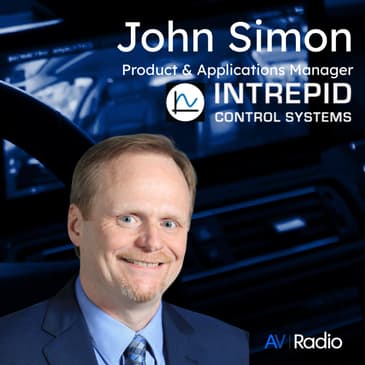
John Simon, Product and Applications Manager at Intrepid Control Systems, joins us for this episode of AutoVision News Radio. He provides insight into how automotive Ethernet is evolving and why participation in organizations like IEEE and the OPEN Alliance are pathways to success. As a co-author of Automotive Ethernet—The Definitive Guide, John shares more about his contributions to this helpful resource for industry professionals.
2024 IEEE Ethernet & IP Automotive Technology Day: https://tinyurl.com/5ay94e53
OPEN Alliance: https://opensig.org/
Automotive Ethernet—The Definitive Guide, 2nd Edition: https://amzn.to/4dBp09D
Automotive Ethernet in One Hour: https://tinyurl.com/5f7vpkwp
Understanding Media Access Control Security (MACsec) via Juniper Networks: https://tinyurl.com/466mf8rk
Definitions, Challenges & Considerations of SDVs ft. Intrepid Control Systems, Dataspeed, Keysight Technologies, and AutoVision News Radio:
- Spotify: https://tinyurl.com/2dcekyea
- Apple Podcasts: https://tinyurl.com/mr2vptvr
Follow AutoVision News Radio on LinkedIn: https://tinyurl.com/49jyrd3b
[00:00:00] Now in the middle of one of the most significant eras in automotive, Carl Anthony amplifies the minds and voices behind this historic transformation as the host of AutoVision News Radio.
[00:00:10] Mic check one two.
[00:00:11] All while coming to terms with middle age, father loss, and what it means to be successful in Detroit.
[00:00:16] We are always in a state of learning here in the automotive industry. One of the reasons why I enjoy living and working in Detroit.
[00:00:25] As a baseline for this episode of AutoVision News Radio, I went through the Automotive Ethernet in One Hour course taught by Colt Correa, Chief Operating Officer of Intrepid Control Systems.
[00:00:37] Link in the show notes to this free class on the Intrepid YouTube channel.
[00:00:41] In the class, Colt provides a brief history of Ethernet and the distinction between standard Ethernet and automotive Ethernet,
[00:00:50] while covering the differences between technologies like CAN and FlexRay.
[00:00:55] Colt's class also includes sections on switches, networking topologies, and Ethernet frames.
[00:01:01] To expand my knowledge on the topic, I spoke with John Simon, Product and Applications Manager at Intrepid Control Systems.
[00:01:09] He holds a Master's in Electrical Engineering from the University of Pittsburgh, with a career spanning over three decades in the automotive industry.
[00:01:17] John has worked at General Motors and Delphi, where he transitioned through the domains of body and security, driver information, and infotainment.
[00:01:26] He has held key roles in product engineering, sales, and leadership.
[00:01:30] In his seven-plus years at Intrepid Control Systems, John has launched numerous Automotive Ethernet products and co-authored the second edition of Automotive Ethernet, the Definitive Guide.
[00:01:41] As John explains, the most rewarding aspect of his role is educating those new to the automotive Ethernet community.
[00:01:49] To help us gain a better perspective of automotive Ethernet as a whole, John begins with a brief overview of vehicle networks, including CAN, or Controller Area Networks.
[00:02:02] Moving at the speed of mobility, this is AutoVision News Radio with Carl Anthony in Detroit, Michigan.
[00:02:08] Vehicles have had data networks in them for quite a while.
[00:02:12] A network's a network in that regard.
[00:02:14] They're very similar to the networks that you have at home and work.
[00:02:17] Fundamentally, they are moving data between two computers.
[00:02:21] The difference being in cars is they're not laptop computers.
[00:02:26] They're electronic control units for your body functions and security and your powertrain.
[00:02:33] And in years past, the dominant network was called CAN, or Controller Area Network.
[00:02:38] It was great for what it was designed for, something called signal-based messaging.
[00:02:43] And this is signals being like your wheel speed or your engine torque or your door ajar.
[00:02:50] And these pieces of information are small.
[00:02:52] They're only a few bytes, and they're just sent back and forth between the devices in the car to implement features like speed control volume or your seatbelt warning and things like that.
[00:03:04] In Colt's class, there is a slide titled, When Can, Cannot Any Longer.
[00:03:09] And the idea is that vehicles now are far more capable than 30 years ago.
[00:03:14] If we consider immersive infotainment and navigation systems, the latest powertrain and propulsion systems, and things like autonomous vehicles or V2X, there is just simply a need to transmit more data.
[00:03:28] In essence, the automotive industry needs more bandwidth.
[00:03:32] However, Ethernet has a track record of adapting to challenges like this.
[00:03:37] As John explains, a specific type of communication and connection is needed for the automotive industry beyond the signal-based messaging of CAN.
[00:03:48] Vehicles today need something called service-oriented communication.
[00:03:52] For example, when you connect your phone to your car, there's more data being transferred than on the vehicle networks.
[00:04:01] There's more data, and there's also it needs something called a stateful connection.
[00:04:06] And this means that both devices need to have an open channel of communication back and forth with each other for the system to work.
[00:04:15] And this could be, you know, searching for a contact, playing a song, or opening a call on your phone.
[00:04:22] And CAN just wasn't designed for this.
[00:04:24] It was very simple, just small pieces of information, not this stateful service-oriented communication.
[00:04:30] That was just one thing in addition to bandwidth that CAN was relatively slow.
[00:04:36] The other thing is that Ethernet has a very long history of evolving to solve new problems.
[00:04:42] So when Ethernet first arrived, it was a very simple network.
[00:04:46] It didn't have much utility beyond just moving chunks of data back and forth.
[00:04:52] And over the last 40, 50 years, protocols have been developed and fine-tuned for each new application.
[00:05:00] So to make Ethernet work with web and streaming audio and video and security.
[00:05:06] And development continues for all kinds of applications, especially in automotive.
[00:05:12] John is a contributing author to the book Automotive Ethernet, The Definitive Guide, now in its second edition.
[00:05:19] The resource book, published by Intrepid Control Systems, was written for engineers, testers, developers, technicians, device manufacturers,
[00:05:28] and college students studying for an engineering career.
[00:05:31] The authors note that due to the book's structure, it's not necessary to read the whole thing.
[00:05:37] Instead, the authors recommend that readers access the sections of the book that speak to them,
[00:05:43] as some will likely be more valuable than others, given the reader's experience, background, and career field.
[00:05:50] Think of this more as a resource book to which you can refer, as needed,
[00:05:55] rather than a book that should be read from front cover to back, the authors write.
[00:05:59] In this second edition, the main purpose of this book remains unchanged.
[00:06:04] That is to promote the understanding and use of Ethernet in automobiles and other vehicles.
[00:06:09] The book actually started when I was still working for another company, Delphi, now Aptiv.
[00:06:15] This was back around, it was published in 2014, but in that time frame,
[00:06:20] it was clear that there was an interest in bringing Ethernet into the automotive networks.
[00:06:27] And there was a gap, there's no shortage of books on Ethernet and its applications outside of automotive,
[00:06:34] but there was no reference material in the context of automotive networks.
[00:06:38] So our vice president and COO, Colt Correa, put together a team of him and three other people to fill this gap.
[00:06:46] And so it was published in 2014.
[00:06:49] Ethernet continues to evolve and evolve pretty rapidly, solving new problems every day.
[00:06:55] So when I joined Intrepid in 2017, the book was already becoming dated.
[00:07:00] My first assignments here at Intrepid was working in an area called audio-video bridging and time-sensitive networking.
[00:07:08] And this has to do with making networks work with safety and autonomous vehicles in the areas of time synchronization,
[00:07:18] making sure that communication doesn't have too much latency and it's deterministic.
[00:07:22] So I had been working in that area for a couple years, so it made sense that I jump in and help out in that section.
[00:07:31] It was about like 100 pages, which seems like a lot, but I mean, the book's 1,000 pages, so I consider myself a minor contributor.
[00:07:40] Intrepid Control Systems was founded on July 8, 1994,
[00:07:44] and has, over the years, produced advanced hardware and software tools for engineers working in the disciplines of autonomy, connectivity, and automotive Ethernet.
[00:07:55] Intrepid customers include global automakers, tier one suppliers, and even individual hobbyists.
[00:08:02] Intrepid Control Systems has offices all across the world, in China, Japan, the United Kingdom, Germany, India, and Korea.
[00:08:09] Its headquarters is located in the Detroit Metro.
[00:08:13] Intrepid focuses on network development tools for automotive, and that hasn't changed.
[00:08:18] The technology's changed behind it.
[00:08:20] So as I mentioned, CAN was the previous network.
[00:08:23] There was a number of other networks, UART, LIN, FlexRay.
[00:08:28] And so our company hasn't changed, and then we provide network development tools.
[00:08:33] We have a bunch of different hardware that's a mix of different networks in boxes because all the vehicles are different.
[00:08:42] They have a different number of networks, different type of networks, different applications.
[00:08:47] And so we provide hardware that lets our customers interface their computers or their test racks with the vehicle networks.
[00:08:56] The other side of things we do is providing software that helps people develop networks.
[00:09:03] This involves things like diagnostics, data logging, troubleshooting, software upgrades for the vehicle,
[00:09:11] and also giving them an interface that allows them to write their own applications or test applications that can communicate with the vehicle.
[00:09:21] My particular job is being a bridge between our engineers and our customers,
[00:09:28] making sure that we're focusing on things that are going to be valuable and of use to them.
[00:09:35] Another big task is staying on top of the latest Ethernet trends.
[00:09:42] So I spent a fair amount of time following IEEE, which is the Institute of Electrical and Electronics Engineers,
[00:09:48] and then also participating in something called the Open Alliance.
[00:09:53] The 2024 IEEE Ethernet and IP Automotive Technology Day will take place on October 16th and 17th at Fort Pontchartrain, Detroit, a Wyndham hotel.
[00:10:04] The event allows for manufacturers, suppliers, semiconductor vendors, tool providers, engineers, educators, and the media
[00:10:12] to share the latest ideas and implementation strategies related to automotive Ethernet systems.
[00:10:18] The Open Alliance will host an in-person members' meeting in Detroit the day before,
[00:10:24] on Tuesday, October 15th, 2024, in conjunction with the IEEE event.
[00:10:30] The Open Alliance is a non-profit, open industry alliance of mainly automotive industry and technology providers,
[00:10:37] collaborating to encourage wide-scale adoption of Ethernet-based networks as the standard in automotive networking applications.
[00:10:45] The IEEE and the Open Alliance have a strong and complementary relationship.
[00:10:51] IEEE writes specifications for how Ethernet works.
[00:10:56] So everybody's heard of 802.11 Wi-Fi.
[00:10:59] That's an IEEE standard.
[00:11:01] There are a number of 802 standards.
[00:11:03] So 802.3 defines how data is communicated on wires or cables and different speeds.
[00:11:12] And then there's 802.1, which is how local area networks work, what Ethernet switches do, time synchronization, security, all on an Ethernet link.
[00:11:24] One thing that you need to consider with the IEEE specifications is they were written for absolutely every type of Ethernet network.
[00:11:32] So residential, enterprise, industrial, aerospace, now automotive, as well as every type of application.
[00:11:41] So you have streaming audio and video.
[00:11:43] You have banking.
[00:11:44] You have Internet of Things.
[00:11:46] You have professional audio like concert, stadium concerts.
[00:11:50] So these are thousands and thousands of pages of which only a fraction apply to automotive networks.
[00:11:57] Open Alliance complements IEEE, and it's focused on automotive Ethernet interoperability.
[00:12:04] And in some cases coming up with requirements that are needed for automotive but really don't belong in an IEEE document that all these different markets and applications read.
[00:12:17] In terms of interoperability, the best analogy I can think of is when USB first came out.
[00:12:23] The name says it all, Universal Serial Bus, but it wasn't so universal.
[00:12:28] Version 1 and 2, it was way too frequent.
[00:12:31] You bought a USB device, you plugged it in, and you were disappointed.
[00:12:34] Bluetooth went through some growing pains.
[00:12:37] These things were designed to standards, but obviously there wasn't enough testing.
[00:12:42] There were ambiguities in the requirements.
[00:12:45] And so what Open is tasked with doing is coming up with ways to mitigate or avoid these type of interoperability problems.
[00:12:56] The Open Alliance was founded in 2011 to create, and I quote from the organization's website,
[00:13:03] a transparent space governed by clear rules for anyone to join and participate.
[00:13:09] The true cornerstone was the desire to break free from single company specifications.
[00:13:15] Open Alliance envisioned a world where access to these crucial specifications would not depend on favoritism.
[00:13:23] The mission of the Open Alliance is to remain steadfast in its dedication to standardizing automotive Ethernet technology,
[00:13:30] ultimately empowering the industry to address critical gaps, innovate, and thrive in an interconnected world.
[00:13:38] Part of their job is to take IEEE and other non-automotive requirements and distill them down to requirements that make sense for automotive networks,
[00:13:48] and in some cases complement those requirements to benefit automotive.
[00:13:53] So there might be some special diagnostics that don't apply outside of automotive,
[00:13:57] or some functionality that is built in to conserve energy.
[00:14:01] So they'll focus on those types of requirements.
[00:14:05] And then it also generates compliance tests and hosts things called plugfests.
[00:14:12] So plugfests is kind of an interesting event where a new technology comes out,
[00:14:17] a new version of Ethernet, and everybody comes together and plugs things in and hopes they work,
[00:14:23] or, I mean, verify that they work and work through the problems.
[00:14:27] So these type of events are very important in finding problems up front before you're designing things and trying to put them in mass production.
[00:14:37] Within the Open Alliance are a series of committees, each with a specific goal and focus.
[00:14:44] The committees have numeric names.
[00:14:46] For example, TC15 or Technical Committee 15 is called Multi-Gig Interoperability and Compliance Test,
[00:14:55] while Technical Committee 10 or TC10 is titled Automotive Ethernet Sleep Wake Up.
[00:15:02] John shared some of the work these committees have focused on, including a committee dedicated to something called MACSEC.
[00:15:09] Well, in recent years, it's been all about speed.
[00:15:12] When automotive Ethernet first came out, it was 100 megabits per second, quickly went to 1 gigabit.
[00:15:19] And in the last, you know, three to five years, it's been 2.5, 5, and 10 gigabit,
[00:15:25] as well as the desire to look at something slower, a 10 megabit version of Ethernet to support low-cost applications.
[00:15:38] There's definitely still some activity going on with these new speeds before they hit production,
[00:15:43] but the most active group right now in Open Alliance is called TC17.
[00:15:48] That stands for Technical Committee 17.
[00:15:50] And they're working on bringing something called MACSEC into the automotive networks.
[00:15:56] And so this is the lowest layer of security on Ethernet between devices.
[00:16:03] And it's not anything new.
[00:16:06] Almost everything associated with Ethernet in the vehicles has been around for years.
[00:16:12] It's been used in the IT industry for a long time, so it's mature.
[00:16:16] But TC17 is putting a lot of effort into how to best use it for automotive.
[00:16:23] So they're eliminating requirements that don't apply, making decisions that will help take cost out of the silicon that goes into the devices,
[00:16:32] that help make testing easier.
[00:16:35] One thing with the security, all types of security is there's usually some sort of key exchange.
[00:16:41] MACSEC key agreement is a protocol that's used in everything on the Internet or Ethernet.
[00:16:48] It can take seconds to actually successfully exchange keys.
[00:16:54] When you start your car, you don't want to wait seconds for your rear view backup camera to come up.
[00:17:00] So they're doing things like making changes or making assumptions in the key agreement to go from seconds down to 30 milliseconds.
[00:17:11] And then they're also doing plug fests with this, where you're bringing new hardware and new software stacks together to work out problems as a team.
[00:17:20] The term software-defined vehicle is now at the top of our automotive lexicon.
[00:17:26] Although one could argue it's a buzzword or a marketing term, there are some genuine considerations associated with software-defined cars.
[00:17:34] As outlined by Open Alliance Technical Committee 18, one such consideration is something known as remote control protocol,
[00:17:43] a lightweight communication technology meant to ease the transition towards zonal architectures.
[00:17:49] According to Technical Committee 18, the usage of remote control protocol makes it possible to shift complexity
[00:17:57] around a reduced number of centralized computing platforms, thereby reducing complexity, size, and cost on attached peripheral devices.
[00:18:07] If you're not familiar with how the networks or functions in your car work on a low level,
[00:18:13] when you open the door, that signal goes to one electronic module that's running one set of software,
[00:18:20] and then it sends a network message to another device or multiple devices saying,
[00:18:26] hey, the door's open, and then the dome lamps in the front come on, maybe the dome lamps in the back.
[00:18:32] So that's kind of where things are today with what they call a domain architecture.
[00:18:39] Things are going to what they call a zonal architecture, and you probably hear the buzzword software-defined vehicle.
[00:18:46] And one of the goals of software-defined vehicle and zonal architectures is to put as much complexity into the fewest number of modules,
[00:18:56] or ultimately one compute module.
[00:18:59] When you do this, you try and push all the software into one module,
[00:19:03] you'd almost have to connect every device, every switch, every lamp to that single module,
[00:19:10] and that doesn't seem like a very optimal solution.
[00:19:13] So what RPC, or remote control protocol, does is it's a simple protocol that's used over Ethernet to control peripherals.
[00:19:25] So now these edge nodes or these modules on the edges of the vehicle, they're just a configuration.
[00:19:32] They're looking for a message, when I get this message, turn this lamp on.
[00:19:36] When I get this message, send back outside air temperature.
[00:19:40] So that now, all the software's in one box, and it's just really communicating with these peripherals in a very simple way.
[00:19:49] John says those who wish to learn more or become involved with the Open Alliance should not let a perceived lack of experience deter them.
[00:19:58] That it's okay to just hang back and take notes and build up your skill set that way.
[00:20:03] Likewise, John encourages engineers at every stage of their career, especially younger engineers,
[00:20:10] to participate in IEEE and attend the 2024 IEEE Ethernet and IP Automotive Technology Day.
[00:20:17] If you do attend, you will have the opportunity to hear John speak and introduce yourself.
[00:20:23] Once your company is an adopter, any number of employees have access to the website, to the specifications,
[00:20:31] to the calendar of all the technical committees up to now TC18.
[00:20:38] And so you can participate in the meetings.
[00:20:41] You can look at past meeting notes and past presentations.
[00:20:44] You don't need to be an expert to participate.
[00:20:47] In fact, it's a great opportunity to learn.
[00:20:50] So a lot of these meetings, there's a lot of experts, a lot of decision makers,
[00:20:55] and you can just be a fly on the wall and you can learn a lot.
[00:20:59] Another organization that's good to follow is IEEE.
[00:21:03] So you can join this on an individual basis, but all these specifications for the 802.1 and 802.3,
[00:21:10] all of those are free to openly join.
[00:21:13] Just go to the IEEE website and you can find out what activity, what's going on in different areas of wired Ethernet.
[00:21:22] There's also some good events to attend.
[00:21:24] IEEE sponsors an automotive Ethernet tech day in a different city each year.
[00:21:29] This year, it's hosted by Ford in Detroit this October.
[00:21:33] So there's two days of presentations.
[00:21:35] You get to meet a lot of people that all share the same interests.
[00:21:39] I'll be giving this talk on a MaxSec and I'll be sitting on a discussion panel about the future of automotive Ethernet.
[00:21:47] I'm really looking forward to it.
[00:21:49] There's also something called Automotive Ethernet Congress.
[00:21:52] It's held in the same city every year, Munich, usually in the first quarter.
[00:21:57] The events are somewhat similar, but quite honestly, technology moves at a pace that it's not really too much overlap.
[00:22:05] There's usually not too much difficulty finding fresh topics every six months.
[00:22:09] See the links in the description to learn more about the 2024 IEEE Ethernet and IP Automotive Technology Day and the Open Alliance.
[00:22:18] Links in the description as well to Automotive Ethernet, the definitive guide, and Automotive Ethernet in one hour taught by Colt Correa.
[00:22:26] AutoVision News Radio is available on the digital antennas of Spotify, Apple Podcasts, iHeart, and more.
[00:22:33] In Detroit, alongside John Simon, I'm Carl Anthony, AutoVision News Radio.
[00:22:39] Amazon anonymization says to all visitors the popular electrodes in between
[00:22:39] And they're connected to credit or contests here to the maintenance of the Science Projects.
[00:22:39] These days you have seen it clearly under gefilm Dietmp winds.
[00:22:39] So it's going to be on-line for a continuation of virtual outset.