
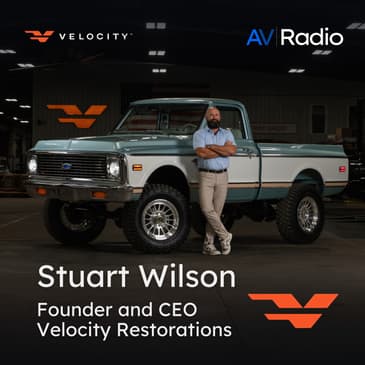
For U.S. Navy veteran Stuart Wilson, a difficult restoration project led him to create the process and client experience he wished existed in the first place. What began as a small garage operation, shaped by the problems Stuart ran into restoring his own Bronco, became Velocity Restorations, a company now operating from a 135,000-square-foot facility in Florida, building what's known as Re-Engineered Classics.
AutoVision News Radio host Carl Anthony met with Stuart at The Henry, Autograph Collection in Dearborn, Michigan, where the two sat inside his personal truck, a Founder's Series International Scout, to talk shop. The two discuss the difference between a restomod and a Re-Engineered Classic, how the buyer base continues to evolve, and why Velocity-built vehicles are meant to be driven, enjoyed, and even passed down.
More Resources:
Velocity Restorations Official Site: https://www.velocityrestorations.com/
Velocity Restorations Instagram: https://www.instagram.com/velocityrestorations/
Square Body Trucks: Complete Guide to the 1973–1987 GM Generation via Velocity Restorations: https://tinyurl.com/yc8ytp6c
Hagerty Study Finds Gen Z Loves Driving, Gravitating Towards Collector Cars via AV Radio: https://tinyurl.com/29t39cha
Follow AV Radio on LinkedIn: https://tinyurl.com/49jyrd3b
AV Radio is a Detroit Deep Media Production: https://detroitdeepmedia.com/
[00:00:00] Michigan made, Iowa inspired, streaming worldwide. Automotive knowledge for the deciders, the drivers, and the dreamers. AutoVision News Radio with Carl Anthony in the Motor City. Well, it was in the spring of 2008 when a younger version of the voice you hear now pulled out of Wyman's Ford in Atlantic, Iowa.
[00:00:21] The proud owner of a 2005 Ford Ranger FX4 Level 2, complete with BF Goodrich tires, a 4-liter V6, and an MP3-capable CD player. Like many from the Hawkeye State, I grew up with an affinity for trucks of all shapes and sizes.
[00:00:41] Yes, Ford was always at the top of my list, but I adored the Silverados of the 1990s, and preferred, much to the mystery of many of my high school friends, the Dodge Ram to the Dodge Viper. Suffice it to say, we all have that one vehicle, one we recall across a great spectrum. Everything from fond memories to being the inspiration for our automotive careers.
[00:01:06] Maybe it was the family hauler your parents drove, the rugged pickup your grandfather turned wrenches on, or the sleek sports car your eccentric aunt and uncle cruised around in. Maybe it was something you saw on TV, in a magazine, at a show. Maybe you've been lucky enough to own it, or maybe you aspire to one day. Whatever the case, we all have that one vehicle.
[00:01:32] For U.S. Navy veteran and Velocity Restorations' founder and CEO Stuart Wilson, it was a first-generation Ford Bronco. What started as a personal passion project has grown into one of the nation's leading bespoke builders of classic vehicles. Today, Velocity operates from a 135,000-square-foot facility in Florida,
[00:01:53] where more than 170 specialists hand-build iconic trucks and SUVs that preserve the soul of the originals while delivering a modern driving experience. Working on his first Bronco, Stuart realized that while enthusiasts love the character of vintage vehicles, they also wanted the reliability, comfort, and performance that modern engineering and design provide.
[00:02:17] It is through Stuart's work that a new category of vehicles has emerged, known as the re-engineered classic category. I had the opportunity to meet Stuart during his visit to Dearborn, Michigan, where he shared the story behind Velocity Restorations. It's also fair to say we had another guest on the recording with us, the subtle perk of a GM 6.2-liter V8.
[00:02:42] Moving at the speed of mobility, this is AutoVision News Radio with Carl Anthony in Detroit, Michigan. Velocity is a luxury lifestyle brand that's rooted in iconic American vehicles. We tailor these vehicles to each individual client, focus on the highest level of craftsmanship and materials that we can use, and we build cars that are meant to be driven, they're meant to be enjoyed, and they're built to be passed on to future generations.
[00:03:08] Velocity wasn't always that. It started with me buying a Ford Bronco, getting it home, and it was a non-restored truck and had multiple oil leaks. It didn't run well, couldn't keep it driving sort of on the road, and I sort of started off into, well, I'm just going to get the engine rebuilt, and then it moved into the transmission and other components. So for me, the driving experience wasn't great. Then once I got into a couple different restoration shops, I realized nobody really did everything.
[00:03:35] So I had the engine in this shop, transmission in one shop, body in another shop, the chassis in another shop, and then that experience was horrible. So finally got the vehicle all back together in tight times after getting out of the Navy and some other choices that I made. But at the end of the day, I had to sell that Bronco. I used that money to purchase another one, and I flipped that Bronco. And so we sort of just started on this buying and selling. It moved into people contacting me for restorations.
[00:04:03] We grew this network of buyers that wanted the products that I designed ultimately, but I still didn't have this great build process like an OEM might have. And so the journey for that client was, reminded me sort of my journey. It was over budget, over time frame, parts weren't available or delayed. They had too many choices to make, and so they couldn't make any choices. Builds were delayed. And so ultimately when they got the finished product, they were extremely happy.
[00:04:31] But the process of ownership getting there was miserable for them. And so that sort of took us from 2011 to about 2019. And then I said, hey, I'm going to take all the most requested options that we have, and I'm going to spec build a truck. And so I spec built this first truck. Client bought it. He picked just the paint color, black paint, brown leather. And when he got that first truck, number one, he got it in six weeks. He was super happy, and he said this is the best custom vehicle I've ever owned.
[00:05:00] And for me, it wasn't custom at all because all he chose was paint and leather. But for him, because he got to choose that, it was custom to him. And so that sort of clicked in my brain. And so we did some spec builds from 2019, 2020, while we were still doing all the custom work. Ultimately, we started contracting several of these builds because they're set price, set time frame, and you knew when you were going to get the car and how much they were going to cost. So that sort of moved into, hey, I need a bigger facility.
[00:05:25] I only had about 18,000 square feet at that time, and I bought 135,000 square foot facility. And we moved in in July of 2021 with one assembly line established in this massive building. And I was like, oh my gosh, what am I going to do? I need to lease out half this building, and I'm not sure what to do with it. I don't know if I can afford it. And ultimately, we sold a lot of cars in 21 and 22. By the end of 22, we had two assembly lines, each building a Bronco a week. So we were on pace to build about 100 trucks. Clients were happy. Contracts were coming in.
[00:05:55] And then the client was so happy and loved the experience. They wanted another product, but they didn't want another Bronco. I didn't want to bring those people back into the custom world that I had sort of pushed myself out of because it was so difficult. So then since 2022 to today, we've now developed 10 different models of vehicles from that 60s to 80s era of mostly trucks, some Mustangs as well. And we built on four assembly lines, and we're building about 150 cars a year.
[00:06:23] We've got about 170 employees building those cars today. Stuart, what are we sitting in right now? Tell us about – this is a Scout, right? And I see a Founder Series badge. So tell us about what we're sitting in right now. Yeah, so this is a 71 International Scout. We start with the original vehicle. And in the Velocity model lineup, we have the 9 or 10 models. But then within each model, we have different trim levels.
[00:06:47] So we have the Signature Series, which is Entry, and then Heritage, which has some of our custom components on it that we've designed. Then you have the Founder Series. This is Founder Series. This truck's actually pretty special. This is my personal truck. But ultimately, the Founder Series was designed because as the company scaled, I couldn't be involved with speccing every vehicle anymore and designing every vehicle. And so I started sort of losing touch with the clients and with the build process, and that was the part I really loved about it.
[00:07:14] And so I created the Founder Series for buyers that had already owned two prior Velocity vehicles. And I invite them into the Founder's Club. And that's where I get to sit down with them. I get to understand their story. How did they get where they're at today to buy – this is a $600,000 truck, right? How did you get here? What did you do? What lessons did you learn along the way? Here's how I got here. These are the lessons I've learned. How are you going to use this vehicle? Who in your family is going to use it? What design aspects do you want?
[00:07:43] And then I leave that sit down, and I go design a vehicle for them. We go back and forth with the rendering process. Finally, they lock in that spec. And these are one-off vehicles. The wheels that are on this truck, I custom designed these wheels. Another set of these will never be designed. The bumpers, the lights. There's several just one-off components that are built for that Founder to have the most exclusive, highest trim level of a Velocity built. Right. And so, Stuart, walk me through now.
[00:08:12] Let's say that I come to Velocity. What's the process like if I'm a potential customer? Maybe I have an idea of what I want. Maybe I don't know what I want. Maybe I just saw the website, and I thought, wow, there's a lot of cool vehicles here. Walk me through the process of working with you. Yeah, so we sort of have two different avenues of the buy process. Number one, we're in Pensacola, Florida. It's not the metropolis of the country, and it's not the easiest to get to through airports and things. So really, we only meet about 10% of our clients. So about 90% are purchased online. Okay.
[00:08:42] Come through the website organically. And they, for the most part, they understand which model they want. They have an affinity to it as a child growing up. Dad had one. Wife wants something. You know, if the kids are involved, they want a backseat. They don't want a bench seat truck. So they already have a pretty good understanding of what they want. And so when they make that initial contact, we understand the same thing. Who's going to drive it? How do they use it? Where is it being transported to? And what's your timeframe?
[00:09:09] And so we see about 30% of our clients where they still want to get in, and they want to touch the samples. They want to feel everything. They want to make all those choices in the build process. And that's great. It takes about 60, 90 days to sort of lay all that out. And then it takes us about four months to build those trucks. Then the other side of it is about 60, 70% of our clients buy straight off our showroom.
[00:09:32] So we take historical numbers of colors and options and say, okay, hey, we're going to build three Brittany Blue Broncos with Hickory interior, diamond, with these up fit or these refit options on it. And we put them in a showroom and they always sell because ultimately some people just want it that weekend. And they need it for a birthday. And they need it for a holiday. And so they know they want blue, but they're okay that you spec it the way they want it. So that's sort of the two different buy options that we have. Right. Right.
[00:10:01] What defines a resto mod? What is meant by that term? Yeah. So we sort of see a couple different levels, right? You have the vehicle that I bought originally, which is like an original vehicle that some guy in his garage has tinkered with. Then you have what is sort of at Barrett Jackson and what you see on these auctions where there's some lower level builders there that are doing fuel injection. You've got a lot of guys that are still building that home and running them through the auction. No warranty.
[00:10:30] No client experience. No quality process. No engineers behind it. Then you have rest of mod. And rest of mod is really where most of the competitive landscape builders sort of play in. And it's similar, but they have a little bit of client experience behind them. There's actually a company there that if you have a problem, you can go back to a company. But the vehicles all have modern drivetrains, modern engines, fuel systems.
[00:10:58] You know, this car has wireless phone chargers, power windows, air conditioning, things like that. So that's rest of mod. Then we have really defined, and you're starting to see other people use this term now, re-engineered, where we are not utilizing parts off the shelf from the aftermarket supply chain. Those products are not designed with near as many R&D hours and dollars thrown behind them as like an OEM product.
[00:11:24] So when we say re-engineered, we are trying to use as many OEM components from late model vehicles into our builds so that these builds are serviceable and they have the longevity of an OEM vehicle. And so we're re-engineering them to be outfitted like an OEM vehicle. And there's limitations to that, obviously, but that is how we're going about the process compared to most of the competition. Sure.
[00:11:49] On your website, Stuart, on the homepage, there's a beautiful picture there of your factory, of your facility. And I know we touched on this a little bit, but tell us a little bit more about the factory. Yeah, so 135,000 square feet, about 170, 175 employees, depends on the day, a little bit there. But if you can imagine one big, and this factory is actually cool, it's from the 60s. It was a plywood factory at one point. It has a rail spur that comes into the factory.
[00:12:16] It also re-manufactured military planes at one point. So this is a heavy industrial, 300 people, 400 people have worked here. Big, long factory. And when you look at the factory, there's four assembly lines. And those assembly lines have roughly 12 stations per assembly line. Now, the vehicle starts in station one on a Monday. It goes through the metal fab department. Station two is exhaust roll cage and bumpers. And then it goes off into the paint shop. And paint shop is station three, where the body work is done.
[00:12:45] Station four is paint. And then it starts in the actual mechanical assembly process, where chassis, engine, drivetrain is assembled. Then electrical goes in. Then we press up the air conditioning, the fuel system, the coolant system, make sure there's no leaks, make sure it's running. Then the body is assembled with the interior. It goes off to test and tune, through QC, off to detail, and then it ships. And so that's sort of like this long process.
[00:13:10] The techs work in the same station every day, so they become really efficient and really good at what they do. Competition doesn't have assembly line process. They don't have the QC checks and engineering behind it. And that person might build a Bronco, and then next week they're building a K5 because they don't sell 100 Broncos a year. So they can't have that repetitive work where you pick up quality and efficiency. Right.
[00:13:37] That very first Bronco, what was it like the day that you got it when you were driving it? Did you ever have any idea that it would inspire all of this? Yeah. So interesting, and I've got a lot of friends that are in this space, and they grew up loving cars, and they were the gearhead. They could work on anything. They could fix anything. I wasn't that guy. I was mowing yards at 12 years old, and I could keep my lawnmower going and my weed eater going. But I wasn't working on cars.
[00:14:02] I remember some of these cars growing up, but I didn't have this huge affinity to them, right? And so my buddy, I own that piece of hunting property, and my buddy hit me up and said, hey, I found a toy for you. I know you're looking for like a weekend sort of cruiser. It's a Bronco. I went, loved it, drove it. It was fun, top off, windows down, blaring music, just sort of having fun, right? And my wife and I would drive in it, and it was a cool experience. But then almost the journey of it through the restoration process really soured that and ruined it.
[00:14:30] And so once I went about it as a business, I didn't get into it as a gearhead that I wanted to turn wrenches. I got into it as how do I make this experience better for somebody? How do I solve this industry problem of people like there's so many shops that take deposits and never build the cars, and they take your money, and two years later you still don't have the car, and you get no client experience, and you have no warranty behind it. How do I solve that problem?
[00:14:56] Once I started solving those problems, and then I fell in love with the vehicles during that design process and the driving of it. You know, it wasn't this truck, but I took my K5 Blazer on a 3,000-mile road trip in five days. That was fun. That was cool. I fell in love with that experience after I solved the other problems. Right. Stuart, you may have heard this before, this idea that maybe young people aren't interested in cars. You sometimes hear that narrative.
[00:15:23] So when I started the company in 2012, I would say, using general terms here, but I would say that our buyers were 55 to 65. Sure, sure. Today we had a message come in on Instagram. Hey, I want to buy this car. Send me the deposit link. Paid the deposit. Contract signed from a 29-year-old. Right. Date of birth. Not even 29. I'm sorry. Date of birth, 1999. So 27 years old. Sure, sure. That didn't happen 12 years ago. Right.
[00:15:51] That is a generational shift of money. And this is vintage. This is cool. I want to be part of this. This isn't plastic. This isn't, you know, fake. I want that experience that I never had. Or they want to be part of what their dad or grandpa or something like that had. And they want to have that time. But average buyer now is probably around 44 years old for us. But that shift is incredible. And do you find, Stuart, that these buyers, are they taking these vehicles to shows, to display? Are they really driving them?
[00:16:20] We have a few buyers that take them to shows. Sure. You know, like we really sell the lifestyle experience. The kids in the backseat getting ice cream. You know, having fun. The kids in the backseat with the surfboards. You know, I saw one. I was out in the Hamptons this past summer. And I was in Montauk. And like, I saw one of our trucks and I chased it down. The woman gets out. Bathe in suit. Board shorts. Kid crawls out of the back. Surfboard's on. Truck's full of sand. Yeah. She's just out driving a truck. Just loving it. She just pulled up on the dunes, went surfing, came back.
[00:16:49] They were hitting lunch. It's their life, right? And like, that's what we enjoy seeing. And the trucks are meant to be enjoyed and driven and passed on. We hone in on that. You can take them to a car store. I mean, this thing's beautiful, right? Yeah. But we want you to drive it. We don't want to see the car three years from now with 200 miles on it. We want it with 5,000 miles on it. We want to know you drove it. Yeah. You mentioned a second ago that when you're with some of your customers, you ask them about the key learnings that they have or the key lessons that they've learned over the years.
[00:17:19] What about for you, Stuart? In this journey you've had with Velocity Restorations, what are some key learnings and some key insights? Yeah. I think, you know, really going back to number one, my mom was like the hardest working person I've still probably ever met today. She's still working woman, you know, homeschooled, cooked meals, did her side business till 2am, got up and did it all over again. Right. So I learned how to just work hard from, from my mother. When I got into the Navy, I learned to push the limits of like what hard really meant. Right. Like, sure.
[00:17:49] I had one experience in Navy. I was up almost a hundred hours because the ship was broken. And so when you apply that into business, that number one, there's always a way to win. You, you never stop. You always find a way to win. It may not be what you expected, but you always find a win in it. And I just always did that. And we always came up across hard times, hard things that most people would have caved business would have stopped. And we just pushed forward. And I have a group of guys that have been with me, you know, eight to 10 years now. I've got one guy's been with me 11 years and they've been through that.
[00:18:18] And they just sort of came up in the Velocity way. And there's a big difference in that way. At the end of the day, chase your dreams. Don't stop. There's always a way to win. Just keep going. See the links in the show notes for more information on Velocity Restorations. AutoVision News Radio is a Detroit Deep Media production available on all major podcast platforms. From the Henry in Dearborn, Michigan, alongside Stuart Wilson, I'm Carl Anthony, Auto Vision News Radio.