
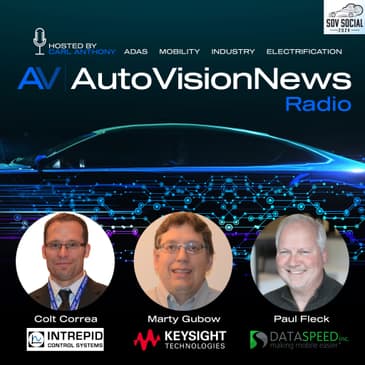
On Wednesday, May 8th, AutoVision News Radio host Carl Anthony moderated a panel session on software-defined vehicles as part of SDV Social 2024 organized by Intrepid Control Systems. Carl was joined by three respected panelists: Colt Correa, Chief Operating Officer of Intrepid Control Systems; Paul Fleck, founder and CEO of Dataspeed; and Marty Gubow, Product Manager at Keysight Technologies.
The panel discussion delved into crucial aspects that set software-defined vehicles apart from traditional ones, the necessary adaptations for electronic architectures, and Detroit's pivotal role as the automotive industry transitions to a software-defined model.
Join us for a rebroadcast of this previously live panel discussion from the Intrepid Control Systems headquarters in Troy, Michigan.
More Resources
Automotive Ethernet - The Definitive Guide: https://amzn.to/3V7uW4c
The Software-Defined Future of Automotive ft. Volvo Group, Ford of Europe, and AutoVision News Radio via Reuters Events
- Spotify: https://tinyurl.com/4z26vvfj
- Apple Podcasts: https://tinyurl.com/w5yvjkxv
Connected Car Study Reveals Features Buyers Will Trade Personal Data For
- Spotify: https://tinyurl.com/b79vxhwx
- Apple Podcasts: https://tinyurl.com/2kwc4rhs
How Can SDVs Put Automotive Suppliers Back In The Driving Seat via Randstad Digital: https://tinyurl.com/2k5wkary
Follow AutoVision News on LinkedIn: https://tinyurl.com/49jyrd3b
[00:00:00] Now in the middle of one of the most significant eras in automotive, Carl Anthony amplifies the minds and voices behind this historic transformation as the host of AutoVision News Radio, all while coming to terms with middle age, father loss and what it means to be successful in Detroit.
[00:00:18] Software-defined vehicles or SDVs have become the term that we see and hear everywhere in the automotive industry. And perhaps it's because the trajectory of software-defined vehicles seems undeniable. By 2027 there will be approximately 367 million software-defined vehicles worldwide.
[00:00:39] SDV sales are expected to increase by 20 million over the next five years. And by 2032, the global software-defined vehicle market is expected to reach 211 billion. On Wednesday, May 8th, I moderated a panel session on software-defined vehicles as part of SDV Social 2024, an event organized by Intrepid Control Systems.
[00:01:03] After a behind the scenes tour of the Intrepid headquarters in Troy, Michigan and after seeing some cool demos, our panel session kicked off. The goal of the panel, as part of SDV Social 2024, was to examine software-defined
[00:01:18] vehicles to a further degree and what this transformation means for you, for me and for this industry that we make our livelihoods in. I was joined by three distinguished panelists, Colt Correa, Chief Operating Officer of Intrepid
[00:01:33] Control Systems, Paul Fleck, founder and CEO of DataSpeed and Marty Gubow, Product Manager at Keysight Technologies. By way of introduction, Colt has 25 years of experience working on software and electronics hardware with numerous types of vehicle networks and holds six U.S. patents.
[00:01:54] Colt is the author of a leading book in his field now in its second edition titled Automotive Ethernet, The Definitive Guide. Paul started DataSpeed in 2009, initially to provide engineering services in a variety of areas but later zeroed in on autonomous vehicles.
[00:02:12] One of Paul's most notable achievements has been the development of DataSpeed's Drive-by-Wire Kit, in addition to customized autonomy software, full system integration and cloud connectivity. To date, over 500 vehicles in the autonomous vehicle industry feature DataSpeed's Drive-by-Wire
[00:02:30] Kit and Marty holds a Bachelor of Science degree in Electrical Engineering from Lawrence Tech and a Master of Science in Engineering Science from Renzalier Polytechnic Institute. He is currently the TSN Program Manager with the Network Test Segment and is responsible for the strategy of Keysight's TSN products.
[00:02:50] The first voice you hear will be Colt's, followed by Paul and Marty. Join me now for a replay of our panel discussion as part of SDV Social 2024, organized by Intrepid Control Systems. Moving at speed of mobility, this is AutoVision News Radio with Karl Antony in Detroit, Michigan.
[00:03:09] So I think you had a good introduction there to define software-defined vehicle, but for me, first of all, software-defined vehicle means a lot of different things to different people. It's a marketing term, so depending upon where you're coming from it means different things.
[00:03:23] But in general, for me as part of the electronics industry, it's just the next progression of what's been happening for the last 30 years. We see traditionally vehicles being a mechanical piece of machinery, a little bit of electronics to do some fuel control, spark control.
[00:03:39] And then now we've developed into hundreds of ECUs inside of vehicles and the software inside of the vehicle becomes more of a distinguishing factor as far as DNA goes. That's been happening for the last 30 years as a progression.
[00:03:53] And SDV is the next step beyond that, just the next progression where essentially it's become more of a marketing term than anything else because companies want to have so much software involved in the vehicle that they can allow after-sale revenue from the vehicle.
[00:04:12] So it's like we hear the term mobile phones that are on four wheels. So that's really kind of the push for features. The next ability to generate more revenue for automobile companies is to generate revenue after the sale.
[00:04:27] So we see that already with Tesla, with Supercruise where there's subscription models. So the more automotive companies can be successful in generating revenue after the sale of the vehicle, the more profitable that they'll be. And that's the big push towards SDV technologies. Cole, thank you.
[00:04:45] Paul, same question to you. How do we define the term software-defined vehicles? What makes them different from traditional vehicles? I think if you go back to automotive electronics way back when, before they had processors,
[00:04:58] you started out, you had electronics and cars and then the introduction of the microprocessor. So the automotive companies had to start hiring coders, right? They called them coders back then. Now they're software engineers.
[00:05:12] But back then the product was like the ECU and then software was just kind of a part of the product that went inside that ECU. But the software was the enabler to sell the piece of hardware. They wanted to sell that piece of hardware.
[00:05:27] So nowadays I think what you're transitioning to is the hardware becomes ubiquitous, right? The zone controllers and things like that. And the differentiator to the end user, the customer, is the experience that they'll get through the piece of software.
[00:05:43] So you have multiple different companies that are trying to create a user experience through software where the embodiment is in hardware but really it's the differentiator is in the software. Marty, same question to you my friend. How do we define the term software defined vehicles?
[00:06:01] What makes them different than traditional vehicles? You know when I first heard this term software defined vehicles, I thought back to the early days of microcontrollers and cars. And I thought back, but even in the very early days we had calibration values,
[00:06:17] we could change the options in some of the experience by the user by just reprogramming back then it was eProms that removed the flash. So software has always been a very big part of the configuration of what's in the vehicle.
[00:06:35] But I think what we really mean by the term software defined vehicles today is what is the software is defining the product differentiation that you have in your vehicle. So if vehicle companies saw no differentiation in engines or transmissions or battery packs
[00:06:57] or motors, they would just buy them on the outside. But when a vehicle company tries to make itself different, it has to find what are the things that make my vehicle different from somebody else's and what's going to make them by my vehicle?
[00:07:13] And I think there's an awareness now that the software experience in the vehicle is really the defining factor of what people buy. People are going to go to the showroom because they have a certain operating system or they have a certain carplay and so forth.
[00:07:28] So I think in the auto companies are really realizing this, that this is a huge differentiator. They have to treat software like it's an engine, a transmission, a core element of the vehicle. And you see that today because you see companies moving away from standards like carplay
[00:07:44] and Android Auto because they want to differentiate themselves and make themselves truly different. To me, that's really what people feel like software defined vehicles are. Now that we have this framework laid, this foundation laid, what are the adaptations
[00:08:02] that must be made to the electronics and the electronic architectures of a vehicle that's made to effectively transition to a software defined model? Colt, we're back to you. I think it's sort of like a progression.
[00:08:17] We've had a lot of electronic content being added to the vehicle over the last 30 years and the architecture inside for electronics engineers is called domain based architecture. That means you have a specific set of hardware and software dedicated to like powertrain engines or propulsion system or brakes.
[00:08:36] The new paradigm as we're moving forward, the real software defined vehicle is to combine all the intelligence from let's say 100 different ECUs in the vehicle into as much as possible into a single piece of computing power which is like a super brain.
[00:08:52] And that gives you the ability to control all the software, the OEM, the ability to control all the software downloaded into a single ECU and then the mechanical parts that actually control the vehicle, the actuators and sensors then become sort of dumb, remote controlled devices.
[00:09:10] So the architecture change that we're seeing is from what we call traditional domain based architecture where you have a network that's designed for ECUs and software designed for a particular purpose, a particular domain like powertrain brakes, HVAC, lighting, cooling,
[00:09:27] these kind of things to a central processing unit that performs multifunctions and then you remotely control the actuators and sensors over the network. So we see the network becoming more important and just the centralization of electronic
[00:09:43] controller units of many different units into as much as possible a single one inside the vehicle. Thank you, Cole. Paul will jump over to you. Just a refresher on the question, what adaptations must be made to the electronics and the electronic
[00:09:58] architectures of a vehicle to effectively transition to a software defined model? As you consolidate functions into maybe less ECUs but with more capability, the processing power has to dramatically increase as well as the amount of nonvolatile memory. You need that just to contain the large program sets.
[00:10:23] You're networking, you've got to go with a higher speed networks because of the amount of data that you're going to be moving around in real time. You also have to really pay attention to some form of cybersecurity layer to ensure
[00:10:36] that people with nefarious intent don't inject something into the ECUs especially doing it through the delivery of a lot of these software features is going to be over the air updates. So that network controller, wireless controller that brings that data and you really have
[00:10:57] to protect that coming in so that you don't get code in there that shouldn't be operating in your vehicle. Yeah, the one thing that I think of is in the original days of the ECU in memory,
[00:11:09] we would have an operating system running on the controller and we call that bare metal. It would be one operating system, it could even be a custom very simple operating system talking right to the sensors, right to the hardware.
[00:11:22] Today when we want software defined vehicles, we want the ability to be able to add functionality so we have to have a much more advanced architecture. So what we do is we tend to take different functions and put them in software elements
[00:11:37] like containers or virtual machines so that we can isolate one function or a new software program that I download or a new functionality I have. You can't have all of these different programs trying to talk to the hardware all the time
[00:11:53] so you have to have some driver level, you have to have containers that allow one program that be isolated from another program so that it can't corrupt its memory space for security and as you add this complexity with containers and virtual machines that
[00:12:09] drives a lot more processing power because there's a lot more overhead in those layers and it also drives a lot more communication among systems. So software architecture has to change if we want to allow dynamic virtual programs
[00:12:26] to be installed at the whim of the customer because we wanted to be customized, we wanted to be the mobile phone on wheels and be able to load my apps and so forth. So a lot of software behind making that all happen. Marty, that's excellent. Thank you, Colt.
[00:12:42] We'll come back to you for this next question. So everything we've been talking about here, let's just take it one step further. How will these adaptations and changes impact the automotive electronics industry and ECU manufacturers in Michigan and even globally?
[00:12:59] So first, I think there is no such thing as a Michigan automotive industry anymore. It's very global. Everything is connected. Almost every manufacturer and even including Intrepid Control Systems as a tools company, we're global. It's all connected together.
[00:13:14] So I don't think there is any such thing as localized industry anymore, number one. And then secondly, there's going to be a lot of consolidation. We're moving from a situation where vehicles have hundreds of different ECUs, from dozens
[00:13:29] of different suppliers to as much as possible a single central brain. So that's going to cause a huge disruption. That's number one. As far as number of suppliers, there's going to be some huge winners. In supply base, there's going to be some huge losers.
[00:13:45] And secondly, the OEMs are bringing, as you said, software defined vehicle. What does that mean? The OEMs want to control the software now whereas in the past, you've seen software being created and distributed, created by large suppliers. And they supply that to the manufacturers.
[00:14:04] And now more and more of the manufacturers want to do that themselves and only take the hardware from the supply base so that they can differentiate themselves from other manufacturers. So those are the big changes that are happening right now.
[00:14:16] You know, again, if you go back into that history, the introduction or the use of electronics in the automobiles. So it used to be tier one supplier would have a feature or something they're trying to sell the OEM. Maybe it was a motor that did something.
[00:14:30] Well, you know, the OEM would have that component supplier source out their own small ECU that maybe control that function. And so that's why you'd have, you know, I don't know, 50 plus separate little ECUs inside the automobile.
[00:14:46] And then they'd be talking either maybe a CAN network or some other network or not talking on a network at all as a standalone ECU, right? So now as you get this consolidation and you have less ECUs, but the complexity of the
[00:15:00] remaining ECUs is going to go way up. And with that complexity, you know, you have to have effectively contract manufacturers that have the equipment that can process, you know, a CPU that maybe in the past might have been an 80 pin device to something that's got a thousand
[00:15:18] balls on a VGA. Your small mom and pop little contract manufacturers that there's quite a few men in Michigan supporting the industry, most of them probably won't survive. It'll go to the large, really the large contract manufacturers.
[00:15:34] So you'll see continued, I think, consolidation of the manufacturing base for that. Marty, same question here just to refresh our memory. How will these adaptations everything we've been talking about? How does that impact the automotive electronics industry and ECU manufacturers globally?
[00:15:53] I was at a, you know, a large OEM back in the very early days when we wanted to buy an ECU. We bought the ECU and the software from the same company. It was an integrated package. And it made it difficult to
[00:16:08] commoditize that ECU because everything was tied together. So as things evolved, the auto companies built their own I.O. level layers so they could try to have different suppliers, supply different hardware and then they wrote the upper level software. But that was still tied to specific architectures.
[00:16:29] It still was based on the same microprocessor technology. You could only have so much flexibility. But now that we have virtual machines that are pretty common, what you tend to do is you virtualize the hardware and that can run on a variety of different platforms.
[00:16:46] So I think you're going to start seeing software that's designed to run on multiple vehicles, just like we can take our favorite mapping program and run it on multiple handheld devices. We can run it on our car. You're going to start seeing industries would specialize in different components
[00:17:06] that get incorporated into the car and a lot of competition between these modules, these software modules that get moved around. So I think it's going to really open things up. It's going to be an interesting ride to see how when you get into your car,
[00:17:21] how you can select maybe there's a driving mode from company A or a driving mode from company B that you like better. Colt will come back to you for this one. So everything that we have been discussing.
[00:17:34] What are the primary hurdles and considerations and how can these challenges be addressed and overcome? One of the things that I like to say is kind of a joke, but if you look at a network, a traditional network architecture of a vehicle, the domain
[00:17:51] architect, you got powertrain, you got HVAC, you got lighting on and on and on. You look at the electrical schematic architecture on a high level. It's a very good representation of the internal structure of the people organization within an OEM.
[00:18:08] And often the different groups don't even talk to each other for their entire career. You know, so I see one of the challenges in this is how do we get multiple domains HVAC, lighting, so forth, infotainment to communicate
[00:18:24] in such a way that the software from those different groups within an OEM can coexist inside of an ECU. And everyone gets the resources that they want, the priority that they want, and so forth. So I see that as a big challenge.
[00:18:39] And secondly, the supply base, like Marty said, is you've had specialized ECUs from manufacturers that do one function and now they're going to have to, if they're going to survive, they're going to have to learn how to coexist with other suppliers that are competitive in the space
[00:18:56] within one ECU. I see some of the challenges, the biggest challenges of being not so much technological challenges but organizational challenges. Paul, same question here for you. Primary hurdles and considerations. How do we address and overcome these challenges? So, you know, as these systems become more complicated, right?
[00:19:17] The engineers have to continually educate themselves and stay, stay current with the technology. The other thing too is obviously stay abreast of tool developments, like what Intrepid has ongoing, right? They seem to invest a lot in their tool set to stay current because,
[00:19:36] you know, a lot of with software defined vehicles and zonal controllers and you're going to have quite a few different networks operating. So understanding networks is a very important thing. Yeah, I think, you know, the local school base, university base around,
[00:19:56] especially around Michigan here is extremely important because there's a lot more software engineers now than there are hardware engineers. It used to be we design a lot of stuff in hardware because it's the only way to get it done.
[00:20:09] Now we tend to just digitize it and we'll use it. The ESP will do it all in software because it's easier and we can get it done quicker. So we're taking advantage of the advances in technology and processing speed, but we need a lot more software engineers.
[00:20:23] And you see when you go to universities today, the number one major now is software engineering, computer science, and that's good. But there's a lot more to learn now than there was when I went to school, software is a lot more complex.
[00:20:36] There's, you know, and it's just amazing when I look at the curriculums today that a computer science student would go through versus what it was, let's just say a few years ago. And it's just amazing. They do twice the curriculum and they just do it twice as fast,
[00:20:50] but the students just pick it right up because, you know, they were born with a computer in their hand. And it's just amazing how things move much faster now in the in the computer science world. Thank you, Marty.
[00:21:01] Well said for our last question this evening, Colt will come back to you given Detroit's historic role in automotive manufacturing. How do you envision the motor city's future evolving with the widespread transformation towards software defined vehicles? I can't emphasize enough what Marty said.
[00:21:22] I mean, Detroit's success or failure in the future with vehicle technology is going to be around the engineers that we can produce, the people that want to even come here or, you know, the people that we can home grow in our universities to
[00:21:37] just be technical and always stay on the cutting edge. I mean, that has always been the case. If you look at the most successful automotive companies in the world and the suppliers supply base, the people that supply technology, the passion for technology is what's going to
[00:21:52] either make or break the future for us. Paul, same question with this conversation we're having around software defined vehicles. What do you see for the future of the motor city? Let's talk the barriers event barriers to entry to even be an automotive manufacturer, right?
[00:22:08] Basically, with the advent of, you know, the electric drive trains, it costs a lot more money or a lot less money, I should say, to create your own brand, your own vehicle brand. China has quite a few handful of electric vehicles
[00:22:26] that they'd love to ship over here to the United States. So on Silicon Valley, you have quite a few startups that were electric vehicle manufacturers. So if you look at all vehicles, including that truck outside, they all have a few things in common, right?
[00:22:41] They got a way to drive a propulsion system. They've got four wheels. They've got an interior and then they've got some form of user experience. So for Detroit to really stay relevant, right? With all these competitors out there, you've got to
[00:22:55] create enough of a differentiator and a user experience for the passenger inside the vehicle that's going to separate what you're trying to sell compared to all the other entrants that are coming into the market. You know, a software-defined vehicle where you put those
[00:23:11] features in there and that you create that user experience that somebody loves the way maybe the center console works, things of that sort, the things that customers have to interact with. That's going to probably be very important and that's going to be done through differentiation, through software.
[00:23:29] Marty, what's your take on all this? Well, I think that's our competitive advantage, at least in the Midwest or in Michigan. You know, it's not water, the nice weather we have today. I think it's the amount of engineers in the university system that we have all around us.
[00:23:46] Within five hours of Detroit, we are probably close to most of the top 25 engineering schools in the world. What's in Michigan? What's in Illinois? What's in Indiana? Even looking out over to what's in Toronto and Ontario, there's within five hours of here, we have enormous
[00:24:07] amount of engineers we're putting out every day. We can even look down south in Ohio too, even though I'm from Michigan. But there's just a huge amount of talent. You know, we have Carnegie Mellon that's just five hours away.
[00:24:21] I think the Midwest has such a resource of people and talent and the infrastructure to keep this going. And you don't find that in other parts of the country. You go to Silicon Valley, they have a lot of engineers,
[00:24:32] but they're not generating as many new engineers as we are here in the rust bout in the Midwest. So I think we're really poised, especially now as the world becomes more distributed to be much, much stronger here. Cult Korea, Paul Fleck, Marty Gubble.
[00:24:47] Let's give them a round of applause. To learn more about software-defined vehicles, see the links in the show notes. AutoVision News Radio is available on Spotify, Apple Podcast, PodBeam and more. In Troy, Michigan from the Intrepid Control Systems headquarters alongside Cult Korea, Paul Fleck and Marty Gubble.
[00:25:09] I'm Carl Anthony, AutoVision News Radio.