
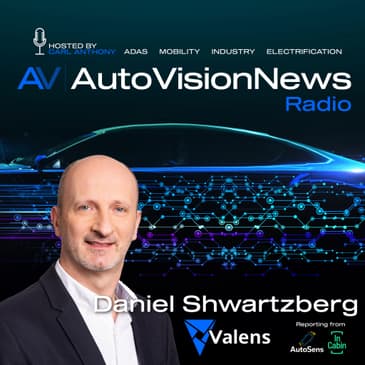
During AutoSens and InCabin USA 2024 in Detroit, Daniel Shwartzberg, Director of Business Development and System Solutions at Valens Semiconductor, joined AutoVision News Radio Host Carl Anthony for a discussion about MIPI A-PHY, the importance of that standard, and how the automotive industry can continue to leverage and embrace it.
Daniel also speaks about the A-PHY-compliant chipsets from Valens, the VA7000 Series, engineered to withstand harsh EMC and environmental interferences and cable degradation that results from age, temperature change, and physical impacts. He also shares what he loves most about his work and what legacy he hopes to leave at the end of his career.
More Resources
MIPI Alliance: https://www.mipi.org/
AutoVision News LIVE at AutoSens and InCabin USA 2024 w/ Daniel Shwartzberg of Valens: https://tinyurl.com/5n6kbcvd
Carl Anthony w/ Daniel Shwartzberg of Valens via the AutoSens & InCabin YouTube channel: https://tinyurl.com/4pe882f8
Valens Semiconductor Collaborates with Sony Semiconductor Solutions to Complete EMC Testing of an Interoperable A-PHY Chip System: https://tinyurl.com/4udcpswu
Valens Semiconductor Partners with Black Sesame Technologies to Add MIPI A-PHY Connectivity to Black Sesame's ADAS and Cross-Domain Compute Platforms: https://tinyurl.com/3zxb6xds
Follow AutoVision News on LinkedIn: https://tinyurl.com/49jyrd3b
[00:00:00] Now in the middle of one of the most significant eras in automotive, Carl Anthony amplifies the minds and voices behind this historic transformation as the host of AutoVision News Radio, all while coming to terms with middle age, father loss, and what it means to be successful in Detroit.
[00:00:17] During AutoSense and In-Cabin USA 2024 at The Huntington Place in downtown Detroit, we held our AutoVision News Live Interview Series from the exhibition floor.
[00:00:29] As part of that series, we were grateful to be able to host some of the top minds in ADAS, automated driving, AI, interior sensing and more.
[00:00:38] Among those experts was Daniel Schwartzberg, Director of Business Development and Systems Solutions at Valens Semiconductor.
[00:00:47] Daniel sat with us for a live interview for the AutoVision News LinkedIn page, but we also did a separate recording for AutoVision News Radio, which I will replay for you now.
[00:00:58] Daniel takes me through the history of MIPI-AFI, the importance of that standard and how the automotive industry can continue to leverage and embrace it.
[00:01:09] We also talk about the A-Fi compliant chipsets from Valens, the VA-7000 series engineered to withstand harsh EMC and environmental interferences, as well as cable degradation that results from age, temperature change and physical impacts.
[00:01:26] While on site at AutoSense and In-Cabin in Detroit, Daniel showed me a demo at the Valens display about how unwanted noise at a certain decibel level can jam and freeze a safety critical camera system, which we also talk about.
[00:01:41] Join me now with Daniel Schwartzberg from the exhibition floor at AutoSense and In-Cabin USA 2024.
[00:01:48] Moving at the speed of mobility, this is AutoVision News Radio with Carl Anthony in Detroit, Michigan.
[00:01:55] Daniel, let me start by saying that I really truly have the utmost respect for you.
[00:02:02] I your passion, your energy, your knowledge, your enthusiasm.
[00:02:07] You are the best spokesperson for Valens, truly.
[00:02:11] It's very kind of you to say Carl, thank you.
[00:02:13] It's mutual.
[00:02:14] I really love the work that you do and I really enjoy talking to you and sharing that passion with you.
[00:02:19] Let's begin with an overview of Valens.
[00:02:22] Tell us about the work you're doing today.
[00:02:24] Sure.
[00:02:24] So Valens is a fabulous semiconductor company producing and bringing to market high performance wired connectivity solutions, not only to the automotive industry.
[00:02:36] We actually began our journey in 2006 with a technology that was intended for the professional audio video market.
[00:02:45] We invented a technology that we called HDBaseT to allow for the convergence and extension of multiple different data types,
[00:02:53] data protocols that were prevalent in the industry, the priority industry at that time.
[00:02:57] Things like HDMI video, USB, Ethernet, controls.
[00:03:04] Even we can do power over that cable, but over a very, very much longer cable than any of those native interfaces were previously capable of doing it.
[00:03:11] We call that technology, as I said, HDBaseT.
[00:03:13] We founded the HDBaseT Alliance in conjunction with Sony Pictures, Samsung and LG.
[00:03:19] And that technology basically has become the de facto standard for the professional audio video market.
[00:03:25] We have now more than 200 members in that HDBaseT Alliance.
[00:03:30] Almost every single one of them is producing products with our chipsets in them.
[00:03:35] But around about, I would say the company's been going since 2016, so 18 years out, I would say around about 10 years ago.
[00:03:44] We were approached by a very well known OEM in the automotive market saying, we've seen what you do in audio video.
[00:03:51] You're saving a lot of cabling and solving a lot of problems for the installation of those systems.
[00:03:56] We have similar problems in the automotive world, right?
[00:03:59] We have wire harnesses that are heavy and difficult to make and expensive.
[00:04:04] And should something go wrong in the vehicle with the harness, it's basically a lost cause, right?
[00:04:10] And they said, maybe you can take that AV technology, the audio video technology, you have an adapted to suit automotive applications.
[00:04:18] And that's what we did.
[00:04:19] So we took all of the goodies that we had developed, all of the technology keystones that we had developed for audio video products and transferred it to an automotive environment and to an automotive application.
[00:04:33] And that's what we do today as well.
[00:04:35] So we basically have these two business units.
[00:04:38] My focus primarily is in the audio, in the automotive.
[00:04:42] I do have some roles in audio video, but in the automotive.
[00:04:46] So I'm busy helping customers and potential customers use our first generation of automotive technology as well as our second generation, trying to help them solve the sort of problems that they are experiencing with their systems in order to help them to get to market quicker and to be able to fulfil the needs of their system.
[00:05:06] So we are involved very much in automotive.
[00:05:10] We've had considerable success with our first generation of automotive chipset.
[00:05:14] I can tell you that we've been on the road now for, wow, three, three and a half years in Mercedes Benz vehicles.
[00:05:21] That first generation automotive chipset forms the wide connectivity backbone of their MBUX infotainment system.
[00:05:28] It began with the S-Class, but has been rolled out to C-Class, E-Class and, you know, very widely adopted in the Mercedes vehicle range.
[00:05:36] And I think that really qualifies us as a supplier, a qualified supplier to the automotive industry.
[00:05:42] Daniel, as OEMs are looking to move to higher levels of ADAS and even full automation on the road to autonomy, what key elements in the vehicle need to be addressed?
[00:05:56] So that's a really good question because I think that's really we're at that point now in the industry.
[00:06:00] We see a need to move up the, you know, the levels of ADAS until I guess the eventual Holy Grail, which is full autonomy.
[00:06:08] And I think we need to look at a number of elements.
[00:06:10] First of all, the type of and quantity of sensors that need to be put into the vehicle.
[00:06:17] And you can go to Google and you can find, you know, everyone's got their own theory on this.
[00:06:20] But as we step up the levels, we see more and more sensors going in.
[00:06:24] That's that's an unavoidable fact right now.
[00:06:27] Some OEMs maybe are trying to limit themselves to one or two types of sensors.
[00:06:30] But ultimately, we see more and more sensor types, more and more sensor quantities, volumes going into the vehicles.
[00:06:37] They can be cameras, of course, radars as well as lidars.
[00:06:41] Now, it's not only the amount of sensors that are going into the vehicles, but also the amount of bandwidth that they are generating.
[00:06:47] So we're seeing higher and higher resolution cameras.
[00:06:50] We're seeing radars with wider fields of view.
[00:06:53] We're seeing lidars as well, requiring and driving more data from the sensor itself to the ECU.
[00:07:01] So there's more sensors.
[00:07:03] There's a variety of sensors and they're all pushing out more bandwidth.
[00:07:07] So what we're seeing here is a lot of bandwidth being produced and being distributed within the vehicle.
[00:07:14] So that's one side.
[00:07:15] On the other side of it now, we've generated all this data.
[00:07:18] What do we do with it?
[00:07:19] Right. Right. So we need to process it.
[00:07:22] In the past, we've seen more than 100 ECUs, more than 110, 120 ECUs, electronic control units in high end vehicles.
[00:07:29] Each of those with their own processing elements.
[00:07:31] And that becomes impractical to maintain.
[00:07:34] That becomes unscalable.
[00:07:35] In particular, as I've mentioned, we see more and more of these systems being brought online with high bandwidth links.
[00:07:41] So there is a trend to move to centralized processing.
[00:07:44] Okay.
[00:07:45] Centralized processing means taking things away from the edge and having very high performance compute elements.
[00:07:50] Probably a few of them for some redundancy and some load sharing as the central brain of the vehicle.
[00:07:56] Right.
[00:07:56] So now I have a lot of high bandwidth data being generated.
[00:08:00] I need to process that data in centralized elements.
[00:08:04] Now, the question is how do I get the data from one side to the other?
[00:08:08] And that's where we need high bandwidth data links.
[00:08:11] Okay.
[00:08:11] Multi gig data links.
[00:08:14] Now they need to run very fast.
[00:08:17] A lot of bandwidth.
[00:08:18] They also need to have very, very low delay because a lot of these systems that are going to be pushing the data are mission critical, safety critical systems.
[00:08:26] Right.
[00:08:27] I cannot generate all this great sense of data if I then and then lose it on its way to the processing element.
[00:08:33] Right.
[00:08:33] So we have a need for high bandwidth, highly, highly reliable, low delay, low latency data links to connect all of this together.
[00:08:42] So we see changing architectures to a more centralized processing.
[00:08:47] We see more data being driven towards the center.
[00:08:49] We see a need for really, really robust data links that enable all of that to be coming together kind of the glue between the elements in the system.
[00:08:57] Of course.
[00:08:58] Daniel, we have spoken in the past before about MIPI A-PHY.
[00:09:05] Can you take us through what A-PHY is?
[00:09:08] Give us the history.
[00:09:09] Where does it come from?
[00:09:10] Absolutely.
[00:09:11] With great pleasure.
[00:09:12] You know, it's my favorite subject right now.
[00:09:15] We always talk about it.
[00:09:16] I know we do because it really is a game changer.
[00:09:18] Right.
[00:09:19] I mean, until this point in time, those high bandwidth links that we've been talking about have been based on proprietary single sourced technologies and turn the clock back just a few years to the start of the pandemic.
[00:09:33] Suddenly, the automotive industry found itself facing huge supply chain issues with semiconductors.
[00:09:39] I mean, things that were almost thought of as commodities suddenly couldn't be supplied.
[00:09:43] Right.
[00:09:44] And since that point in time, proprietary and single source are basically dirty words in the industry.
[00:09:50] Right.
[00:09:50] Everybody wants to move to a standard.
[00:09:53] So A-PHY finally brings the industry what it's been wanting, a standardized high speed SerDs link, serializer deserializer link for extending all of that sensor data I was talking about a few moments ago down to the ECUs, down to the centralized processing thing.
[00:10:09] So A-PHY is a standard and a standard means a multi vendor ecosystem of silicon providers, of product providers.
[00:10:18] And the great thing is because it's all standardized, it means that anybody who develops according to that standard is guaranteed interoperability.
[00:10:24] So I can buy systems from different players.
[00:10:26] I can buy silicon from different vendors.
[00:10:29] And I know that when I plug it together, it's just going to work.
[00:10:32] OK.
[00:10:32] So A-PHY first and foremost is a standard which moves us away from those proprietary solutions.
[00:10:39] But A-PHY is more than that, it's also a digital based technology.
[00:10:43] OK.
[00:10:44] Those proprietary single source solutions I just mentioned are kind of based on analog types of circuits.
[00:10:50] Right.
[00:10:51] They use something called forward error correction to deal with noises and the modulation scheme that is primarily NRZ, which is a two level signaling scheme.
[00:10:59] Now, the problem with those implementations are that as bandwidth needs to increase, the frequency of the data on the cable also increases.
[00:11:08] OK.
[00:11:08] And as frequency increases on a piece of copper, so the attenuation, the signal losses in that piece of copper in the cable increase.
[00:11:16] So higher frequencies means higher signal losses, which means that at the end of the link at the compute side, now I have less signal.
[00:11:24] So that means I have a worse signal to noise ratio.
[00:11:26] It means it's more difficult to recover the data at the far side.
[00:11:30] How do those types of proprietary legacy solutions overcome that?
[00:11:34] Well, they're limited in terms of the bandwidth, which means less frequency, which means less loss.
[00:11:39] They're limited in terms of the cable distances they can achieve.
[00:11:42] They're also limited in terms of the cable types.
[00:11:44] They have to work with shielded cables because shielding keeps noise outside of the cables to prevent it getting into the cable and into the system.
[00:11:53] And all of that is highly limiting in terms of the types of systems you can deploy and types of cables.
[00:11:59] You can use the lengths of the cables, the placements of the elements within the system.
[00:12:03] A-Fi is a digital, it's a DSP based technology with hardwired DSP algorithms in the silica.
[00:12:11] What that means is that we implement advanced mechanisms in dealing with noise and in keeping the frequency of the cable low to reduce the signal losses anyway.
[00:12:21] So for example, A-Fi has a just in time noise canceller specified within the standard that actually rather than trying to keep the noise out,
[00:12:31] actually receives the noise, detects that an electromagnetic noise attack has occurred and is able to within a period of time of just under one microsecond to cancel out that noise.
[00:12:43] So we have this noise canceller that switches on, cancels out the noise and it does it in a very, very short period of time.
[00:12:49] That gives us extremely robust links in terms of their resilience to electromagnetic interferences, EMI kind of noises.
[00:12:56] Now during that very short learning and training time to cancel out the noise, so we lose a few data packets.
[00:13:04] And now we have a second mechanism as part of our algorithms that are hardwired in the silicon,
[00:13:09] which is a retransmission mechanism that happens at the lowest layer in the stack, at the physical layer, meaning it's extremely, extremely quick.
[00:13:17] So what we can do is we will detect the noise loss and we can then retransmit those lost packets.
[00:13:22] And that ensures that all of the data gets across.
[00:13:25] Now, we use that retransmission also for data packets that arrive but maybe have some errors in them.
[00:13:32] And we use that basis an error correction mechanism.
[00:13:34] So that retransmission has two key functions, as I just said, but it all happens completely blind to the rest of the system.
[00:13:42] So you know what's at the application level, at the system level, what you see is a guaranteed data throughput.
[00:13:49] What you see is a fixed latency of depending upon the link speed, but it's a few microseconds.
[00:13:56] That's all a fixed latency.
[00:13:58] So as far as the system is concerned, it has no idea that there was a noise attack that just been canceled or there was some retransmission going on.
[00:14:05] The system just sees good data arriving with a fixed delay, a fixed latency.
[00:14:11] And also I should mention with an extremely, extremely low packet error rate,
[00:14:15] A-Fi specifies a bit error rate of 10 to the minus 19.
[00:14:21] Sorry, a packet error rate, not a bit error rate, end of the day.
[00:14:25] A packet error rate of 10 to the minus 19 which guarantees unrivaled resilience in terms of those electromagnetic noises.
[00:14:34] It is several orders of magnitude better than what those legacy analog based technologies can achieve.
[00:14:39] So as I say, it's a standard and you guarantee an ecosystem that is flourishing and that all knows to work seamlessly one with the other.
[00:14:47] And you're right, Daniel, it is a game changer which is why every time we have a chance to talk and do an interview, this is why we always talk about it.
[00:14:55] Absolutely.
[00:14:55] You know, this is an industry that in some cases moves fairly slowly and it moves fairly carefully,
[00:15:02] but I think suddenly changes are being imposed upon us with those sort of things that I said earlier,
[00:15:07] the increasing numbers of sensors, the increasing amounts of bandwidth and we need to suddenly make a step forward.
[00:15:13] We need to move away from those legacy solutions because simply they're not going to be able to get us to where the industry needs to go.
[00:15:19] So I think we're at a tipping point and the fact that it's also a standard is basically like a win-win.
[00:15:25] Right.
[00:15:27] The Lens has released the first A-Fi compliant chipsets that are now on the market.
[00:15:32] So we have this comprehensive overview of A-Fi technology.
[00:15:36] Let's explore some of the benefits it's going to offer OEMs now.
[00:15:40] Absolutely.
[00:15:41] So first of all, I think I've already mentioned the resilience to noise makes it a lot easier to design systems that have to pass AMC testing.
[00:15:50] And I think what A-Fi brings as well is I mentioned those other technologies use shielding.
[00:15:56] The problem is that shielding effectiveness degrades over time.
[00:16:00] This has been proven in testing.
[00:16:01] There's an IEEE study and it basically says that the shielding will go down as the cable ages.
[00:16:07] Cables age over time, cables age through heat cycles, cables age through flexing.
[00:16:13] And so what will happen is when the system is new and the cables are new and the vehicle rolls off the lot, everything looks great.
[00:16:19] The shield is great. You have perfect AMC performance.
[00:16:21] But over time, as the cable degrades and the shielding effectiveness goes down,
[00:16:25] suddenly you will lose that shielding effectiveness.
[00:16:28] And now you're opening yourself up to AMC issues on systems which could be, quite frankly, mission critical and safety critical.
[00:16:34] Front facing cameras, all these kind of systems where I need to make sure that my data is resilient.
[00:16:40] So we have these first A-Fi chipsets available on the market today that allow the OEMs to kind of put those concerns to bed
[00:16:48] and literally to bring the best performing connectivity solution to market within their vehicles.
[00:16:54] We are currently sampling and very soon will be releasing to production.
[00:16:57] Once we finished all of our qualification processes, a number of serializer and deserializer.
[00:17:03] The serializer chips, of course, sit on the sensor side.
[00:17:06] The deserializers are like the receiver that sit on the ECU side.
[00:17:10] And those will allow us to work up to eight gigabits per second, depending upon the variant of the chip.
[00:17:16] And on the deserialized side, you can have quad receivers, dual receivers with one or two outputs in the direction of the SOC.
[00:17:25] We can actually have redundancy built in at the chip level.
[00:17:28] We can do packet switching.
[00:17:29] We have a lot of capabilities within the silicon.
[00:17:32] What's really neat, actually, and I'm going to come back to this point about standardization,
[00:17:37] is anybody who has access to the standard can do their own silicon development.
[00:17:42] Now, the MIPP Alliance, I should have mentioned at the beginning, boasts some 400 member companies.
[00:17:47] So that's a very big ecosystem of players who all have access to this technology.
[00:17:51] But so good is the AFI standard that just a few weeks after the first version of the spec was launched,
[00:17:57] so the IEEE came along and of course, the IEEE is a huge standardization body as well.
[00:18:02] They came along and said, we want to adopt AFI as a standard of our own.
[00:18:05] They do that through their industry affiliate network program.
[00:18:08] So now you have the hundreds of members of the MIPP Alliance,
[00:18:10] plus also the hundreds of member companies of the IEEE all who have access to this technology.
[00:18:15] And because it's a standard, it means that integration is possible.
[00:18:18] And this is where I bring us to the recent press releases with Sony Semiconductor Solutions,
[00:18:22] maybe the number one vendor of image sensors in the world,
[00:18:27] who have already announced that they're integrating AFI into their sensors.
[00:18:30] And in fact, the most recent press release was the second round of interoperability,
[00:18:34] their prototype silicon on the transmit, our deserializer on the receive.
[00:18:38] And of course it passes, as you would expect.
[00:18:40] It's a standard. They follow the standard, we follow the standard.
[00:18:43] You've got interoperability built in.
[00:18:45] So we're bringing these first versions of chipsets.
[00:18:47] We see second sources springing up already, like I say, Sony Semiconductor Solutions.
[00:18:52] And as I say, it enables the OEMs to achieve their goals.
[00:18:55] Higher bandwidth, 15 metres of coax cables.
[00:18:59] You can route the system as you want the wiring system.
[00:19:02] You can position the sensors optimally.
[00:19:04] Our chipsets, by the way, also work up to four gigabits per second
[00:19:07] on a single unshielded cable.
[00:19:10] Now that's unheard of.
[00:19:11] I mean, SurDees that run over unshielded cable has really not been possible,
[00:19:15] at least not at multi-gig speeds.
[00:19:17] Four gig over unshielded cabling, and in particular over simple low-cost connectors,
[00:19:22] can also help to bring real cost reductions and cost savings to the industry.
[00:19:26] So it's robust data links.
[00:19:28] It's long data links.
[00:19:29] It's the use of unshielded pairs, unshielded wiring.
[00:19:34] It really ticks all of the boxes that the OEM needs,
[00:19:37] in addition to being a standard with a multi-vendor ecosystem emerging as we speak.
[00:19:43] And we're seeing products out there already.
[00:19:47] We are here at AutoSense and in-cabin USA 2024
[00:19:52] at the Huntington Place in downtown Detroit,
[00:19:54] in the heart of the Motor City.
[00:19:57] Daniel, here in the middle of the Motor City,
[00:20:00] how can the automotive industry continue to embrace A-Fi technology?
[00:20:05] Well, we see that embrace already beginning.
[00:20:08] And we don't have it on show here, but we did have it in our booth at CES.
[00:20:12] We had a snapshot of the ecosystem of products
[00:20:15] that is rapidly emerging that support this standard, right?
[00:20:19] To support the A-Fi standard.
[00:20:20] We saw an ecosystem that is wide as well as deep.
[00:20:24] And when I say wide, I mean it covers all of the various elements
[00:20:28] that a new technology needs to bring it to market,
[00:20:31] in particular in the automotive industry.
[00:20:33] So we have the silicon, we have the IP from companies like Valence.
[00:20:37] I just mentioned Sony semiconductors.
[00:20:40] We see LG Enotech in Korea,
[00:20:42] a huge company bringing system and package modules to market supporting A-Fi.
[00:20:46] And the day before CES, we announced our collaboration
[00:20:49] with Intel Foundry Services,
[00:20:51] who are true believers in the A-Fi standard
[00:20:53] and are working with us to bring our next generation of chipset,
[00:20:57] all the way up to 16 gigabits per second, to market.
[00:21:00] So we see the IP side, the silicon side,
[00:21:02] we see an ecosystem emerging there.
[00:21:04] Then we see test equipment from companies like Keysight,
[00:21:08] from companies like Avantest.
[00:21:10] We see a verification IP for the silicon development teams
[00:21:13] that comes from Cadence.
[00:21:15] So in other words, we see test equipment vendors
[00:21:17] also rushing to bring products to market.
[00:21:19] And then we have all of the sensor size,
[00:21:21] we see cameras from many, many players,
[00:21:23] Nippon Chemicon, Chemtronics in Korea, Leopard Imaging,
[00:21:27] and many, many others,
[00:21:29] platforms from companies like Mobilye,
[00:21:32] Black Sesame in China,
[00:21:34] also bringing A-Fi support to market.
[00:21:37] And then as I said, it's not just cameras.
[00:21:38] We've seen satellite radars, lean radars,
[00:21:41] where the processing is moved to the ECU,
[00:21:43] so you have much smaller, cheaper, low-power radars themselves,
[00:21:47] from companies like SRS in Korea, G-Pulse in China,
[00:21:51] and even LiDAR from a company called InnoVis,
[00:21:54] who many people probably know,
[00:21:55] who use our chipsets not to go long distances,
[00:21:58] but rather to solve a problem
[00:21:59] that the LiDAR chip is rotating in a 360 implementation,
[00:22:03] and they need to get the data from the rotating parts
[00:22:05] of the fixed SoC in the base.
[00:22:07] And there's an air gap between those two parts of the system.
[00:22:10] They needed a technology that was robust enough
[00:22:13] to cross a physical discontinuity
[00:22:15] in the channel from transmit to receive,
[00:22:17] and they told us, I said,
[00:22:18] yes, yours were the only technology that could do it.
[00:22:21] So we see that the industry is already rushing to embrace it,
[00:22:26] and I think we're just going to see that continue to grow
[00:22:28] and grow and grow as more and more vendors understand
[00:22:31] the benefits that A-Fi bring the industry
[00:22:33] and A-Fi bring to the ecosystem.
[00:22:36] Daniel, what do you enjoy most about being part of the Valens team?
[00:22:42] There are so many things, Karl, I have to tell you.
[00:22:45] It's a very dynamic company.
[00:22:48] There's something really, really fun about going into the office
[00:22:51] to know that you're working on cutting-edge technologies
[00:22:54] with really outstanding engineering teams.
[00:22:58] I mean, we have engineers...
[00:23:00] If you think I'm passionate, you should speak to those guys.
[00:23:03] I mean, it starts at the very top from our CTO,
[00:23:07] who was one of the co-founders of the company.
[00:23:09] His passion is second to none,
[00:23:11] and it filters through that passion,
[00:23:14] filters through right down into the engineering teams,
[00:23:17] into the validation teams,
[00:23:19] and even to people like me
[00:23:21] who are not directly involved in the engineering
[00:23:22] but who go out to almost be like technology evangelists,
[00:23:26] to bring the technology to market.
[00:23:28] And I think it starts from the very top
[00:23:30] with our management team,
[00:23:31] who really believe that we're onto something special
[00:23:33] in all of our product portfolios,
[00:23:35] but also in particular this MIPI-AFI offering.
[00:23:39] And yeah, it's nice to be involved in an organisation
[00:23:42] where people share that passion with you.
[00:23:44] So the days fly past, which is also nice, right?
[00:23:48] Nobody wants to go into a job where you're clock-watching
[00:23:50] and I barely have time to breathe many of the days.
[00:23:53] I'm travelling a lot and I'm meeting the customers,
[00:23:55] and I love that.
[00:23:57] I love to... Like I love speaking to you,
[00:23:59] I love to bring that technology to the market
[00:24:02] and to see the responses
[00:24:04] and to see that when I'm talking to people,
[00:24:07] they understand, they sense it.
[00:24:08] Ah, that noise-cancelling and retransmission,
[00:24:12] we had a really big problem.
[00:24:13] I think that's going to solve that problem for us.
[00:24:15] So you can see that we're reaching the pain points.
[00:24:18] And now for me, you know...
[00:24:20] My wife maybe would like me to travel a little bit less,
[00:24:22] but I think she understands the passion that I share
[00:24:25] and why it's important for me
[00:24:26] to be in front of those customers and potential partners
[00:24:29] and really share that.
[00:24:32] Daniel, with all the important work that you're doing today,
[00:24:35] what is the legacy that you would like to leave
[00:24:38] at the end of your career?
[00:24:40] Wow.
[00:24:41] So listen, I could come up probably
[00:24:42] with something really corny and say,
[00:24:44] you know, we've made the world a better place
[00:24:45] by having A-Fi, robust systems preventing accidents,
[00:24:48] but... Which is true.
[00:24:49] Which is true, it's true,
[00:24:50] but I guess that's a little bit corny, a legacy.
[00:24:54] I would like to think...
[00:24:57] I would like to think that people see me as being genuine,
[00:25:00] that I have really been able to bring something good,
[00:25:03] to be able to share some knowledge,
[00:25:06] to help people to make informed decisions
[00:25:08] about their products.
[00:25:11] You know, it's...
[00:25:13] For me, it's important that the...
[00:25:15] That people can rely on the information that I'm sharing.
[00:25:19] You know, I wouldn't call myself a great salesman,
[00:25:22] but I think I'm an evangelist of technology,
[00:25:25] and I want people to be able to learn from me
[00:25:27] and to trust what I am saying right.
[00:25:29] So if that's the legacy that they spoke to Daniel
[00:25:32] and they felt confident that what he was saying was right
[00:25:34] or, you know, was believable,
[00:25:37] then I think that's the little mark
[00:25:38] that I hope I can leave on the world.
[00:25:40] To learn more about Valens Semiconductor
[00:25:43] and the MIPI Alliance,
[00:25:44] see the links in the show notes.
[00:25:46] AutoVision News Radio is available on Spotify,
[00:25:50] Apple Podcasts, Podbean and more.
[00:25:52] From the Huntington Place in downtown Detroit
[00:25:55] at AutoSense and In-Cabin USA 2024
[00:25:59] alongside Daniel Schwartzberg,
[00:26:01] I'm Carl Anthony,
[00:26:03] AutoVision News Radio.