
In early 2025, LeddarTech and its LeddarVision perception solution were selected by a leading commercial vehicle manufacturer for model year 2028 vehicles. LeddarVision was chosen after a comprehensive evaluation by this customer, who determined its performance, scalability, and efficiency were ideal for a multi-modal sensor system with both cameras and radars.
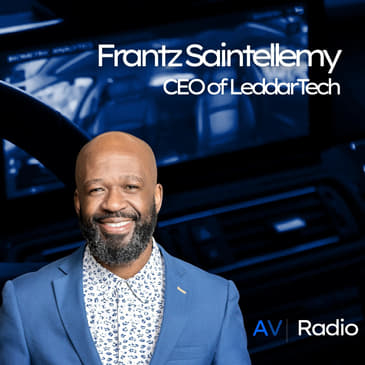
Frantz Saintellemy, President and CEO of LeddarTech, joins Carl Anthony on AutoVision News Radio to expand on this OEM design win. He shares an in-depth look at LeddarVision, how AI integration can lead to safer roads, and why democratizing safety for the masses is, and always will be, at the core of LeddarTech.
LeddarVision PDF Overview: https://tinyurl.com/6wkvm62m
LeddarVision E-Book: https://tinyurl.com/35fx4r4y
LeddarTech Announces First OEM Design Win for LeddarVision ADAS Solution: https://tinyurl.com/5n7rz7bc
Pierre Olivier, LeddarTech's Chief Technology Officer, discusses the company's low-level sensor fusion architecture at Reuters Events Automotive USA 2023: https://tinyurl.com/bdedpc7f
Follow AutoVision News Radio on LinkedIn: https://tinyurl.com/49jyrd3b
AV Radio is a Detroit Deep Media Production: https://detroitdeepmedia.com/
[00:00:00] - [Speaker 0]
Now in the middle of one of the most significant eras in automotive, Carl Anthony amplifies the minds and voices behind this historic transformation as the host of AutoVision News Radio.
[00:00:10] - [Speaker 1]
Mic check one two.
[00:00:11] - [Speaker 0]
All while coming to terms with middle age, father loss, and what it means to be successful in Detroit.
[00:00:18] - [Speaker 1]
In the nineteen nineties, my friends and I had a theory about video games. If we could play the arcade version, it would make us better at the console version. Or if nothing else, make the console variant seem more manageable even on its hardest difficulty. Which if you beat the game on the hardest setting, you usually got the best ending. And so it was with me and my friends gathered around the sticky joy pad and the glowing screen of any given game in the familiar confines of Aladdin's castle on a Saturday afternoon.
[00:00:50] - [Speaker 1]
A motley crew of high school scholars and screwballs. That was us, a basketball star, speech and quiz bowl competitors, band members, and the biggest dude on the football team. All of us convinced that higher scores in the arcade would transition to our Super Nintendo, Sega Genesis, or Sony PlayStation. While those soda and Slurpee sipping days are fond memories now, we may have had one thing bright. If you do something at its highest level in theory, it's not beyond the realm of possibility to match the output according to the use case if that use case changes.
[00:01:29] - [Speaker 1]
For example, if one of our little siblings wanted to game with us, we didn't go full arcade on them. You would dial your output accordingly without giving away the fact you were letting them win. Because the real joy was the round of celebratory high fives for a first grader who wanted to hang with us cool high school kids. That was a far different output than when we were playing amongst ourselves. And in a similar way, this is LetterTech with its letter vision technology, an advanced environmental perception solution for the automotive and mobility segments from passenger light vehicles to off road heavy industrial vehicles.
[00:02:10] - [Speaker 1]
LetterVision software provides a comprehensive environment model delivering superior perception performance from any sensor set to enable and accelerate the development of high performance solutions that are scalable from ADAS all the way to highly automated driving. Based on Lettertek's comprehensive and demonstrated raw data sensor fusion expertise, LetterVision software processes sensor data to achieve a reliable understanding of the vehicle's environment, which is required for navigation decision making. Along with its scalability from ADAS to highly automated driving, other key features of LetterVision include flexible modularity to handle a growing variety of use cases, features, and sensor sets, and centralized sensor agnostic object level fusion, which fuses all sensors for higher and more reliable performance. Among the primary goals for letter vision is safety no matter the driving occasion. Say for a family on their way to a surprise birthday party at the local arcade for their son or daughter.
[00:03:22] - [Speaker 1]
To share more on Lettervision and Lettertech as a whole is President and CEO, Franz St. Helene, an engineer, innovator, and internationally recognized expert in advanced technologies. Franz has over twenty five years of experience in the electronics and automotive sector with specialized knowledge in autonomous driving, AI, IoT, and automation applications in addition to business and product development and global sales and marketing. Throughout his career, Franz has produced numerous patents and technical innovations and founded or co founded successful startups and companies. He holds degrees in electrical engineering, business and marketing, and is a graduate of the MIT Sloan Engineering Fellows Program on Innovations and Global Leadership.
[00:04:10] - [Speaker 1]
He was appointed chancellor of the University of Montreal in October 2021. As we begin with Frans, he provides an overview of LetterTech and its focus in automotive.
[00:04:22] - [Speaker 2]
Moving at the speed of mobility, this is Autovision News Radio with Karl Anthony in Detroit, Michigan. LetterTech, we are an AI, software company for automotive. We build fusion and perception software for the vehicle to have a better understanding of of its environment to basically, our software reproduces the environment in a high resolution three d model, and that allows the vehicle to actually identify, classify, and segment objects within the scene, and then make driving decisions like predicting motion planning, but also allow the driver to understand or help the driver understand what's happening in the scene. We can also go all the way up to autonomous driving, where the only company today that has this low level fusion model. It's integrated into TI processors, NVIDIA processors, as well as ARM processors.
[00:05:24] - [Speaker 1]
Reading from the Lettertek website. Lettertek's automotive grade software technology, LetterVision, is a scalable, cost effective, sensor agnostic solution that delivers highly accurate three d environmental models. Letter vision. What is it? How does it work?
[00:05:45] - [Speaker 1]
And where can we see it in the automotive industry?
[00:05:48] - [Speaker 2]
It's sort of like you and I, Carl, looking at the road. Our eyes and and ears are senses. And our brain makes the decisions based on what we sense in this environment. So what our software allows the vehicle to do is to take pulses or inputs from cameras, from radars, from lidars or ultrasonic sensors, but also from your navigation system, your HD map, and even your vehicle dynamics. What I mean by vehicle dynamics is how is the car responding to the road?
[00:06:20] - [Speaker 2]
Is it slippery? Is it raining? Is it on on dirt, gravel? Or is it on on asphalt?
[00:06:26] - [Speaker 1]
Yeah. Yeah.
[00:06:27] - [Speaker 2]
So all of these provide cues to the state of the environment. Are you on a highway? Or you are in a very dense environment where there's a lot of vehicles, there's a lot of obstacles? So by recreating a very accurate three d model of this environment and putting all these classes of objects and obstacles into the scene, identifying them by using AI, and also make prediction based on on how fast the vehicle is driving, how fast other vehicles are also driving, whether they're moving or not, is there vulnerable road users. So all of these are interpreted by our software, and then they provide a model for the car to be able to make decisions, driving decisions.
[00:07:14] - [Speaker 2]
So that's the perception side. So we take all that software, all the inputs from cameras, radars, and all these sensors, we fuse them, recreate that environmental model, then we apply AI on top of that to derive an understanding of what's happening, and then allow the car to make driving decisions. And these driving decisions may be keep the lane. It may be keep the distance between the the vehicle that's ahead of us, you know, adaptive cruise control, for example. Or it may be for automated braking systems if you're seeing that the vehicle is gonna actually hit an obstacle and the vehicle could take over to make this braking decision.
[00:07:55] - [Speaker 2]
It could be steering as well. So any of those decisions, they're all made on the vehicle's understanding of this environment. And so this is the most sophisticated and most complex system that an ADAS or AD system will have. That fusion perception model is the key to make the safest driving decisions.
[00:08:19] - [Speaker 1]
Yeah. Excellent. And let's stay with that. Fusion and perception model and safe driving decisions. Lettertek recently announced a significant milestone.
[00:08:28] - [Speaker 1]
One of the world's leading commercial OEMs selected you as its fusion and perception software supplier for their ADAS program for twenty twenty eight model year vehicles. At the core of this is LetterVision. A multipart question here, friend. Tell us more about this OEM design win. How did it come to fruition and where does LetterVision fit in?
[00:08:53] - [Speaker 2]
Yeah. This is a we're very excited by this announcement. This is accumulation of work that's been going on for the past two years with this customer. Vehicles have to meet safety and regulatory demands across the globe. In 2022, the European Union enacted the general safety regulation, which mandates all classes of vehicles be able to identify vulnerable road users and avoid collisions with these vulnerable road users.
[00:09:27] - [Speaker 2]
Vulnerable road users are typically your cyclists, pedestrians, motorcyclists. But also, the the rule says these cars have to be able to understand road signages across 80% of the roads in Europe. And, they need to be able to avoid collisions or avoid misunderstanding a stop sign or even a low speed sign, or you're entering into a school zone, for example. So, the vehicle has to be able to have enough sophisticated to understand and read those signs and to be able to actually enable safe driving decisions. So car manufacturers across the globe are scrambling to be able to find solutions to respond to that.
[00:10:12] - [Speaker 2]
Existing solutions that are based on camera only do not meet the regulatory demands. So they need a more sophisticated approach, but that does not also mean that the car manufacturers can add unlimited cost to meet those regulatory demands because you cannot sell your your trucks or your cars because you just meet the regulatory demand. We have been working with a number of OEMs across the world over a number of years now. And just right now, these OEMs have done their own analysis of all the systems out there in the world. And they've selected the LetterTech Letter Vision solution based on the superiority of the performance, the cost that it enables.
[00:10:57] - [Speaker 2]
It enables lower cost, but it also enables the scalability, meaning that as regulatory demands increase, as consumer demands increase for more autonomy, this software stack can evolve with those demands. We have checked all the boxes with this OEM, and this bodes well because since we've made this announcement, Carl, pretty much I would say five or six more customers have actually reached out to us and asking us for the same solution.
[00:11:26] - [Speaker 1]
It's just like a domino effect, Franz.
[00:11:29] - [Speaker 2]
It it is.
[00:11:30] - [Speaker 1]
How do you build and design something like this that's future proof? And and I really have to give you due credit here. You're not just meeting a current standard, although that's important. You're able to go with these customers every step of the way. How do you design a solution like that?
[00:11:48] - [Speaker 1]
It's fascinating to me.
[00:11:50] - [Speaker 2]
You know, our main priority when we were developing the letter vision was to actually address the future demands for autonomous driving.
[00:11:58] - [Speaker 1]
Right. Right.
[00:11:59] - [Speaker 2]
But, you and I, we can wish as much as we want, but robotic cars on any roads and on any conditions, driving freely, they are many decades away still.
[00:12:11] - [Speaker 1]
Yeah. Yeah.
[00:12:12] - [Speaker 2]
I think you can do autonomous driving in very geo fenced areas or in specific geographies or even cities, like in San Francisco, in Phoenix in Arizona, or maybe in Austin, Texas. These are very geo fenced, very specific areas. But, you know, driving in snow or in the bright sun or in the desert or driving in the rural areas or in New York City, it will take time to have one car that can drive in any of these conditions. But our software was built for that.
[00:12:49] - [Speaker 1]
I get that. That makes sense.
[00:12:50] - [Speaker 2]
As we started engaging with customers, customers wanted to have more of a today's solution to address safety demands. And so what we were able to do is actually scale back the performance of the system based on these actual needs for today. But that same software, if you don't limit the performance, you can actually go all the way to level four and level five autonomy. That is the secret sauce because our design was designed for full autonomy to begin with. However, we know that today cars have to be integrated into consumer types of budgets, and they also have to meet those basic safety needs at low cost.
[00:13:34] - [Speaker 2]
Think about the letter vision as your Microsoft OS, the stack.
[00:13:39] - [Speaker 1]
Okay. Okay.
[00:13:40] - [Speaker 2]
So Microsoft three sixty five, you can get it with all the suites of Office, but you can also just check certain parts of the the the suite where you only get the portion that you need. If you're a company like Boeing, your suite is very, very different than this small company who's got 10 people.
[00:14:01] - [Speaker 1]
Right. Right.
[00:14:02] - [Speaker 2]
Depending on your budget and on the use case, you adapt the suite based on your needs. That's how the letter of vision was built. It was built for the most extreme, the most complex of tasks, but it's also customizable to meet the needs that are very, very near and low cost that are ADAS systems. And so that's how we've been able to future proof our our design and also allow ourselves enough room and and scalability for when different types of tiering, different types of branding, different types of levels. It's the same software.
[00:14:35] - [Speaker 2]
It's just a question of how much of the performance you wanna enable.
[00:14:39] - [Speaker 1]
AI, artificial intelligence, what is its role? Do you see a correlation between AI Mhmm. And safer roads?
[00:14:51] - [Speaker 2]
Yeah. This is a a very good question. Today, we are in a position where the systems are far more sophisticated, processing capabilities are much stronger, much better, which allows us to use artificial intelligence to augment the human capacity, to augment the capabilities of of the vehicles. And so because of this, now we can create these systems that have three sixty coverage of its environment and that can function in any type of weather condition and that uses cameras, radars, or lidars, or ultrasonic sensors, or HD map, all of the vehicle dynamics to make the most precise driving decision based on what is happening real time around the vehicle. And so even that, if you consider with AI, how the beauty of AI is every mile that gets driven gets recorded, augments the capability of the system.
[00:15:54] - [Speaker 2]
So as the system drives more, as more cars use our system, as more miles gets driven, the more sophisticated, the more intelligent it becomes. So imagine if you can take harness, the power of a million drivers putting intelligence into the same software and becoming better and better. All these million drivers as they get on the road, all the knowledge gets fed back into the same software stack. The more it gets driven, the better it is, except that you and I, we are drivers. As drivers, it's only based on our own unique experience.
[00:16:33] - [Speaker 2]
Now, the system can benefit from a million experiences across the globe. That's the difference between the human driver and the AI system that we're building. You can imagine how much better that the driving experience will be with that.
[00:16:49] - [Speaker 1]
With all of this that we've been discussing, Franz, what is the legacy you would like Lettertek to have left someday in the future?
[00:16:58] - [Speaker 2]
Well, for us, we wanna democratize access to safety for the masses. It shouldn't be the the capability of buying a car that's has all the options, the safety options. It should be basic. Just like your seat belt, just like your airbags, it should be basic. And for that to become basic, we need to build intelligent systems that are low cost, that are continuously evolving, that are high performance, and that take advantage of state of the art artificial intelligence.
[00:17:30] - [Speaker 2]
It can't just be for phones. It can't just be for gaming. It can't just be for, you know, data processing. It can also be to save lives. There are there's one point three, one point four million people in the Western world that gets killed by benign car accidents.
[00:17:47] - [Speaker 2]
And in nine out of ten times, it's because of human error. It's because of the difficulty of staying in a lane. They create face to face collisions because you're distracted or you're tired or you didn't see the you didn't understand the state of the road or it's slippery and the car didn't react. You didn't react fast enough. All of these problems can be eradicated with the LetterVision software.
[00:18:15] - [Speaker 1]
See the links in the show notes to learn more about LetterTech and LetterVision. AutoVision News Radio is available on the digital antennas of Spotify, Apple Podcast, and more. In Detroit, alongside Franz St. Eleni, I'm Karl Anthony, AutoVision News Radio.