
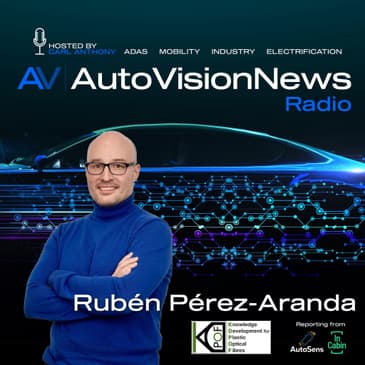
As part of AutoSens and InCabin USA 2024, we welcomed a number of industry thought leaders as part of our AutoVision News LIVE broadcasts from the exhibition floor. One such expert was Rubén Pérez-Aranda, co-founder and CTO of KDPOF.
During AutoSens and InCabin, Rubén helped AutoVision News Radio host Carl Anthony better understand the KD7251 for automotive applications, a single-chip solution integrating optical fiber interface, optical engine, photonics, and electronics in a hybrid package supporting a standard reflow assembly process.
Join Carl and Rubén for this previously live broadcast from the exhibition floor at the Huntington Place in downtown Detroit during AutoSens and InCabin USA 2024.
More Resources
AutoSens Insights Interview with Rubén Pérez-Aranda, CTO and Co-Founder of KDPOF: https://tinyurl.com/48wab9bu
KDPOF KD7251 Presentation Deck: https://tinyurl.com/282958fj
Follow AutoVision News on LinkedIn: https://tinyurl.com/49jyrd3b
[00:00:00] Now in the middle of one of the most significant eras in automotive, Carl Anthony amplifies
[00:00:05] the minds and voices behind this historic transformation as the host of AutoVision News Radio, all while
[00:00:11] coming to terms with middle age, father loss, and what it means to be successful in Detroit.
[00:00:17] As part of AutoSense and in Cabin USA 2024, we hosted a number of industry thought leaders
[00:00:24] as part of our AutoVision News live broadcasts from the exhibition floor.
[00:00:29] One such expert was Ruben Perez-Aranda, CTO and co-founder of KD Path.
[00:00:35] Ruben has served for over 20 years as a manager of R&D projects for the development of digital
[00:00:42] communication systems, covering the full path from information theory based research to
[00:00:48] integrated circuits qualification and series production.
[00:00:52] Ruben is an IEEE senior member and an industrial engineer specializing in electronics and automation
[00:00:59] control.
[00:01:00] During AutoSense and in Cabin USA 2024, Ruben spoke more about the latest innovations from
[00:01:07] KD Path including the KD7251, a single chip solution integrating optical fiber interface,
[00:01:14] optical engine, photonics and electronics in a hybrid package supporting a standard
[00:01:21] reflow assembly process.
[00:01:23] As we began our discussion from the exhibition floor, I shared an overview of a prior interview
[00:01:29] I did with Ruben for the AutoSense and in Cabin YouTube channel.
[00:01:33] I'll leave a link in the show notes.
[00:01:35] In the meantime, I'm pleased to be able to replay for you now.
[00:01:39] My interview with Ruben are guests during AutoSense and in Cabin USA 2024.
[00:01:45] Moving at the speed of mobility, this is AutoVision News Radio with Karl Antony in
[00:01:50] Detroit, Michigan.
[00:01:51] Allow me just as we begin to give a little bit of a backstory because we did a previous
[00:01:57] interview that's on the AutoSense and in Cabin YouTube channel.
[00:02:01] So a bit of a backstory here.
[00:02:04] Connecting sensors to AI units requires a data network deployed throughout the vehicle
[00:02:10] where information generated by sensors is aggregated by zonal ECUs and then transmitted
[00:02:16] to the AI units.
[00:02:18] Now aggregation amplifies the rate requirements between 10 and 50 gigabits per second per link.
[00:02:26] In our previous interview that I mentioned, Ruben, for the AutoSense and in Cabin YouTube
[00:02:30] channel, we analyzed that legacy electrical physical layers face limitations such as
[00:02:37] high insertion loss and return loss which translates into signal integrity and EMC
[00:02:43] issues that ultimately impact the cost and energy efficiency.
[00:02:49] Now these problems will worsen over time as cable and connectors age, making electrical
[00:02:55] solutions really inadequate for future scalability.
[00:02:59] In this scenario, optical links become a very attractive solution offering superior
[00:03:06] EMC performance, low power consumption and scalability for future data rates.
[00:03:12] That's a summary Ruben of what we talked about in that prior interview.
[00:03:16] Yeah, I think it's a very good summary.
[00:03:18] So in KDPoF, we are a Spanish company, a fabulous company that we were founded in 2010.
[00:03:27] We invent high speed optical communication for automotive environment, specifically for
[00:03:32] automotive environment.
[00:03:34] We already have chips in serious production for gigabit over a plastic optical fiber
[00:03:39] and now we are really focused in the development of the new multi-gigabit optical communications
[00:03:46] for automotive using a different fiber, that is glass multi-gigabit fiber.
[00:03:51] And we offer to the market a fully qualified automatic gray chips that integrate photonics,
[00:03:59] electronics and optics in a single chip solution.
[00:04:03] What is KDPoF showing here at AutoSense for 2024, Ruben?
[00:04:09] We are presenting in this event the new optical transmitter for multi-gigabit.
[00:04:15] This is the KDPoF 7251, it's able to operate up to 10 gigabits per second.
[00:04:21] We are showcasing here in a booth, in the booth number 258, a demo of a symmetric transmission
[00:04:29] of 10 gigabits using automotive gray optical fiber connectors and cable.
[00:04:36] So the people can touch the cable, can play with the connectors and see how flexible and
[00:04:42] robust is this cable without affecting the performance of the system.
[00:04:48] Ruben, what are some of the other main features and characteristics of what you have on display
[00:04:52] here at AutoSense?
[00:04:54] This chip is very a special chip and unique chip.
[00:04:57] This chip is going to be certified functional safety ACB,
[00:05:02] qualified according to ACQ 102G2.
[00:05:06] And we have different functionalities.
[00:05:08] We have in the chip the capability of operating as Ethernet-5, so supporting the connectivity
[00:05:15] between some ECUs and artificial intelligence units with symmetric traffic.
[00:05:22] But this chip also includes MIPE interfaces.
[00:05:25] So CSI-2 for connecting cameras, radar, leader or DSI-2 for connecting displays.
[00:05:32] And we also support IEEE 1722 encapsulation, so we encapsulate our Ethernet, MIPE and
[00:05:41] the remote control protocols.
[00:05:45] We have also the support of aggregation, desegregation, multi-drop traffic because
[00:05:51] for example, you can use this chip to aggregate the traffic from a leader, camera, radar and put all together
[00:05:59] over a single fiber and send to the main processor in the car.
[00:06:03] Right. Ruben, I think the next question, and I would imagine you could ask that frequently,
[00:06:09] this, ask this frequently is how do you integrate all of these functionalities into an optical transceiver?
[00:06:16] How is that possible?
[00:06:17] Yeah.
[00:06:18] Yeah, it's a very good question because it's one of the most difficult things.
[00:06:22] Yeah.
[00:06:23] Yeah.
[00:06:24] So I would like to emphasize because this is a single chip solution.
[00:06:27] So we integrate the optical interface for connecting the fiber directly to the chip,
[00:06:34] the optical engine that make the optical coupling between the photonics on the fiber,
[00:06:40] the photonics, so laser, photodial, and electronics.
[00:06:45] And everything in a hybrid package supporting assembly process in PCB.
[00:06:53] So this is the very best optical transceiver able to support reflow process for direct assembly in PCB.
[00:07:02] Right, right.
[00:07:03] You had mentioned that this is a single chip solution.
[00:07:06] Ruben, can you elaborate more on the characteristics of this single chip that we've been discussing?
[00:07:12] Yes.
[00:07:13] So inside this chip we have a first CMOS die.
[00:07:18] This CMOS die, the silicon integrates the DSP, the electronics, the analog signal circuits,
[00:07:27] the high speed digital interface, microprocessors, monitors, et cetera.
[00:07:31] And we decided to integrate everything in a single die using CMOS because CMOS technology
[00:07:37] are qualified for automotive and allows you to produce in very low cost.
[00:07:42] So this is the first element that we have.
[00:07:45] Then we have a pixel that is the laser and we have the photodiode.
[00:07:50] And these three dies are assembled over an organic substrate, that is a BGA substrate.
[00:07:57] And on top of that we have a lead and a small structure that implement the optical lenses
[00:08:04] to couple the photonics to the fiber and the mechanical interface with the optical ferules of the chip.
[00:08:11] And this package is very innovative because it requires very high precision positioning
[00:08:17] of the photonics on the lead and requires to select the materials and the glues, et cetera
[00:08:24] to support the reflow process that is operating up to 345 degrees Celsius.
[00:08:31] So you need to select all these recipes for assembly of this chip and the materials very well.
[00:08:38] Sure. Ruben, I imagine this question is something you might get as frequently as well
[00:08:43] but if you have this single solution approach and this hybrid packaging
[00:08:47] which is remarkable and innovative all at the same time
[00:08:50] but how do you manufacture it in a series production or in a method
[00:08:56] that supports high volume for the automotive industry?
[00:08:59] Yeah, it's a very frequent question and very good question.
[00:09:02] This hybrid package is not a standard package.
[00:09:05] So you cannot subcontract these big companies doing assembly and test for you.
[00:09:12] You cannot contract the big O's at the A's here.
[00:09:15] So what we are doing in the company is setting up an assembly facility to make this assembly.
[00:09:23] So we are setting up manufacturing lines, fully automatic manufacturing lines
[00:09:28] including all the steps that you need.
[00:09:30] Wafers are processing with dicing, high precision positioning,
[00:09:37] tibonding, fleet chip, wire bonding, lead attached, final test, et cetera.
[00:09:42] So we subcontract the manufacturing of the CMOS die.
[00:09:45] We subcontract the pixel on the photo diode or the substrate on the lead
[00:09:49] but we put all together inside the manufacturing line
[00:09:54] to guarantee a very high quality and low cost production of this very unique kind of product for automotive industry.
[00:10:05] For more information about KD-POP, see the links in the show notes.
[00:10:09] AutoVision News Radio is available on Spotify, Apple Podcasts, Podbean and more
[00:10:15] from the Huntington Place in downtown Detroit
[00:10:18] as part of AutoSense and in Cabin USA 2024 alongside Ruben Perez-Aranda.
[00:10:24] I'm Carl Anthony. AutoVision News Radio.