
Whether our vehicles are clean or cluttered, spotless or in disarray, they carry the people we care about most. While there is no substitute for defensive driving, intelligent and intuitive Advanced Driver Assistance Systems (ADAS) can be a helpful companion for mindful motorists. If software-defined cars represent the future, what will it take to develop and engineer this type of next-generation ADAS platform?
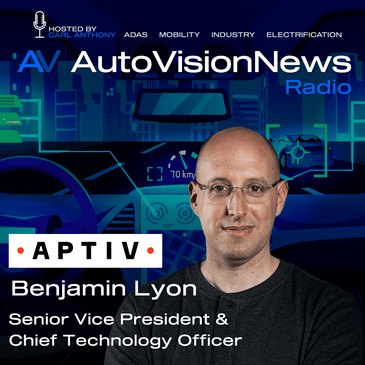
In this edition of AutoVision News Radio, we welcome Benjamin Lyon, Senior Vice President and Chief Technology Officer of Aptiv. He shares the core principles that guide Aptiv's approach to ADAS and software-defined vehicles, highlighting the significance of Wind River's Hypervisor and containerization. Benjamin also discusses the culture of intellectual curiosity at Aptiv, how company leaders address challenges, and his desire for a legacy focused on people.
More Resources:
The Story of Aptiv's Smart Vehicle Architecture: https://tinyurl.com/3j99j9cb
What Is a Zone Controller: https://tinyurl.com/5n8hc4zt
Central Vehicle Controllers Make Software-Defined Vehicles Possible: https://tinyurl.com/3k24p9hj
Aptiv Completes the Acquisition of Wind River from TPG: https://tinyurl.com/mwrv62sf
What is a Hypervisor via Wind River: https://tinyurl.com/47sp27cw
Follow AutoVision News Radio on LinkedIn: https://tinyurl.com/49jyrd3b
AV Radio is a Detroit Deep Media Production: https://detroitdeepmedia.com/
**Audio Clip from MiniDisc Recording: Originally aired Monday, July 2nd, 2007, KJAN Atlantic AM 1220, Carl Anthony, 5 pm Newscast: "Authorities Urge Caution on Iowa Roads Ahead of July 4th, Some Residents of Cass County Hesitant to Travel."
[00:00:00] Now in the middle of one of the most significant eras in automotive, Carl Anthony amplifies the minds and voices behind this historic transformation as the host of AutoVision News Radio. Mic check one two. All while coming to terms with middle age, father loss, and what it means to be successful in Detroit. Just as many podcasters do today, I recorded this virtually.
[00:00:21] My guest, Benjamin Lyon, Senior Vice President and Chief Technology Officer of Aptiv, was in another location as his schedule often requires a great deal of travel. Meanwhile, I was in a hotel room in La Vista, Nebraska, a suburb of Omaha. As I do each year around the Thanksgiving season, I returned to Omaha to watch the Huskers and spend a weekend with my best friends from college. All of us attended Iowa Western not far away in Council Bluffs, Iowa.
[00:00:50] While recording with Benjamin, I could glance out the window, my room on the sixth floor, to see traffic on Interstate 80. Should I jump on I-80 from my hotel in La Vista, I could be at the Iowa Western Campus and to my old radio station, 89.7 The River, in about a half hour. I thought back to my Introduction to Mass Communications class in the fall of 2003, when our instructor asked us how many cars go up and down I-80 each day.
[00:01:19] After throwing out random numbers, none of which were probably correct, our instructor rephrased the question, asking out of all the vehicles that travel I-80 in a given day, how many make the news? The answer is only the ones that crash. But what if we could prevent those crashes? Officials in Southwest Iowa are urging those in the KJA enlisting area to exercise caution this week, especially on I-80, and with the fourth on Wednesday.
[00:01:46] Some Nishina Valley residents are nervous about traveling and wondering how otherwise preventable accidents can be stopped. That's the question we've been asking ourselves in automotive for some time. And that question has been a driving force for so many in this industry. The vision of what the world would look like if cars didn't crash has inspired and motivated an entire generation of engineers, including all of those at Aptiv.
[00:02:12] By way of introduction, Benjamin Lyon is Senior Vice President and Chief Technology Officer of Aptiv, where he is responsible for the technology leadership of the Global Engineering Organization, which includes, at the time of this broadcast, more than 19,000 technologists located in 12 major technical centers across the globe.
[00:02:33] With more than 20 years of senior engineering experience, Benjamin ensures Aptiv remains at the forefront of emerging technologies in the automotive and mobility sectors. Before Aptiv, he served as Chief Engineer and Executive Vice President of Engineering and Operations at Astra Space, Inc., where he deployed 22 satellites to low Earth orbit and launched the Astra Space Engine Hall Effect Thruster product line.
[00:03:00] His tenure at Apple includes over two decades of developing sensors, displays, high-performance compute, and safety and security-critical technologies for scale. While at Apple, Benjamin also co-founded their autonomous systems effort. He received a Bachelor of Science in Electrical and Computer Engineering from Carnegie Mellon University. During our conversation, you will hear Benjamin mention three essential items, Wind River, Hypervisor, and Containers.
[00:03:30] In a press release dated December 23, 2022, Aptiv announced its completed acquisition of Wind River. Quoting from that press release, Wind River's proven technologies have been used across multiple industries to address the challenges the automotive industry is facing.
[00:03:46] By integrating the Wind River Studio cloud-native software platform into Aptiv's industry-leading smart vehicle architecture, Aptiv will enable customers to unlock the full potential of the software-defined vehicle throughout its complete lifecycle. Regarding Aptiv's smart vehicle architecture, or SVA for short, it's described as an optimized set of technologies that provide a foundation for the modern software-defined vehicle.
[00:04:14] This includes the hardware and software architectures, and the ability to use cloud-based tools to develop, deploy, and operate these vehicles throughout their lifecycle. SVA has three key principles. The first is that it separates I.O. from compute, by employing zone controllers to reduce physical complexity.
[00:04:36] Second, it abstracts software from hardware, by leveraging a central vehicle controller, also known as the little brain. This little but powerful brain handles all the communication within the car, coordinates with the zone controllers, and abstracts body control functions. As described by Aptiv, there is a need for a layer between the main brain and the nervous system of a vehicle.
[00:05:02] This little brain bridges the digital world with the analog, translating the decisions made by the main brain into actions carried out by the nervous system of the vehicle quickly and efficiently. The third principle of SVA is that it serverizes compute, so higher-level ADAS software can focus on making the best decisions for on-road safety, while the UX software can focus on creating the best in-cabin experience.
[00:05:31] The software, running on open-cabin experience, containerizes applications into modules that can be easily updated. A video on the Aptiv website details the story of SVA. That video helps viewers imagine what these containers look like with a graphic illustration of blue and green boxes. ADAS has its containers.
[00:05:56] The foundation of this graphic representation of the ADAS and the UX containers is a long rectangular box labeled Mixed Criticality Hypervisor. Wind River describes a hypervisor as a software that uses virtualization technology to create, run, and manage virtual machines. Also known as a virtual machine monitor, a hypervisor keeps its operating system and resources isolated from the virtual machines it manages.
[00:06:26] A key benefit of a hypervisor is that it allows developers to run multiple operating systems simultaneously on only one hardware system. When you hear Benjamin refer to Wind River, hypervisor, and containers, those things are a basis for how Aptiv approaches the future of mobility. A future that is safer, greener, and more connected.
[00:06:50] We begin by asking Benjamin how Aptiv determines what goes into its automotive portfolio and what solutions will be of the most value to its customers. Moving at the speed of mobility, this is AutoVision News Radio with Carl Anthony in Detroit, Michigan. Yeah, it's a great question to think about how do we really focus down on the things that are going to matter. They're going to matter to our customers. They're going to matter to their customers, the end customer.
[00:07:19] And I'd say there are a couple of bits. The first is we look at industry megatrends. Products are getting safer, they've got to be sustainable, and the whole world's getting more connected. And that's true in automotive as well. And so when you think about those trends of safety, sustainability, and connectivity, we're really looking at how can we take those megatrends and create solutions that really enable our customers to go down that journey.
[00:07:48] The second I'd say is we really focus on solving common challenges that are actually across our customers in various different industries. So for example, Wind River that delivers a real-time operating system and hypervisor that is applied today already in aviation and in telecommunications.
[00:08:09] And we're bringing that across into automotive to enable things like rapid software updates, byteside software updates, and containerization over in automotive. You know, when you think about our different customers, they vary greatly on where they are on their digital journey.
[00:08:27] Our portfolio has to align with meeting our customers where they're at, which means one customer that's highly digital native, they may need a sensor, for example, out of our autonomous package. Or they may need a base operating system for real-time performance where it's got to work every time and all the time.
[00:08:46] Another customer comes to us and they go, we need complete robotic driving end-to-end from the operating system through the middleware, through the application and algorithms of robotics, all the way to hardware, computers, sensors, radars, cameras, things like that. It's got to, on one hand, provide the latest and greatest performance balanced with cost. But at the same time, it's got to be modular. It's got to be able to meet our customers where they're at.
[00:09:16] Benjamin from Aptiv's website, and I'm going to quote directly here. We believe that advanced safety features should be available in as many vehicles as possible. Aptiv's Gen 6 ADAS platform is open, scalable, and optimized at the system level to deliver industry-leading performance while democratizing ADAS solutions as they mature. Can we take a grand tour? Can you give us the grand tour of the Gen 6 platform?
[00:09:46] So there are a few key principles. The first is safety and reliability. Yeah, okay. You know, if you look at adoption of ADAS and of robotic driving, the adoption is beginning to really pick up now, but it struggled for quite some time. And I would say that one of the key aspects of that was reliability.
[00:10:06] That if it doesn't actually work in all the scenarios that a user wants to use it, or if it does strange things that either the user doesn't understand, or maybe it wasn't the best choice, that causes users even if they bought the feature to turn it off and not use it. I'd say the second piece is our ADAS system has to manage the complexity of software. It's a robot.
[00:10:30] It's got millions of lines of code, sophisticated algorithms, AI and machine learning all integrated into it. And so that system, that ADAS system has to be built. Think of it like a puzzle. If you build a system where everything's tangled and interconnected without clean connections, then it becomes very difficult to build the puzzle from puzzle pieces and then swap out. Let's say, you know, your dog eats one of the puzzle pieces in your puzzle.
[00:11:00] You know, you get a replacement puzzle piece. You want to just be able to click right into the rest of the puzzle. Right. So think about the same thing with complex software. That's what we call in the software world containers. Okay. And the ability to basically build ADAS principally from a bunch of very standardized, clean interfaces that we call containers so that you can take out a piece, upgrade it, test that piece and drop it in. And the system just works. That's a key principle.
[00:11:30] Right. The next is it's got to be secure. Yeah. Okay. Right. Like when cars weren't connected to the internet, it wasn't a big deal. Now that cars are getting more and more connected to the internet, which is good, it enables all these new connectivity functions. The downside is the attack surface is much greater.
[00:11:48] Our perspective is, is that the development of our software stack needs to use all the latest cybersecurity best practices as well as technologies to ensure that the system is never compromised. But also there's data. There's the data that you've got sensors on that vehicle. Those sensors can see out into the world. They can see into the cockpit. That's important for safety. But at the same time, you don't want that data going to the wrong places.
[00:12:16] ADAS should be one. It should be seamless. Two. It should never create confusion, mode confusion for the user. Who's driving the vehicle? Is the ADAS driving the vehicle right now? Am I driving the vehicle? What am I supposed to be doing? Right. Right. That's all got to be really clear. The system has to take on the complexity and give a very simple interface to the user for great human factors. And then also that creates choice for customers. Right. It's like, OK, today I really want to enjoy driving the vehicle.
[00:12:44] Tomorrow, I want to be able to relax a bit and have the vehicle do the driving. How do you do that in a way that is seamless? So those are the principles. One of the things that's really neat about Aptiv's Gen 6 ADAS is that Aptiv has a long history in radar. Radar can do things that cameras can't do. Cameras can't see through fog, but a radar can see through fog. You can get some really important data from a radar.
[00:13:12] Now, I'm not saying that radar should be the only sensor that's on an ADAS system. And Aptiv's ADAS system uses radar on camera. Sure, sure. What I am saying, though, is that radar is an incredibly powerful tool for handling all sorts of scenarios. In the past, one of the challenges with radar is something called false positives.
[00:13:34] And so that limited, especially the application of autonomous driving to really kind of making radar a hero and making great use out of it. One of the things that's really neat that's happened at Aptiv is that we've developed a machine learning stack that takes kind of the power of all of our expertise in radar. The fact that Aptiv was literally the first company to develop a radar for a car. Sure, sure.
[00:13:59] And what that's let us do is use the radar for things like detecting pedestrians, detecting curbs. That's really neat because it enables a few really cool things. For example, using fewer cameras and using the radar for some of the functions that you would have needed a camera for. Okay. It allows working in what we call ODD, a greater ODD, the operational design domain, allowing the ADAS to work in situations better in situations where cameras might struggle.
[00:14:29] For example, in the rain and in the fog. What that does when we make radar the hero and confuse it together with camera and IMU, an inertial measurement unit, so it senses motion. You take these sensors, you fuse them together. It allows us to provide a significantly greater performance at a given cost point. Okay.
[00:14:49] So that's one just key thing that comes out of our offering is from our Rin River RTOS and Hypervisor up through our radar sensors, camera sensors, motion sensors, et cetera, and then our deep learning and machine learning algorithms, we're able to offer higher levels of autonomy at a significantly lower price. Another thing that's really neat about this particular ADAS system is that it really scales cleanly.
[00:15:18] You know how we were talking earlier about containers and modularity? Yes, yes. Yeah. So this is like that. We have an offering that's basically, think of it as like it's a smart camera paired with the radar and some algorithms that sit in some embedded compute that allows you to deliver things like autonomous emergency braking, AEB, which is important for regulatory purposes.
[00:15:40] And you can do that at the mass market, super, super cost effective, and yet have something that performs really, really well, really reliably and safely. And then as you want to increase performance and move up to L2, L2 plus, L2 plus plus, you're just clicking in some additional compute. You're clicking in some additional sensors without having to re-architect the system.
[00:16:06] And it's that plug and play kind of way of architecting our system that really makes the Gen 6 ADAS really scalable. That's the beauty of it is that you can do the mass market regulatory version, and then you can scale all the way up to premium, super highly featured without re-architecting. And that's part of, again, why you're able to give that performance versus cost.
[00:16:32] So hopefully that gives you kind of at least a sense of what we do over there. There is a local coffee shop that Danielle and I go to in Detroit, in the local Detroit area, and they always have a puzzle, a community puzzle that everybody does who comes in and orders coffee.
[00:16:51] But after our discussion, Benjamin, I will see that puzzle differently from now on, and then I'll take that mentality and that visual out to my vehicle, which has a full suite of ADAS features. This analogy that you're talking about between the containers and the puzzles, excellent imagery. How do you and your engineering team, how do you, from a creative standpoint, come up with these ideas and develop these creative? And it's amazing.
[00:17:20] Well, it's culture, culture, culture, right? And then after that, it's also culture, culture, culture. I'm sure it's the same thing for you in any industry where you're creating content and you're being creative. And that's very true here.
[00:17:35] Of course, you have to add on the need for not only a culture of intellectual curiosity, you also have to have a culture of safety and a culture of carrying the responsibility of knowing, again, that you're developing a product that goes into something that is mobile, where you put your most important folks, your friends, your family into it. But you pair those two things, that culture of creativity and intellectual curiosity, wanting to know the why behind the what. Yes.
[00:18:04] Pair that with a deep passion for safety and a passion at the end of the day for pairing humanities and human interaction with technology. That's where the magic happens, right?
[00:18:19] Is if you have an autonomous vehicle, if you have an ADAS system that drives naturally and creates an experience for folks that doesn't disrupt but actually adds to their comfort, always wondering why and then digging another layer deeper. However, a supplier can come to you and a supplier comes to us and goes, well, we're going to miss this milestone because we have the following issue.
[00:18:48] The place where active leaders tend to start is why. What is the root of the issue? Is it a technical thing? Have we learned something new about algorithms, something new about physics, something new about human behavior? And capturing that learning is important, just like executing and delivering is important.
[00:19:10] But it's that intellectual curiosity, that wanting to know why and truly understand the root of things that is just so core to our culture. And you see that, you know, in our products. Let's roll that into software defined vehicles or SDVs for short, which are now at the top of our automotive lexicon. How does Aptiv see the software defined vehicle?
[00:19:36] It starts or really it started with a problem that has been really plaguing automotive, but not just automotive, any large complex electronic system for a number of years, which is as you add features, you tend to add boxes with compute in them or boxes with sensors in them or boxes with input devices or displays in them. And as you add those boxes, you have to add connectors and wires. That has a number of impacts.
[00:20:05] The first is, is you're adding a lot of mass. The second is you're adding a lot of complexity. Before you may have had, call it 25 connections. And now you've got thousands of connections, let's say. Every one of those connections is now a potential point of failure, right? It's a potential loss of liability. The extent to which you can simplify, for example, on the corner of a vehicle, you have the lights, right?
[00:20:34] And you have multiple different lights, right? In your headlights of your vehicle. Sure, sure. You also have the local crash sensors in those locations. You might have ultrasonic sensors in those locations. In that corner, you might have a controller for plugging in your USB or for some other vehicle function.
[00:20:56] Well, if you had to run all those wires back to a central computer and plug them all in with separate connectors, that's a lot of wire and a lot of connectors. Sure, sure. And instead, take a little computer and put it in a zone. Call it a zonal controller. And now plug everything that's nearby it in to that little computer, that little zonal controller. And now you convert everything that's going on into messages that you can send over the internet. It's like a little internet in your car.
[00:21:24] Now you're just sending one internet cable. Maybe it's Ethernet. Maybe it's CANFD. Take your pick of what protocol you want to use. But now you're just sending one cable back to the main computer. And so now you've got this information superhighway in your car with much more simplified wiring. So there are fewer things to debug when things fail, fewer things to fail in the first place.
[00:21:53] And then, of course, when you think about the cost of assembly, now you don't have to have workers plugging in all these different cables all over the place in a vehicle and climbing over a vehicle and trying to route these huge harnesses multiple feet in length. So the first piece of the software-defined vehicle, call it phase one, is really solved for complexity and mass of wiring up and hooking up a vehicle and then improving reliability.
[00:22:21] So you're turning a hardware problem into a software problem. Now that pushes complexity to a different place. As you put multiple functions that used to be in separate boxes now onto the same box, maybe onto the same silicon, now you are having to manage multiple different functions, multiple different features in software all on the same computer. It used to be that you would have a computer that does your HVAC control.
[00:22:49] So it controls your air conditioning and your heating. And separate from that, you'd have a head unit that controlled the audio. And then you had a separate unit that actually may have done the navigation, let's say. Imagine carrying around a laptop for doing your email and a music player for playing your audio. You'd have so much weight on you. Oh my gosh. You'd be carrying, yeah, you'd be impossible to go through an airport. You'd have so many bags. That's right. That's right.
[00:23:17] Just like in that space where all that's now been combined into a smart device and a digital wallet on that smart device. But now you have all those functions that have to be managed with complex software on your smartphone, for example. Similarly, on a vehicle, now you have infotainment, in-cabin monitoring, ADAS, the environment like we were just talking about, the HVAC system, all being managed on the same piece of hardware.
[00:23:45] So now you need software technologies to make sure that all those features run and they don't interfere with each other. That's especially important with safety critical systems. We can't have the safety critical system like an ADAS suddenly stop working because you decided to play some, you know, your favorite track in the infotainment. Right, right. So that's where Wind River's hypervisor comes into play. That's where Wind River's real-time operating system comes into play.
[00:24:13] That's also where containers come into play because they create really nice, clean interfaces. So one key piece of this, as we talked about containers earlier, is having that modern software practice. The other is, and I strongly believe that what's great about Aptiv is we have the right software, the right hardware, and the right tools. The other piece is the right DevSecOps.
[00:24:36] What that really is, is a set of tools that allow you to go from requirements, what do I want the thing to do, to, you know, the actual development of the software, and then all of the testing and characterization of that software. Both to make sure that it does what it's supposed to do, and to make sure that it doesn't do what it's not supposed to do, and to make sure that it's secure. And then, of course, deployment, you know, over-the-air deployment.
[00:25:02] So having that DevSecOps pipeline is really important. And with 5G, you have the ability to create what's called network slicing, which means you can put super high-priority traffic on a lane that gets basically a, it's kind of like a dedicated lane. You're guaranteed a certain level of latency, a certain level of availability, a certain level of performance, as long as you're within range of the network. You buy your car, and it has a certain, you know, amount of compute power in it.
[00:25:32] But it's got great displays, it's got a great audio system, the input device, the touchscreen, and the jog dials, etc. They all work, and they work really well. Let's say a year and a half after you buy your car, there's this new feature that comes out that is a really awesome 3D rendered view of the world that's much more intuitive and easy to use in mapping, let's say, and how you just show the map to the user.
[00:25:57] Well, it may be that the graphics processing unit, what we call a GPU, is not capable enough to actually do that real-time rendering. Or it may be that the storage or the memory on the car that you bought may not be able to store all the data necessary to feed that rendering.
[00:26:13] Well, with 5G, you can actually start to leverage, and this is in the future, this is not today, but in the future, you can start to leverage edge compute resources, where actually you're doing all the rendering at a compute site that's either in a cell tower or a data center that's very close to the cell tower, within a couple miles of the cell tower. And then you're streaming it, just like kids do online gaming today.
[00:26:39] You're now streaming that user interface to the vehicle. Now all you have to do is present that, stream those graphics to the display, and now you have to be able to upload to the edge the user input that the driver does touching the touchscreen or using the jog dial. It's just like music streaming or video streaming, but in this case, you're using it to create a much better user interface for the customer.
[00:27:06] For that to work as a product, you have to have the kind of availability and reliability that comes with the rollout of 5G and that feature of network slicing. But think about what an incredible value you can bring to a customer. You can bring so much more rich functionality at a lower on cost at the vehicle. Typical person's car is actually sitting around for the vast majority of the day doing nothing. True. Yes, exactly. Yeah.
[00:27:35] But edge compute, right? Your cell tower, those cell towers are dealing with all the thousands of cars are constantly passing. So why not put the processing power there where it really gets utilized? And as a result, the price drops because it's actually the assets really getting used. When you think longer term in SDV, that's kind of the holy grail where not only do you have mixed criticality, where you have infotainment and critical safety functions running on the same hardware,
[00:28:04] you're also beginning to be able to push some of this functionality off onto the edge. And that's part of why it was so important to Aptiv to really be involved with Wind River, where a big core of their business, the Wind River business, is actually enabling 5G for actually a number of major carriers in the United States and globally. Because that allows us to really learn and make sure not only we build a system, but we build the right system.
[00:28:34] Benjamin, it's been such a pleasure to sit and have this conversation with you. I just want to ask one more thing, if you could share one more insight with me. No problem. What is the legacy that you hope to leave at the end of your career when you retire? I'm going to quote, and I won't say who I'm quoting. There was a famous technology leader who's now gone. We used to say, if you're resting on your laurels, you're wearing them on the wrong end. And I strongly believe that.
[00:29:02] So I don't spend a ton of time thinking about my legacy per se, because I really want to focus on being useful and doing good work. That said, I've been very, very fortunate to live at this intersection between people and technology for decades. It's gotten to be at the center of things like the iPod and the iPhone and the iPad and, you know, the digital wallet and things like that.
[00:29:26] What I would love as a legacy is actually the people who I get to touch and get to help now at this phase in my career, where really I can really take joy in seeing the next generation of leaders and entrepreneurs and innovators and executors of difficult technologies and succeeding and bringing them to all of us as customers.
[00:29:50] The extent to which I can look out and see that I've been even just a tiny bit helpful to all of them. That to me is just like, there's just a tremendous amount of joy in that. So maybe that's it. Maybe that's the legacy. See the links in the show notes to learn more about Aptiv's smart vehicle architecture, Wind River and Hypervisor. AutoVision News Radio is available on the digital antennas of Spotify, Apple Podcast, Podbean and more.
[00:30:17] In La Vista, Nebraska, alongside Benjamin Lyon. I'm Carl Anthony, AutoVision News Radio.