
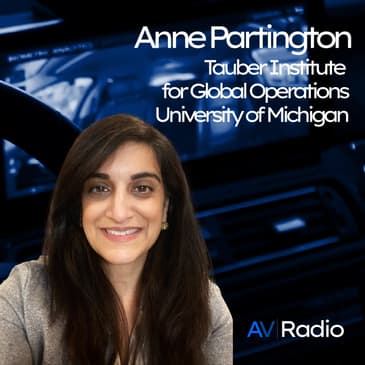
If we had only a handful of words to define the trajectory of our lives, what words would we choose? Inspired by her parents, who immigrated to the United States, and her years as a mechanical engineer, Anne Partington, Managing Director of the Tauber Institute for Global Operations at the University of Michigan, encourages us to find those few special words that truly define us.
With extensive automotive industry experience, Anne has held leadership roles in product development, program management, and global supply chain at General Motors and Stellantis where she led a $3.5 billion mechatronics global purchasing team. She has also led an automobility technology commercialization program at the University of Michigan. Anne holds a BSE in Mechanical Engineering from the University of Michigan and an MSES in Management of Technology from Rensselaer Polytechnic Institute.
Anne joins AutoVision News Radio host Carl Anthony to discuss the value of family and inclusion, why placing ourselves where the work is getting done matters, and why advocating for the next generation is vital.
More Resources:
Tauber Institute for Global Operations at the University of Michigan: https://tauber.umich.edu/
Automotive Women's Alliance Foundation: https://awafoundation.org/
Leave No Woman Behind ft. Kim Ziomek of AWAF
- Spotify: https://tinyurl.com/45hr6xy8
- Apple Podcasts: https://tinyurl.com/y98yt6uf
Follow AutoVision News on LinkedIn: https://tinyurl.com/49jyrd3b
[00:00:00] Now in the middle of one of the most significant eras in automotive, Carl Anthony amplifies the minds and voices behind this historic transformation as the host of AutoVision News Radio, all while coming to terms with middle age, father loss, and what it means to be successful in Detroit.
[00:00:17] I've been thinking about what a purpose statement for my life might look like, especially since I am, admittedly, struggling with middle age. There are no doubt good things about being older, career, marriage, nieces, nephews, hawk, my rescue cat from the Michigan
[00:00:34] Humane Society who is attempting to crawl on my computer right now as I record this. All good things about being older, but I just wish that time would slow down, if only for a bit.
[00:00:47] I've reached a point in my life where I can say that something happened 20 years ago, and it really was 20 years ago. Like when Danielle and I go for coffee at our local spot,
[00:00:58] and I mention to the barista that the song playing is by friends Ferdinand or the Killers or Snow Patrol, and sometimes I wonder how in the world did 20 years go so fast? I remember playing those songs
[00:01:11] on the radio when I was first on the air, at 89.7 the river, and I remember that music being new. Now I've become the guy jamming out in the aisle at the grocery store
[00:01:22] while I marvel at just how many flavor combinations they can come up with for breakfast cereal. And while these observations are humorous on the surface, underneath they are a representation of my struggle and sometimes outright inability to come to terms with getting older. They are a
[00:01:40] representation of my insecurity, that insecurity of whether or not I've done something good and now that this much time has passed, is it too late? If you find yourself at these sorts of
[00:01:53] intersections where you have to process or reflect, it is my hope that after listening to this episode of AutoVision News Radio with Anne Partington that you are inspired. After recording this, Anne has inspired me to create a purpose statement. It's a work in progress, but I find it's
[00:02:10] helping me come to terms with things. By way of introduction, Anne Partington is the managing director of the Tabor Institute for Global Operations at the University of Michigan, where she oversees the Fellows Program and Leadership Development Initiatives while fostering strategic industry partnerships. A mechanical engineer with extensive automotive
[00:02:31] industry experience, she has held leadership roles in product development, program management and global supply chain at General Motors and Stellantis. Anne serves on the advisory boards of the Automotive Women's Alliance Foundation, the Motor City's National Heritage Area,
[00:02:45] and was honored by the Society of Women Engineers on their National 2022 Women You Should Know list. Allow me now to make the introduction, someone I'm glad to call a colleague and a friend. Anne Partington, managing director of the Tabor Institute for
[00:03:01] Global Operations. Moving at the speed of mobility, this is AutoVision News Radio with Carl Antony in Detroit, Michigan. So, you know, I am the child of two immigrants who came to this country with a great deal of hope and much of that hope was instilled in their children
[00:03:18] and their friends' children in the hope that they might bring impactful work to the communities that they lived in, the work that they did, and aspire to create opportunities for the generations ahead. My journey, early journey was a lot about creativity, ingenuity,
[00:03:36] innovation. We didn't have a whole lot of money, but we had a whole lot of fun. People were always welcome at our kitchen table. I think of my mother having run the United Nations of the kitchen tables. People were always welcome at our table. She was feeding people,
[00:03:53] exchanging recipes, a very talented woman in her own right, very gifted and knowledgeable. But she understood the power of the human connection, and she taught it to us well, generationally and with people with really different identities. You know, I think we
[00:04:10] had pretty much through our teenage years probably pretty much the typical immigrant dream of parents working hard, reminding me every day my dad's question was, you know, did you finish your homework? Because education was the gateway to opportunity.
[00:04:25] And then my dad got sick, and he had a critical injury and came down with some other infections that then changed his life completely. And in that aspect, it changed our lives
[00:04:40] completely. And I think it gave me both an early window in my teenage years of what it means to really be a champion for others, relentlessly think about one's own purpose and impact to the
[00:04:53] world and to recognize that there is strength and humility and the loudest voices aren't always the strongest voices. And so, you know, when I think about the seven years that my father was really sick, I saw some of the greatest teams in the world operate. And these were
[00:05:11] the teams in the emergency room and in the hospital where operations and supply chain when it was at its key could provide the type of care and community that my father needed.
[00:05:23] I saw the way our community in some aspects really revolved and supported my father. And I saw the ways in which society no longer really accepted someone with an identity where he was now very
[00:05:37] physically limited. And so as a young person, as an engineer, someone who is taught to create for the long term to design for the universal, to think about how to make things inclusive. I think those formative early years really taught me about how to be flexible, relentless, kind,
[00:05:58] you know, in the pursuit of purpose and yet very focused on getting to an outcome that could drive equity and belongingness for all. When your father got the first diagnosis, when you first found out about that news, what was the dynamic like in your family? How did that
[00:06:16] change you? How did that make you feel? So I went from the day before Thanksgiving, researching recipes and watching Oprah online. Thanksgiving was the holiday my father and I cooked. My mother sat back. We had a huge potluck and everyone we knew was invited to getting the
[00:06:35] call that Tuesday to come to the hospital. And so really it changed my life overnight because it was not something where we could sink into it slowly. It happened in a manner where it was very
[00:06:47] sudden and we realized about a week later that he had had an extensive smile cord injury. It taught me to really be resilient and to take a pause and really think about a situation at hand and think about psychological safety. If someone's physically heard, are they psychologically safe,
[00:07:07] then we can really unpack the rest of what needs to be done. Today I can talk about this in a very more matter of fact way but I can tell you there are deep roots. And I think a lot about the
[00:07:19] legacy and the humility and even the kindness that my dad continued to show people even through all those years. He was also an engineer's engineer creating, innovating, continuing to write papers at the time AI was not very prevalent but he tested some new voice control software at that
[00:07:39] time and he continued to learn and to contribute to the best of his ability. Yeah so you are an engineer's daughter and you take that skill set to both GM and Stellantis or as it's been
[00:07:55] known before prior at FCA. So Anne tell us about the work you did with GM and with Stellantis and some of the key learnings there that have served you well over the years. Sure so key
[00:08:09] learnings of working in two incredible OEMs are vast and varied both from a technical skills standpoint as well as what I would call the needed soft skills that take up the majority
[00:08:24] of the toolbox. And I'm not quite sure why we call them soft skills they are the necessary skills to get work done. So you know I would just tell you briefly that I've worked in product
[00:08:35] development program management, human factors, global purchasing. I was an experiment one of a few that went from the technical side to what was affectionately called the dark side at the time and I love it. Global purchasing supply chain you have to have a relentless type of ability
[00:08:54] to think along in short term simultaneously to bring people together to solve really tough challenges. So a couple of key learnings I would say is number one is you have to have a growth mindset. The world is continuously evolving requiring new ways of thinking, new ways of
[00:09:13] doing whether that's a software during my time many systems went from purely physical to mechatronics software hardware systems and continue to evolve. So you know recognizing that one's technical skills are at a certain spot but that continuous opportunity to be willing
[00:09:33] to learn and grow is really important. A couple of other things are to be curious and to not get frustrated when you're trying to learn something new. Life is not easy learning these new skills is not easy and so the ability to then second is to manage failure
[00:09:51] and to recognize that every failure is a learning opportunity at heart and to then instill that into the culture of every team and every organization that people work in that spirit of failing is another opportunity to learn and grow is really important. And then I guess a third
[00:10:11] one I would say is that learning how to get work done you know showing up again and again supporting others and learning how to have reciprocal relationships supporting those relationships and developing them so you can help one another along the way. And then when there
[00:10:31] are those really significant challenges those stop everyone in their track and let's mobilize as a team around a common purpose that needs to be resolved ASAP people come to the table because they recognize the work that's been done along the way and so I think continuously working
[00:10:51] together to be those multipliers to know how to get work done and bring others along elevate their work and vice versa is really key. So I would say those would be sort of three main areas of
[00:11:06] learning you know at a more high level. And now we move up here to the present day where you are the managing director of industry partnerships for the Tabor Institute for global operations at the University of Michigan link in the show notes and a two-part question here first
[00:11:26] tell us more about the Tabor Institute and then further to that your role there. So the Tabor Institute for Global Operations is an institute that is a collaboration between the Ross School of Business and the University of Michigan's College of Engineering. It's founded by
[00:11:44] our still very active founder Joel Tabor we're very thankful to him and he had the foresight to really think about the importance of bringing together students from different functional areas in a multidisciplinary two-year curriculum to jumpstart both their technical learning as well
[00:12:03] as their leadership learning. In other words I would go back to what I shared at the very beginning he thought about what it takes to really get work done and you know within that we have two very
[00:12:15] core beliefs at the Tabor Institute. The first is we believe that by bringing students together from multidisciplinary functions and by having them learn together they have the opportunity then to grow together in their thinking and be open to different ideas and perspectives as well
[00:12:33] as the identities of their fellow cohort. The second piece is that we believe that putting them in a very intensive and immersive industry project a real-world project so we're not talking a project
[00:12:46] that you know will shut the line down the next day but we are talking about a project that has measurable impact that typically has really important opportunities and impacts for the company is typically an ongoing challenge and then becomes the living legacy. The second thing that
[00:13:02] we really believe is it's important to do a real-world project in a cross-functional setting during that time. We add two expert faculty advisors to every one of these projects to really provide additional guidance and support to the students and then the idea is that when
[00:13:21] they come out of this and come back for their second year with us they can take those key learnings apply them and then when they leave us and go out into the world they have built that muscle power of being able to work cross-functionally in industry.
[00:13:36] And I've heard you speak about this before at events and conferences why is it important to mentor and train this younger generation before us? The next generation has even greater and more complex challenges across society than perhaps we knew about maybe they existed but maybe they
[00:13:58] weren't as visible due to the digital age that we live in. I think mentoring is really important as well as coaching and sponsorship there are really three different and distinctive things as well as training. So let's start with training. Training is building muscle power,
[00:14:16] it's building resilience right? We start with three pound weights and maybe you're hoping to get up to that 20 pound and be able to do three reps of 20 without too much fatigue
[00:14:27] it takes time and we don't have a lot of time to solve a lot of these types of challenges today. So our hope is that by providing this training early our students will be able to really work
[00:14:40] together collaboratively and also with others that they engage with whether they're working in the public sector, private sector, the medical industry, automotive they can transfer those skills into really being impactful. Mentoring I think is really important you know we talk a
[00:14:58] lot about failing and failing fast and it's important to have people you can trust, people who will not judge but will give you the guidance that you need to help you connect with others who can share their trajectories and where they had challenges and who might you
[00:15:15] know give you some advice whether it's in the work setting or outside and then I would also advocate for coaching Carl because coaches don't do the work they ask you the tough questions and
[00:15:26] make you do the work. So having a coach to encourage one to self reflect and really think about through this extraordinarily challenging time the transformation we're seeing in tech and in society it's tough and it's fast having a coach to help oneself through I think is really
[00:15:50] important. Why do I think these things are all important because Carl we have a desperate need for talent in these spaces. It's just not viewed as being the premier let's say of the premiers
[00:16:03] when you look at what the demand is versus the jobs that are available and yet it's so core right when you're negotiating at the table for funding and you have a really important
[00:16:16] operations issue if you do not understand and can't speak the language of the COO if you're running if you're a CMO or a CSO you can't really move forward you have to be able to run core operations
[00:16:30] and so by giving our students this opportunity to jump start their careers in this space they have a much better foundational opportunity. And then lastly I think the one thing I would like to say is spending time where the work actually gets done is really important.
[00:16:48] You know I started my job out working on the line I was a manufacturing engineer working on body sealing and working on some ergonomics issues the time I had to spend with people on the floor understanding their issues respecting their work learning that you know money did not
[00:17:09] cross hands with the company until that vehicle was out the door right onto the dealer's floor in the customer's hand and the customer was satisfied with it right. It's a different level of appreciation. We know each other from the Automotive Women's Alliance Foundation sometimes written as AWAF for
[00:17:29] short link in the show notes established in 2001 the Automotive Women's Alliance Foundation is dedicated to the advancement of every woman in the automotive and mobility industries with a core philosophy of advocacy through alliances. At the time of this broadcast AWAF has
[00:17:48] grown to more than 300 members and has awarded nearly 625,000 dollars in scholarships to women pursuing their degrees. Why is it important that we continue to open doors for women in automotive? Why is it important that we advocate for the women next to us? Yes so I think it's
[00:18:12] important to think about how all identities can find a sense of belongingness and I happen to serve on the Automotive Women's Alliance Foundation Board. We work hard to open doors for people
[00:18:27] because there is a gap right now and there always has been and there probably will be for a long time to come in bringing and retaining talent and continuing to attract talent to the industry.
[00:18:42] I will speak just from my own experience that I saw many many incredibly qualified and talented women leave the industry for various reasons and that talent drain is something
[00:18:56] that I feel that I can do a small part in helping to reignite. You saw I used the word reignite so one of my passions is professional development and to help people succeed and during the pandemic
[00:19:12] in early 2020 I had on my vision board to create a small conference where we could really bring some incredible thought leaders together create a space of belongingness and pour into women leaders
[00:19:25] and people of all identities who wish to attend to really ignite their own genius. At my core I believe that everyone has a genius that needs and has an opportunity to be ignited and I'm lucky
[00:19:39] to be here in your space of genius Carl today to spend this time with you and so this year we've you know it's very fortunate and thankful to the team and the board at AWAF that they
[00:19:53] allowed us within the professional development space to really curate a small conference that was open to everyone but we had what 14 incredible speakers this year all represented from the auto industry this is our one event where we modern mobility industry and we try to represent
[00:20:12] all identities early career later career the learnings and experiences lessons and hopes and dreams and how each person can then leave with some additional tools and ideas for how they can ignite their own potential ignite their own genius in moving their career forward you know regardless
[00:20:35] of what they want to do that they see that hope for themselves and that investment from others so as you know I'm sort of the back-end producer of that along with a couple of other folks
[00:20:46] that is a really important I guess initiative of my own is to continue to open doors for women and for people with underrepresented identities there is so much opportunity for people with all
[00:21:00] different types of skills and talents to contribute from my world it is an opportunity to contribute and give to an industry that I deeply care about that I still am very deeply connected to and
[00:21:13] that my hope is that other women also Carl women also support women because there are so few that are moving up the wrong that to continue to lock arms and open doors and to be a multiplier
[00:21:28] regardless of where your seat is to help others through that gate is is really important and as we've been talking here I keep going in my head back to that Thanksgiving day with your father cooking with him I see a link there between what your parents showed you
[00:21:50] to me it seems like that very much influenced your career path and where you are today and why you value the things you value you know there is a six-word purpose statement Dr. Quinn is a famous researcher in the space of positive organizational methodology
[00:22:10] and it's very hard to get one's life purpose down to six words and I'll give you a challenge Carl outside of this is to come up with a six-word purpose statement but I wrote one okay but we'll
[00:22:23] reconvene on that topic because I think it's it's one worth revisiting it will be hard I know it yeah yes so over the last nine years I've refined mine many many times and why I say nine years
[00:22:36] is over the years I've had lots and lots of big boards of visions of things I want to accomplish and goals but to get it down to six words is really it's challenging so here are my six words that
[00:22:49] I'm sharing with you publicly for the first time one ignite purpose when you can ignite purpose whether it's organizationally in a community as a person when you know what your purpose is
[00:23:05] you have a north star so let's ignite purpose that's my first two ignite purpose the second to our channel energy people have a tremendous capability instead of the word inspire I think of the word
[00:23:19] aspire aspire meaning that things are much more achievable than than people think they are and I want people to be able to aspire in whatever organization or group that I lead or work in
[00:23:33] partnership I have with them so channel energy is my next two really channeling that energy towards that purpose and aspiration and the 30s create belongingness because when we have a culture where people feel like they can belong with their whole self all sets of intersectional
[00:23:53] identities really amazing things can happen so my six word purpose statement that I aspire to because I'm not going to say that it's easy it's hard is to ignite purpose channel energy and create
[00:24:07] belongingness you talked about the Thanksgiving day and how I still carry that with me every day so for many people legacy comes later in their career for me I thought about legacy at the very
[00:24:20] beginning of my career so every interaction every bit of daily work every conversation I have with every person is an opportunity to leave a little bit of legacy it is through those bits of giving and
[00:24:36] receiving legacy that can be impactful helpful create a true connection that I think does really ignite purpose channel energy and create belongingness see the links in the show notes to learn more about the topper institute for global operations at the university of Michigan
[00:24:55] and the automotive women's alliance foundation auto vision news radio is available on the digital antennas of spotify apple podcast pod bean and more in detroit alongside and partington i'm carl anthony auto vision news radio