
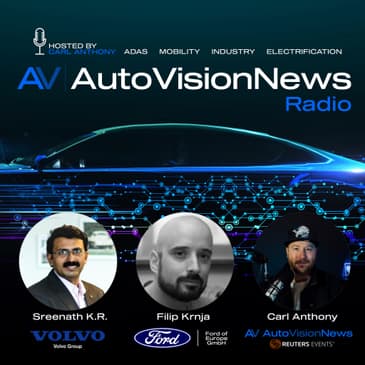
On March 7th, 2024, AutoVision Radio host Carl Anthony moderated a webinar from Reuters Events called the Software Defined Future of Automotive. The webinar examined the topic from both a passenger and commercial vehicle perspective, the importance of merging hardware and software, and why organizational culture change is necessary for software-defined cars.
Carl was joined by two respected and distinguished panelists: Sreenath K.R., Vice President of Computational Systems Infrastructure at Volvo Group Truck Technologies, and Filip Krnja, Chief Designer for Advanced Design at Ford of Europe.
Join us for a rebroadcast of this previously live webinar from Reuters Events on the Software-Defined Future of Automotive.
More Resources
AutoCulture 2.0 ft. Jan Griffiths of Gravitas Detroit
Spotify: https://tinyurl.com/4atrhaxn
Apple Podcasts: https://tinyurl.com/57845vmf
Podbean: https://tinyurl.com/3tkf3b36
Become the Automaker of Tomorrow, Reuters Events Automotive USA 2024: https://tinyurl.com/5yj2te25
Follow AutoVision News on LinkedIn: https://tinyurl.com/49jyrd3b
[00:00:00] Now in the middle of one of the most significant eras in automotive, Carl Anthony amplifies
[00:00:05] the minds and voices behind this historic transformation as the host of AutoVision News
[00:00:09] Radio, all while coming to terms with middle age, father loss, and what it means to be
[00:00:15] successful in Detroit.
[00:00:17] On March 7, 2024, I had the opportunity to moderate a webinar from Reuters events called
[00:00:23] the Software-Defined Future of Automotive.
[00:00:26] For this episode of AutoVision News Radio, I will replay a portion of that webinar which
[00:00:31] focused on software-defined vehicles from both the passenger and commercial side.
[00:00:36] I was joined by two distinguished panelists, Srinath KR, Vice President at Volvo Group Truck
[00:00:43] Technologies and Philip Krenia, Chief Designer for Advanced Design at Ford of Europe.
[00:00:49] As part of Volvo Truck Group, Srinath is responsible for onboard computational and input
[00:00:55] output hardware, communication protocols, platform software for ECUs, functional safety
[00:01:01] and cybersecurity at the vehicle level.
[00:01:04] He has filed 15 patent applications in various automotive domains and has three SAE publications
[00:01:11] centered on predictive controls on hybrid powertrains for commercial vehicles.
[00:01:17] At Ford of Europe, Philip leads a global multidisciplinary team across the UK, Germany
[00:01:22] and the United States.
[00:01:24] That team is helping shape the future of both passenger and commercial vehicles.
[00:01:29] Philip is a creative leader committed to driving innovation and design excellence in
[00:01:34] the automotive industry.
[00:01:36] At home in London on the weekends, he can be found participating in his hobbies of
[00:01:40] riding and skating.
[00:01:42] The first voice you hear will be Philip's followed by Srinath's.
[00:01:46] We begin with a general overview of software-defined vehicles.
[00:01:51] First with a perspective on passenger vehicles and then Srinath with a perspective on commercial
[00:01:57] vehicles.
[00:01:58] Moving at speed of mobility, this is all to Vision News Radio with Karl Antony in Detroit,
[00:02:03] Michigan.
[00:02:04] So in the case of Ford, our portfolio obviously spans across commercial vehicles and passenger
[00:02:10] vehicles.
[00:02:12] On the CV side, maybe it's all about increasing productivity and uptime and
[00:02:18] efficiency for the business.
[00:02:20] However, on the passenger vehicle side in particular, I think there's tons of opportunity to
[00:02:27] amplify and enhance the driving moving experiences besides a general ownership experience.
[00:02:33] So in the case of our, I would say not so boring vehicles such as a Bronco or a Mustang
[00:02:39] or an F-150 Raptor, it's really about dialing into specific emotional value spaces and
[00:02:46] in that sort of software-defined future where software potentially freely flows through the
[00:02:52] vehicle.
[00:02:53] There is enormous opportunity to make this an evolving,
[00:02:56] updatable thing that continuously engages you even as it left the factory.
[00:03:01] So it would ideally even get better over time.
[00:03:04] So in that sort of future, I would see there's tech in place that would allow us to
[00:03:10] orchestrate even new experiences, driving behaviors and engagement based on personal
[00:03:15] data and behavior.
[00:03:16] I would say even increases the longevity of that vehicle.
[00:03:21] With that comes great responsibility as well to be very focused what you want to do and
[00:03:26] how we can achieve that and how you want to differentiate with your brand in that sort
[00:03:31] of future scenario because as everyone, we only have finite resources even in that
[00:03:37] software-defined vehicle world.
[00:03:39] In addition to all the things that Philip has mentioned, we at Volvo have put a very
[00:03:44] aspirational target or a note of being 100% fossil-free, safe and more productive.
[00:03:51] The role of software-defined vehicle is super critical.
[00:03:54] The commercial industry is moving more towards a service-based revenue model beyond the
[00:04:00] products and the electrification is heavily in its way and if you see Volvo has been
[00:04:07] leading on the electrification journey for the heavy duty trucks in Europe.
[00:04:12] As much as important is the autonomous mobility journey what Volvo is trading today.
[00:04:18] So in all these three perspectives, software-defined vehicles forms a backbone to deliver a safe,
[00:04:27] sustainable and more productive product line and ecosystem to the end customers.
[00:04:34] It's time in the journey of automotive industry where past car and commercial
[00:04:39] work are literally converging towards a single point.
[00:04:43] After an overview of software-defined vehicles, we moved on to the relationship between
[00:04:48] hardware and software.
[00:04:50] The analogy we used was to imagine an assembly plant.
[00:04:55] Think of a truck or an SUV coming down the line.
[00:04:58] There is a point where the body and frame come together.
[00:05:01] It's the marriage of these two individual pieces, body and frame.
[00:05:06] From that point forward, they are now joined together as one single vehicle to become one
[00:05:12] effectively.
[00:05:13] For this webinar from Reuters Events we wanted to paint a similar picture by asking how the
[00:05:18] industry will combine hardware and software in an effective and efficient way.
[00:05:24] I think on one hand we have teams doing already a great job at it today with driver-assist
[00:05:29] systems such as BlueCruise but then as you describe it, we're really moving now
[00:05:35] to that space where we need to marry those two things efficiently together.
[00:05:39] I think today we have, if I give some examples, a very targeted approach where we link several
[00:05:46] features together that make up a whole experience such as link on embrace.
[00:05:52] That's like you approach the vehicle, you can map it out and it does certain things
[00:05:56] that you get in and so on so forth.
[00:05:58] So it's in sequence.
[00:06:00] And that is something teams can take away and then assemble it and that's it.
[00:06:05] So you're done but that's in that STV future.
[00:06:08] We're looking at something that is continuously evolving.
[00:06:11] So in theory we could introduce new experiences at any point.
[00:06:16] Now we have to have a much larger conversation about what we want to do across our brand,
[00:06:22] our portfolio, our business and need to get together and start thinking much further ahead
[00:06:28] what it is, what we want to do.
[00:06:29] And I can see there's already tension when it comes to the hardware side and when the digital
[00:06:34] teams are pulled into late and presented with choices they probably wouldn't have made
[00:06:38] to deliver the bit of work in that transitional period where we're seeing this.
[00:06:44] You could align perhaps maybe then on the hardware and say okay let's use this
[00:06:48] tech and then take it from there but then still it would lead perhaps to tech for tech's
[00:06:53] sake and doesn't deliver then on the targeted customer experience adds value.
[00:06:59] I think today all about for us, about creating new ways of working and processes that allow us
[00:07:05] then to orchestrate from hardware and software side and define future experiences we see
[00:07:10] worthwhile delivering.
[00:07:11] So it's a bit like we're moving, we used to be let's say a symphony orchestra
[00:07:16] where everything is set.
[00:07:17] We know what to do.
[00:07:18] We get the notes and play that tune perfectly well.
[00:07:21] I think today we're moving almost into setting a stage for a jazz band.
[00:07:27] And then perhaps we define some of the instruments and players and they start jamming together
[00:07:32] and once you play it even evolves and becomes a tune that is playable and enjoyable.
[00:07:39] So I think we're really at that stage where we're rewiring our brain in that way
[00:07:44] and it has obviously an organizational impact and it's from my end exciting,
[00:07:50] very exciting time to experience that.
[00:07:53] If I take the analogy what you have mentioned about, if I say the bride and the groom
[00:07:58] from commercial vehicle perspective, STV they're the biggest need that the bride and the groom
[00:08:03] runs at the same pace.
[00:08:05] But if you look at the classical development cycle of hardware versus software
[00:08:10] hardware has been always slower and needs more validation time.
[00:08:16] And when it comes to the commercial vehicle industry, the change of models or the vehicles
[00:08:22] have a longer life.
[00:08:24] When I say longer life, the model years don't change once in two years or once in
[00:08:28] you know not even five years.
[00:08:30] Sometimes it is quite a difficult journey when it comes to the software defined vehicles
[00:08:34] because for STV the crux is pretty much the high performance computing notes
[00:08:41] and that is a evolving topic.
[00:08:44] It's a target which keeps moving as you chase.
[00:08:49] And by the time we develop the software on the technologies what is available probably
[00:08:55] two years back and by the time it comes to the stage where it is matured,
[00:08:59] the hardware needs would have changed.
[00:09:01] Of course if you look at the certification and the end cap requirements
[00:09:05] coming from a commercial vehicle safety perspective, more number of radar integrations,
[00:09:11] more number of camera integrations and sensor integrations are demanded.
[00:09:17] So by the time you start developing your STV on a particular hardware
[00:09:21] and you take it to a certain shape, the technology has moved.
[00:09:26] This is one big challenge what every commercial vehicle manufacturer is today facing with.
[00:09:31] Having said that, sir, on some point of time we have to keep the feet down
[00:09:36] and say, yes, this is what we need to start with because STV is a journey.
[00:09:42] It is not a destination.
[00:09:44] So somewhere we have to keep the feet down and say, yes, we start with this set of hardware
[00:09:48] marriage to the software and then we build upon.
[00:09:53] This also brings to the question that how much of an over design
[00:09:57] you need to have it in the hardware?
[00:09:59] If you see that you need a software viability for the next five years.
[00:10:03] Yes, your phones can always have larger ramps and higher capacities for taking more and more
[00:10:09] updates maybe for years.
[00:10:11] Is it viable to have that over design and over capacity reserve in a truck
[00:10:17] and then add that to the cost to be sold to the customers?
[00:10:22] It's a very thin line commercial industry is walking when it comes to this complex system of
[00:10:28] high performance computation on which the STV is heavily looked at.
[00:10:33] Before this webinar was broadcast live, Philip and Srinath and I met for a prep call.
[00:10:39] And one of the topics on that call that Srinath was most passionate about was this idea of the
[00:10:45] flow velocity of the software.
[00:10:50] During the live webinar, Srinath shared this concept and why flow velocity of the
[00:10:56] software is important in the context of software defined vehicles.
[00:11:00] Conventionally, we always had interblocks which are like you release softwares once in six months
[00:11:06] which are getting updated at the no service centers you take it to the thing.
[00:11:11] But come to the era of software defined vehicles, the whole thing is spinning around
[00:11:15] over the air updates where you don't even need to bring your truck or
[00:11:21] your vehicle to the dealer to get the latest and the greatest software version.
[00:11:26] There is a need from code to road to have as short as possible even to the extent of day,
[00:11:33] which means I have a software fix for a thing or I have a feature which I have created and
[00:11:39] the next day it should be available on the truck running across the globe.
[00:11:45] For that to be efficient and ensuring that we don't have issues when I say issues,
[00:11:50] there's a lot of integration efforts when it comes to the software.
[00:11:54] When it was domain controlled architecture, it was quite easy because then you are affecting
[00:11:59] only one part of the architecture. But come to the centralized processing unit, one line of code
[00:12:05] has a huge impact on the ecosystem or the set of functionalities surrounding it.
[00:12:10] So one wrong move can make your truck stand still on the highways.
[00:12:15] You need a faster integration, faster testing cycles, faster,
[00:12:20] or avoiding regressions which is very critical when it comes to the software defined flow.
[00:12:25] And that's where the big role of a tool chain which act as the funnel or the flow diameter
[00:12:33] for this entire course to move back and forth this development scene. So if you target a faster
[00:12:39] delivery of software to customers, then you need to have a more efficient,
[00:12:44] modern and automated flow channel. And this is where today industry keeps struggling because
[00:12:51] then if you try to develop a new software development or the software defined architecture on
[00:12:58] older generation of tool chains, sometimes you get into unknown issues, unexpected challenges
[00:13:05] towards the fag end of your release. That's where the challenge is. You don't get to see
[00:13:10] them in the early stages. So it's very essential for us to have a complete vision
[00:13:16] or at least the next two or three years what is going to happen with this flow.
[00:13:21] At this point in the webinar, we started to focus on the automotive industry's organizational culture
[00:13:27] that while technology is important, we must not overlook the process by which we lead our
[00:13:32] teams and interact with our customers and partners. Jan Griffiths, founder of Gravitas
[00:13:38] Detroit was a guest on AutoVision News Radio in April of 2024. Jan is the architect of cultural
[00:13:45] change in automotive and says that an atmosphere of command and control and a network of silos
[00:13:52] is not the way forward for automotive. And if we are to realize things like software defined vehicles,
[00:13:59] we must give the organizational culture as much time and attention as we do the technology.
[00:14:06] Jan explains it better than I can, so I will leave a link in the show notes to my interview with her.
[00:14:12] During the software defined future of automotive webinar from Reuters events,
[00:14:16] we touched on this topic of cultural change. Srinath shared his perspective first, followed by Philip.
[00:14:23] If I have to say one big change organizations have to go through if they have to make this
[00:14:30] STV journey successful is the culture and I take the reference that we have to think like a startup.
[00:14:37] It's quite natural that we ride on the successes from the past. Any established organizations
[00:14:44] have their strength of delivering software and hardware all through this journey,
[00:14:49] but come to the world of STV, all the concepts and all the lessons learned probably have
[00:14:55] to be relearned or unlearned sometimes if you really mean success. The faster flow also means we
[00:15:04] test fast, fail fast. We don't have the time for putting a software in the prep wait for six
[00:15:11] months to get a feedback of that function of that piece of code. You may have to test it even
[00:15:18] based on your gut feeling to get, so it's test fast, fail fast, redevelop and come back to the
[00:15:25] testing bench. This attitude needs to be reinforced at every stage of the development
[00:15:33] if you really want that. So yes, fully agree that there is a cultural shift and especially
[00:15:39] on the commercial vehicle segment where it was predominantly a mechanical oriented industry.
[00:15:46] The transformation journey to a software defined journey is, it needs a lot of conscious effort
[00:15:53] and then we have change enablers to enhance and enable that direction.
[00:15:59] I've seen how quickly we evolve in that space and even when we get together and meet now in a
[00:16:08] virtual space to evaluate not only design surfaces or proportion, but everything else around it.
[00:16:17] Really trying to capture the whole experience in order to get as close as possible to what could
[00:16:22] be a final product and as you say fail fast and cheap in that sense before we really put
[00:16:30] our resources behind it and working also with distributed teams and having those new
[00:16:36] tools available to work more collaboratively is something that wasn't available necessarily in
[00:16:45] the past. So I'm super excited about that because you start to see not only bringing
[00:16:52] the next design of a vehicle to life but everything around it. I think we're also developing in-house
[00:16:58] tools that leveraging even game engines, right? There's a lot of wizard of all stuff going
[00:17:03] on because you need to kind of give a flavor of what you can do or the vehicle will be able to do.
[00:17:11] That helps us really to holistically capture also future product and key experiences around
[00:17:17] the vehicle so everyone can then come in from different teams and experience that either
[00:17:22] through a VR headset or even in any other screen, right? And get a feel of what the
[00:17:29] future product is going to be. So I think all these tools that are coming into play now
[00:17:34] will help make them better and more focused decisions down to whatever streamlined processes
[00:17:41] you need in the software development side. As our webinar came to a close,
[00:17:45] Srinath and Philip spoke about the features and experiences that can be enabled by software
[00:17:50] defined vehicles. I have to take, if you look at the commercial vehicle segment per se,
[00:17:56] the person who is investing the money may not be the person who's using it. So the fleet owner
[00:18:02] buys the truck so as much as we stress the need for ADAS and other things, we also focus on the
[00:18:09] in-vehicle infotainment to the extent that the commercial industry is going for the need of a
[00:18:17] dedicated process or a high performance computer for handling such kind of things.
[00:18:22] It comes from the complexity what we have on the HMI and the seamless integration of the infotainment
[00:18:29] systems which is no less than a passenger car today. So while we see a rugged truck carrying
[00:18:37] a lot of construction material, the cabin if you get into it, you will find that it is
[00:18:43] as much modernized with a lot of touch screens and the GUIs, Android-based apps. However,
[00:18:52] the primary difference when you say the in-vehicle infotainment is not only from the infotainment
[00:18:58] part, when I say entertainment part but also from the utility part, these Android-based
[00:19:03] tablets or the screens are used to have a seamless connectivity with the fleet management
[00:19:10] where we offer a host of services through this interface from proactive delivery tracking
[00:19:18] to predictive maintenance to the utilization data. And also we use this as a part which probably
[00:19:26] may not be as heavy as in the passenger car industry but to collect the data back on the
[00:19:32] driver behavior on which could be an insurance-based service model for the insurance of the things
[00:19:37] based on the driving or the defensive driving attributes of the driver and even the utilization
[00:19:43] and tomorrow the trucking industry is going in a direction where each truck becomes a cost center.
[00:19:49] So it has its own revenue, it has its own expense and then it's very easy for the
[00:19:54] fleet owner to have a comparison when it comes to between a Volvo or a Mon or a Dan
[00:20:00] rather than just looking at when a police. So each truck can act as its own cost center
[00:20:06] by spending and earning money and that is going to be the infotainment is one part but then the
[00:20:13] overall HMI or the driver interaction part. I mean everything Chinoff mentioned that's
[00:20:20] just a future going forward, it's so beneficial to the business and the fleet owners and
[00:20:27] we see also in the commercial vehicle space there having opportunity to tie in
[00:20:34] specific vocations with your vehicle capability and have the intelligence to then
[00:20:42] really take create tailored experiences for that specific vocation. On the passenger vehicle side
[00:20:48] I think if you talk about driver assist systems or then technology come into play such as
[00:20:54] steer by wire having opportunity to change driving behavior that is just a space that
[00:21:02] hasn't been fully explored yet I would say and maybe to a point that we'll see even
[00:21:08] things happening like I can play this co-branded experience in a certain game,
[00:21:15] a race game and download certain specs and driving behaviors then to my actual vehicle.
[00:21:21] So that's possibilities that you can start exploring in this sort of software defined future.
[00:21:27] To learn more about Reuters events including automotive USA 2024 at the Huntington Place in
[00:21:33] downtown Detroit see the links in the show notes. AutoVision News Radio is available on Spotify,
[00:21:39] Apple Podcast, Podbean and more. In Detroit alongside Srinath KR and Philip Krenia I'm
[00:21:46] Carl Anthony AutoVision News Radio.