
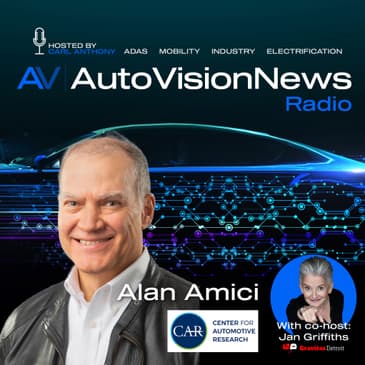
In this special episode of AutoVision News Radio, Carl Anthony teams up with Jan Griffiths, founder of Gravitas Detroit and host of the Automotive Leaders Podcast, for an in-depth conversation with Alan Amici, President and CEO of the Center for Automotive Research (CAR).
Discussing the need for a cultural shift in the automotive industry to match its technological advancements, Alan points out the strategies implemented by General Motors and Ford to attract new talent. He also underscores the industry's need for more diversity, particularly women in leadership roles, to improve decision-making and better cater to market demands.
Alan also expands on the challenges around electrification, the significance of over-the-air updates, and the impact of increased global competition from China.
More Resources:
Center for Automotive Research: https://www.cargroup.org/
CAR Management Briefing Seminars: https://www.cargroup.org/mbs/
Add the Automotive Leaders Podcast to your playlist: https://tinyurl.com/b4532xsh
The Software-Defined Future of Automotive ft. Volvo Group, Ford of Europe, and AutoVision News Radio via Reuters Events:
- Spotify: https://tinyurl.com/4z26vvfj
- Apple Podcasts: https://tinyurl.com/w5yvjkxv
Definitions, Challenges & Considerations of SDVs ft. Intrepid Control Systems, Dataspeed, Keysight Technologies, and AutoVision News Radio:
- Spotify: https://tinyurl.com/2dcekyea
- Apple Podcasts: https://tinyurl.com/mr2vptvr
Follow AutoVision News on LinkedIn: https://tinyurl.com/49jyrd3b
Watch the full episode on YouTube: https://www.youtube.com/watch?v=dDa3QS8zy8o
[00:00:00] Now in the middle of one of the most significant eras in automotive, Carl Anthony amplifies the minds and voices behind this historic transformation as the host of AutoVision News Radio. All while coming to terms with middle age, father loss and what it means to be successful in Detroit.
[00:00:17] When I was in broadcasting school now over 20 years ago at Iowa Western and Council Bluffs, my program advisor, Vicky Jacoba once told me that creative types usually gravitated towards the media studies program, and that while being creative was inherently
[00:00:33] good, it was something we needed to keep in check for our own mental well-being. I find myself missing those days outside of Stewart Hall where me and the rest of my classmates would hold impromptu and unofficial forums with Vicky seeking her input on all matters
[00:00:50] of life, including what in the world we were going to do when we graduated. Like then, that was the kind of stuff that kept me up at night. The inability to throttle back a creative brain.
[00:01:03] The automotive industry is good in that it allows for immense creativity, but it can be an industry that's hard to turn off at night or when we have time away, especially with the rapid transformations we see across the whole of the industry.
[00:01:18] Healthy curiosity and lingering concern exist side by side in our automotive minds. More insight into the current challenges and changes in the automotive industry, my co-host Jan Griffiths and I turned to Alan Amici, president and CEO of the Center for Automotive Research or CAR for short.
[00:01:39] This is a special edition of AutoVision News Radio as it's the first time I've had a co-host and it's all the more special given the admiration and respect I have for Jan. By way of introduction, Alan Amici is a seasoned automotive leader with over 35 years of experience.
[00:01:55] Prior to joining CAR, he held various leadership positions in engineering, manufacturing and service at Chrysler and TE Connectivity. During his extensive tenure at Chrysler, Alan spearheaded the global UConnect infotainment platform and was further recognized as a recipient of the Walter P. Chrysler Technology Award.
[00:02:16] Alan holds an MBA, a master's and a bachelor's in electrical engineering, all from the University of Michigan. My co-host Jan Griffiths is the founder of Gravitas Detroit and the architect of cultural change in automotive.
[00:02:30] Whether on stage, walking the shop floor or behind the microphone as the host of the Automotive Leaders podcast, Jan has become the industry's most significant force for authentic leadership, a style of leadership that demolishes old silos and antiquated principles, building up trust and inspiration in their place.
[00:02:51] Moving at speed of mobility, this is Auto Vision News Radio with Carl Antony in Detroit, Michigan. I saw you take the stage at CAR when you first went into this role. So you've been in this role now for almost two years. What's it feel like?
[00:03:08] Well, the calendar has flipped by very quickly. We've been very active in our work at CAR, so there's been some rebuilding, reconfiguring. There's been some strategies we've put in place. We brought in some new talent. So lots of activities happening at the Center for Automotive Research and really
[00:03:24] exciting things that's happening here. So we've made CAR a stronger entity, lots going on and a really exciting time for CAR but also for the auto industry at large. Alan, on your website from the CAR website, the center, and I'm going to I'll quote verbatim here.
[00:03:41] The Center for Automotive Research is involved in the research of significant issues that relate to the future direction of the global mobility industry. CAR's mission is to produce independent research, convene stakeholders, and analyze critical issues facing the mobility industry and its impact on the economy and society.
[00:04:05] Alan, can we expand more on that? What does that mean? What is the vision for CAR in that context as you have it written on the website? So to expand on that vision, CAR's mission is to inform and advise.
[00:04:21] And we inform and advise with the goal of making the automotive industry more viable and more sustainable. I mean, ultimately, that's our goal. We're a 501C3 nonprofit organization and it's really important that in order to achieve that mission, our methods are threefold.
[00:04:40] And the first is we conduct independent and original research and we conduct research that is addressing the big issues in the automotive industry. And we try to take a broad brush approach, cover the topics that are keeping CEOs awake at night.
[00:04:58] Our mission in that regard is to shine a light on problem areas so people can get together and talk about potential solutions and perhaps even solve some of these things. So number one, original and independent research is the foundation for the Center for Automotive Research.
[00:05:13] So the second way we achieve our mission is through the events that we hold. And our flagship event is MBS, our Management Briefing Seminar. And we hold this event every August. This year will be at the Grand Traverse Resort in Traverse City, Michigan.
[00:05:28] This will be year 59 for the event. And it brings together C-suite executives to talk about the big problems in the industry. How do you make EVs more affordable? How do you make EVs profitable? What's happening with charging infrastructure? How do we increase range?
[00:05:46] What's happening in the battery industry in terms of new chemistry? So critical issues affecting the auto industry has viewed from a CEO or a C-suite executive viewpoint. And then the third way we try to impact the auto industry is through our partnerships.
[00:06:02] And so we have affiliates, which are our private companies, and then automotive community partnerships, which are our public entities. So these may be economic development corporations. It could be the state of Michigan or the state of Indiana. They could be City of Sterling Heights, Michigan, for example,
[00:06:18] or the city of Lima, Ohio, for example. So smaller public organizations that we are able to share our data and our research with to give them some insight into what's happening in the auto industry. So we share our book of deals,
[00:06:32] we share what's happening in investment in that particular space. We weave those three elements together, research, events, and our programs together to try to inform and advise, which is really the purpose of our mission. A lot of technical focus, obviously.
[00:06:49] Not so much focus on the leadership and culture piece of it. And as I'm sure you've heard me say many times, Alan, in this industry, you can't run a 4K video on a 95-windows operating system. So what makes us think we can develop EVs
[00:07:07] in the world of mobility and use the same cultural operating system that we've had in this industry for decades? Is that part of CARS mandate or how do you see that weaving into the overall CAR mission? Well, it can be.
[00:07:23] I mean, there's an element of labor economics and policy that is part of the Center for Automotive Research and it's part of the research that we do. There's a specific example, which is technology, and we could talk about software or software-defined vehicle.
[00:07:37] Many of the automakers are bringing software in-house. That means they're developing their competencies within the organization. That means they're developing mechanisms to manage. That means they're developing the competence to manage these organizations. And so just the fact that companies are motivated
[00:07:56] to bring software in-house doesn't make it happen. It takes the competence, it takes the capability and it takes the leadership to be able to do something like that. And quite honestly, the auto industry is struggling with developing software in-house right now. It's not going particularly well.
[00:08:15] And so this is an area we're very interested in. And you can see some of the moves companies are making. Like General Motors just recently announced their Mountain View Tech Hub. And so they're gonna be sourcing software capability out in Mountain View, out in the Bay Valley,
[00:08:31] to try to bring software talent into the organization. So this is a strategic move that they're making. Board Motor Company on the other hand is taking a different approach. And they're focusing on Michigan Central Station along with new labs. And they're creating an environment that is cool
[00:08:48] and they're trying to give their employees interesting work to work on. And so they're trying to attract talent to the Detroit area for that purpose. So these are two divergent strategies ultimately with the same goal in mind. But I think there's other issues
[00:09:02] that are really important to the automotive industry, women in engineering or women in leadership positions. The auto industry has made some significant progress in the past 15 or 20 years, but we still have a ways to go. There are some examples like Mary Bara who's leading General Motors
[00:09:19] and has done a terrific job in that particular role. But they're still within the organizations. A lot of people won't find women in middle management or even senior management that they can emulate or they can look up to or they can seek a sponsor or a mentor.
[00:09:36] And so there's some progress that has been made but there's some improvements that can continue. And so CAR definitely has a role in workforce development and DEI in that particular space as well. That would be something that I would really love to see
[00:09:50] is just more women in automotive or the barriers come down. That's a automotive industry that I dream of. I'm glad you brought that up, Alan. I think there's better decisions that can be made. I mean, if you look at the product that's out there in the market,
[00:10:07] it's been a little while since we've done this study but at the time we were looking at minivans as 51% of the decision makers on minivans or women. And yet the cars were generally designed by men and engineered by men.
[00:10:20] And so we're missing the market a number of places but I think it adds a richness to the content of the product. It adds richness to the thoughtfulness of what to include and what's important to prospective decision makers or prospective buyers. I think you make better decisions
[00:10:37] if you have a diverse workforce to be able to do that. Everything that you're saying here about the changes in the industry from electrification to software-defined cars, we can include autonomous driving, we can include AI and that. So two pictures here, we've got all that stuff
[00:10:56] that I just mentioned that you've been talking about all this fast-paced transformation at a lightning pace and then what Jan is saying that the leadership and the culture aspect is hugely important. How do we navigate this when we have so much going on on both sides?
[00:11:15] Both the tech side, there's changes on the tech side and there's changes on the leadership side. How do we navigate this? What are your thoughts there? It's an incredible challenge. If you think about the changes that are occurring, we're going from ICE propulsion to EV propulsion
[00:11:32] and we're trying to do all of that in five or six years, say less than 10 years. And this is an auto industry that for the past 110 years has been largely internal combustion engine based. So you've got a change in technology from ICE to EV.
[00:11:48] And so a large portion of engineering companies, automotive engineering companies, more than 30% are devoted to engineering ICE portion of cars. So powertrain engineering, whether they're engines or transmissions. And so in a future where you have purely EVs or eventually hybrid and then PVs,
[00:12:07] you're going to have to move some of that talent out of the ICE arena into the EV space. And so this is a transformation that the auto companies are having to do right now as they move their talent around and they're looking for different talents.
[00:12:23] So they're looking more for software and some of the electrical engineering and in some cases chemical engineering in battery technology. Whereas in the past, they may have been looking for combustion engineers or mechanical engineers in that space. So that's one transformation that's occurring inside the companies.
[00:12:41] The second one is we're trying to do infrastructure at the same time. It's taken somewhere around 50 years to get gasoline pumps at every single corner such that the consumer has lots of choices when they decide to gas up. And in five years,
[00:12:55] we're trying to build out an EV infrastructure that looks like that, that is very challenging to do. And so the federal government has helped spur that with the infrastructure act and with Nevi $7.5 billion across the country to spur the development of DC fast charges
[00:13:12] across the country in these alternative fuel corridors. So we're trying to build out the EV structure at the same time. And a third item that's occurring is companies are trying to rethink how they engineer these vehicles. And so this is the notion of a car
[00:13:29] that is updatable once it goes to the customer. You can use a cell phone as the model as your cell phone is continually being updated. Sometimes you know about them, sometimes you just have to accept and then you get the latest features, enhancements and bug fixes.
[00:13:45] And so the idea here is what changes do you have to make to the architecture and specifically the electrical architecture of the car to be able to facilitate something like this? And so why would I want to do this
[00:13:57] is I want to keep cars that are out in the field safe. And so if I have the latest safety features or perhaps even new safety features that I could deploy easily to a car that's already in service, that would be interesting
[00:14:12] and there's the potential to even save lives if I'm able to do that. Well, that requires over-the-air updates. It requires a reconfiguration of how the cars are architected, hence the discussion about software defined vehicle and rearchitecting that. That's a third change that's trying to occur
[00:14:31] at the same time. This is also very challenging. So the auto industry has been using a supplier model for the past 25 or 30 years and that is an OEM will choose a supplier who will work to the OEM specifications and develop hardware and software and deliver a product.
[00:14:49] And the OEM will integrate this into the car and it becomes part of the network and part of the architecture of the car. Well, if the OEM is doing their own software and they want a centralized architecture and they want to centralize software, so-called software defined vehicle,
[00:15:06] they're not necessarily purchasing the software from the supplier. Maybe they're only purchasing the hardware. So the relationship between the OEM and the supplier changes as well. And so you have these three changes that are occurring at the same time. I need different talent. I need different management styles
[00:15:27] and leadership styles to be able to make that work. I need different verification schemes. I need the ability to keep vehicles that are out in the field updated and verified. So it is a very complicated transformation that the auto industry is going through
[00:15:45] and they're trying to do it very quickly. So any one of those three things would be a big challenge doing all three at the same time is a daunting experience. And quite honestly, it's not the leader from 10 or 15 years ago. It's perhaps a new leadership style
[00:16:00] that can contemplate how should we be doing software differently? How should we be developing software differently? How should we be verifying software differently? Do we have the right talent to do so? Big challenges, lots of changes going on. We live in interesting times right now
[00:16:17] in the auto industry. Alan, you mentioned the way the traditional supply base is set up, the OEMs through the tier system, and that is changing. We are moving to more of a supplier ecosystem. And yes, the model of leadership and culture is changing along with it.
[00:16:32] But one aspect of that that is definitely related to technology is the speed and agility needed to drive innovation. We cannot have innovation operating at the level of speed that we need in this industry. It cannot coexist with fear. And a lot of the culture that we have
[00:16:52] in the automotive industry is based on fear. And so this idea that you will try something new, and if it doesn't work out, you maybe tweak it and you iterate and you iterate and you iterate. And then finally, you get it. All the startup people that I've interviewed,
[00:17:11] they talk about relentless focus on customer pain point and then they try something, small bets frequently and they tweak it and tweak it and tweak it and they keep going because they don't have the fear of failure. They're just focused on the mission and conviction
[00:17:28] and let's get this thing figured out. Whereas traditional auto culture is more, oh, well, we got to have this thing fully vetted. We better have the P&L lined out for the next five years and we got to have this whole thing ready to go.
[00:17:43] That model is not gonna work, is it? Well, a couple of thoughts on that. It is yes, it does feel like we're dragging our knuckles on that one a little bit. I would say the model that has been set up
[00:17:56] that we've been working to for the past 50 years means the moment that car leaves the end of the assembly line is effectively the last time the manufacturer can touch that car. Sure, at a dealership you could make changes and fixes but that's it.
[00:18:11] And so there are no opportunities for software changes without cost. There are no opportunities for hardware changes without cost. We don't want to do, the auto industry never wants to do verification on the customer. Verification is to be done internally and the customer expectations are
[00:18:30] my car operates perfectly. I don't get the blue screen. When I'm crossing train tracks, everything works. My car doesn't stop. It reliably starts every single morning from minus 40 to plus 125 degrees. It is a very robust piece of equipment in a very difficult environment.
[00:18:50] That being said, are there things that we can do to improve the speed? So within my career, a number of years ago the product life cycle, product development life cycle was 60 months, it was five years. And so this even predated the need for camouflage on vehicles.
[00:19:07] Because it took so long, you say, hey, you can look at my car. We just know you can't catch up with it and so it doesn't really matter. I'll show you my car. Between the beginning of my career when it was 60 plus months
[00:19:20] and towards the end of my time when I retired from Chrysler, it was much closer to 20 or 22 months. To do that, the companies have become very efficient. You produce fewer cars, you play much more in the virtual world. You're doing CAD, you're doing virtual mockup, digital mockup assembly.
[00:19:40] You're staying in the virtual world as long as possible, get everything right before you actually cut any steel and build cars. And so this reduces the cost of building prototype cars, reduces the number of prototype cars and it reduces your risk
[00:19:56] because you can iterate very rapidly in this virtual world. Does that solve all the problems? Not yet, but it certainly reduced from 60 months to 22 months and is used by all automakers out there. Let's look at the second premise there is that once a car leaves the assembly line,
[00:20:12] that's the last time the OEM can touch it without cost. That's changing now because a couple of things we alluded to, whether it's over-the-air updates or some type of flash updates where you can in fact, provide value and updated software to a vehicle
[00:20:29] perhaps without the customer bringing into a dealership. Now they can hook to their wifi, schedule the update at night, press accept and you get this software update. This update could be a bug fix, it could be a feature enhancement, it could be a new feature.
[00:20:44] And so you've created this opportunity that does a couple of things. One, it is not the last time I touched the car. I do have an opportunity to update or upgrade the car. I have the ability to take a little bit more risk during the development phase.
[00:21:00] Now we can make mistakes if we're too loose with that policy, we end up having the customer discover problems and you don't want to do that. So you still want to ship a high quality product. You just want to create the opportunity
[00:21:13] to add features later that might be interesting that you wouldn't have time for previously. So that's a very interesting premise that can provide value to the customer. It doesn't actually provide some speed in that the customer doesn't wait till the next generation of car
[00:21:32] to get a particular feature. They may be able to enjoy it on their present version. But it does certainly require discipline. And so one has to contemplate the fact that can I tolerate a bug on iOSX that is updatable two days later on iOSX plus one,
[00:21:53] does the automotive customer feel the same way? And I'm not sure they're there yet and maybe over time they may be more tolerant of it. It certainly depends on the degree of the change in what type of fix occurs. But speed is really important
[00:22:09] and make one more point, competition is tough. And so no longer is GM competing only with Ford and Chrysler or Stellantis, but you also have along with the European manufacturers, the Japanese manufacturers, you have China. And China has significantly improved the quality of their product.
[00:22:29] If you go back 30 years ago and look at some of the Chinese imports that you saw at the Detroit Auto Show, your expectations were they were kind of cheap knockoffs and that's what it was. If you look at the cars now, the craftsmanship is there.
[00:22:40] It's interesting and it's competitive. For the automakers writ large, whether you're talking about North America or you talk about North America and Europe, there's big competition in China and speed is part of the competition. For me, it's about the people. It's about the networking, it's about the collaboration.
[00:23:01] And here we have coming up very soon is the car MBS conference in Travis City. So tell us what do you have in store for us this year, Alan? MBS will be August 5th through 8th in Travis City, Michigan. This is at the Grand Travis Resort.
[00:23:18] So our theme is engage, embrace and embark. This is a bit of a refresh on MBS for us. So with lots of support from the automotive OEMs, we have a lineup that's gonna knock your socks off in terms of speakers.
[00:23:34] So Mark Royce, who's the president of General Motors will be one of our keynote speakers. Joe Hendricks, formerly the chief operating officer at Ford Motor Company, now the CEO of CSX, will be a keynote speaker. Joe will have an interesting perspective.
[00:23:49] He was not only a customer of CSX and now he's the CEO of CSX. So he's been on both sides of that transportation question. We have Alan Swan, who's the president of Panasonic Energy North America. And Robert Lee, the president of LG Energy North America
[00:24:06] will be a keynote speaker. So we've assembled a terrific lineup. We have speakers from Toyota, Honda, Rivian, the supply base, ZF, Eaton and others as well. We've created some new content also for MBS. So there's two areas that we have that are new for MBS.
[00:24:24] One is for Economic Development Corporation. So we're gonna have three roundtables on EDCs. And these will be Economic Development Corporations from around the country. So Michigan, certainly in the Great Lakes region of Ohio, Indiana, Illinois, Kentucky, but also in the Southeast from Georgia and Tennessee and other states.
[00:24:44] We're bringing these EDCs together into Traverse City and we've created these three roundtables and we're gonna bring in a speaker for each roundtable to talk about what's important for people, for organizations that are looking for site selection. This is an opportunity for EDCs to hear firsthand
[00:25:02] what these folks are thinking about when they're looking for the right location for their battery plants or their assembly plant. That's one new piece of content for MBS. The second one is on Thursday in partnership with the Alliance for Automotive Innovation, they are hosting a supply chain summit.
[00:25:20] So this will be after Joe Henrich's keynote speech that Thursday it'll be Thursday from 10 a.m. to about 2 p.m. this summit. And so they're gonna talk about onshoreing and reshoring and nearshoring and friendshoring and how do you make supply chains more robust?
[00:25:36] And they'll be representatives of three federal agencies attending, it'll be the first time we've had this type of event specifically for supply chain. A couple of brand new events that we're adding to MBS, we have some dynamite speakers. So it's gonna have a slightly different look and feel.
[00:25:55] Of course, we have our golf outing that occurs on Monday at the beginning of the week. And Trevor City has been pretty good about having fabulous weather at the beginning of August. So it's a great opportunity to make meaningful connections. It's somewhat of a captive audience
[00:26:11] and we'll have our casino night and a variety of different networking events. So fantastic event. We have our student program as well. We'll have approximately 40 students from universities in and around the Great Lakes area. I love for the students to be there.
[00:26:25] They get a great glimpse of what the automotive industry is like, how automotive conferences work. You get a little confidence going up to an executive and shaking their hands and asking them about what they do and what they see. Come on up and join us.
[00:26:40] A good time to be had by all. See the links in the show notes for more on the Center for Automotive Research, the Automotive Leaders Podcast, and software-defined vehicles. AutoVision News Radio is on the digital antennas of Spotify, Apple Podcast, Podbean, and more.
[00:26:56] In Detroit, alongside Alan Amici and Jan Griffiths, I'm Carl Anthony, AutoVision News Radio.